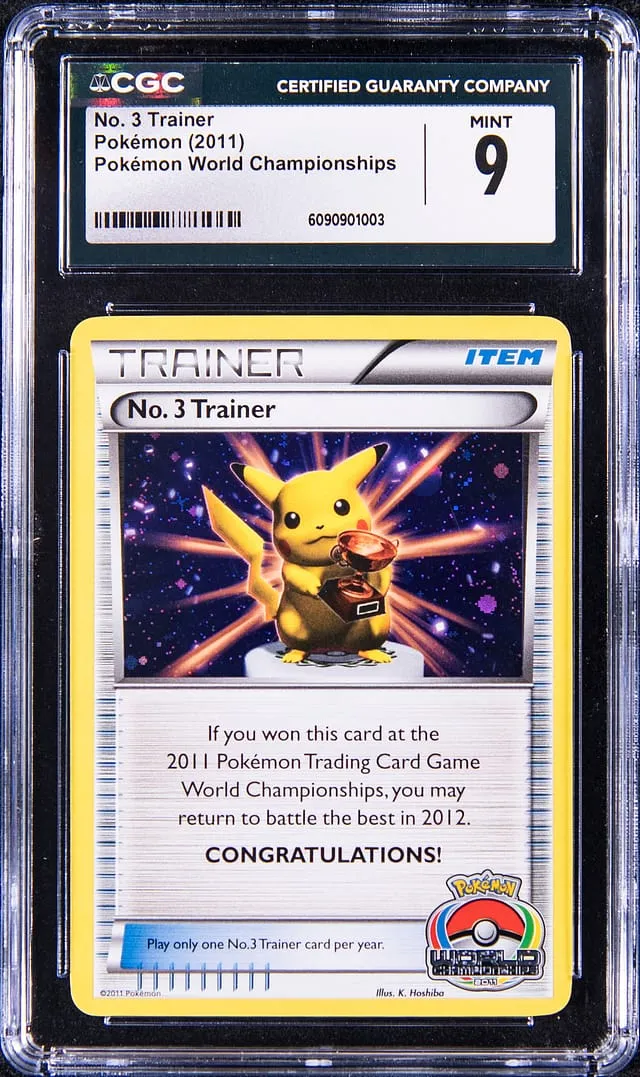
2011 No. 3 Trainer Pikachu Trophy Card CGC 9 Sale
Goldin sold a 2011 Pokémon No. 3 Trainer Pikachu Trophy Card CGC MINT 9 (Pop 1) for $27,280. Here’s what this rare Worlds card means for the market.
Sold Card
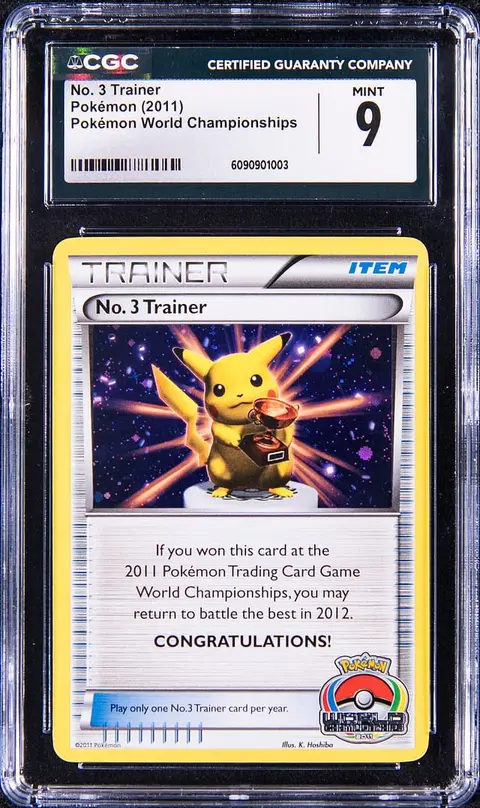
2011 Pokemon World Championships No. 3 Trainer Pikachu Trophy Card - CGC MINT 9 - Pop 1
Sale Price
Platform
Goldin2011 Pokémon World Championships No. 3 Trainer Pikachu Trophy Card (CGC 9) Sells for $27,280
On February 16, 2026, Goldin closed a quietly important sale for high‑end Pokémon collectors: a 2011 Pokémon World Championships No. 3 Trainer Pikachu Trophy Card graded CGC MINT 9, selling for $27,280.
For a niche, ultra‑rare card with deep roots in competitive Pokémon, this result offers a useful data point for anyone tracking the trophy-card market.
What exactly is this card?
Let’s pin down the basics:
- Card: No. 3 Trainer (Pikachu trophy artwork)
- Event: 2011 Pokémon World Championships
- Year: 2011
- Category: Trophy / award card (not pack‑pulled)
- Character: Pikachu (typically depicted holding a trophy or in a champion motif)
- Issuer: Pokémon Company for Worlds competitors
- Grading company: CGC Trading Cards
- Grade: CGC MINT 9
- Population: Pop 1 in CGC 9 at the time of sale
The No. 3 Trainer is a trophy card – a card awarded to top finishers at the Pokémon World Championships. Unlike booster box cards, these are never sold at retail and are given only to a handful of players in a specific year and age division. That makes them some of the lowest‑print, hardest‑to‑replace pieces in the entire hobby.
2011 sits in what many collectors consider the modern-but-not-ultra-modern era of Pokémon competitive history: long past the late‑90s WOTC days, but before the most recent boom in Worlds attendance and streaming.
Why this card matters to collectors
Several factors give this card outsized significance relative to its simple design and lack of serial numbering:
True scarcity from the source
Trophy cards like this exist in single digits per division. Even if a few extras were printed as staff or backup copies, the total pool is tiny compared with almost any pack‑pulled chase card.Competitive history
Worlds trophy cards document actual tournament results. They are effectively physical “medals” for top players. For long‑time players and organizers, they sit at the intersection of competitive history, nostalgia, and collecting.Pikachu trophy artwork
Pikachu trophy cards occupy a special place: Pikachu is the face of the brand, and the art style on these cards is uniquely tied to Worlds. Collectors often prioritize these over more obscure trophy designs.Condition and pop report
CGC’s pop report (short for population report, a census of how many copies are graded at each grade) shows this as a Pop 1 in CGC 9 at the time of the Goldin sale. With a card that started out in tiny numbers, every high‑grade example meaningfully tightens the supply of “top condition” copies.Institutional grading
CGC has built a substantial presence in the Pokémon space. A CGC MINT 9 on a trophy card is now recognized as a serious, marketable grade for high‑end collectors, not just a niche alternative.
Market context and comps
In a market this thin, “comps” – shorthand for comparable recent sales – are tricky. There may be years between public transactions of the exact same card and grade.
Based on available public records and prior coverage of trophy cards:
Direct, same‑card comps (2011 No. 3 Trainer Pikachu, CGC 9):
Public sale history is extremely limited. The February 16, 2026 Goldin result at $27,280 now serves as a key benchmark for this specific combination of year + placement (No. 3) + Pikachu trophy art + CGC 9.Related trophy card sales:
Other Worlds Pikachu Trainer trophies from adjacent years and placements (No. 1, No. 2, No. 3) have historically sold in the five‑figure to low six‑figure range depending on:- Placement (No. 1 often commands the highest premiums)
- Year (early 2000s WOTC‑era trophies tend to be the most coveted)
- Grading company and grade (PSA 9/10 historically dominated, with CGC and BGS increasingly relevant)
Grade scarcity vs. absolute scarcity:
With trophy cards, the difference between CGC 9 and a hypothetical CGC 9.5 or 10 may matter less than the fact that any graded copy is available publicly at all. Many copies remain in winner collections or move quietly in private deals.
Given that context, the $27,280 price:
- Sits comfortably in the range of established trophy‑card sales for mid‑placement, post‑2005 Worlds trophies.
- Reinforces that even beyond the most famous early No. 1 Trainers, later‑era Worlds trophies still command strong five‑figure attention when they surface at major auction houses.
Rather than indicating a sudden spike or collapse, this result reads as a data‑rich confirmation that the trophy segment remains supported by serious, informed bidders.
Why 2011 specifically still resonates
The 2011 World Championships period has a few dynamics that matter to collectors:
Mature competitive scene: By 2011, Worlds was firmly established as the pinnacle of competitive Pokémon, with structured qualifying systems and organized play. The trophies from this era represent a well‑defined, global field of top players.
Smaller print universe than modern Worlds: While attendance was growing, it was still modest compared with the huge attendance and exposure of the 2020s. Fewer divisions and fewer trophy copies still meant a tightly controlled supply.
Bridge era for collectors: Many current adult collectors either played or followed the game around this era, giving 2011 trophies a personal connection that pure vintage sometimes lacks.
CGC MINT 9 and what it implies
A CGC 9 is a high bar for a trophy card that was originally handed out at an event, transported in person, and sometimes framed or displayed rather than sleeved immediately.
Typical factors that hold these cards back from higher grades include:
- Edge wear from raw handling at the event
- Small surface scratches from transportation and storage
- Minor corner softening
Given those realities, a Pop 1 CGC 9 is not just “one of many” gem‑level copies; it may be one of only a handful of tournament‑awarded copies that can realistically achieve a very high grade at any major grading company.
What this Goldin sale tells us about the market
From a market‑watcher’s perspective, the February 16, 2026 Goldin sale highlights a few ongoing themes:
Trophy cards behave differently from mass‑printed chase cards.
Even as interest cycles through modern sets and new rarities, genuine Worlds trophies maintain a distinct collector base that values their competitive provenance more than pack‑pulled scarcity.Grade plus provenance drives outcomes.
With so few copies, each graded example is almost a mini‑auction for provenance. The combination of a notable auction house (Goldin), a CGC MINT 9 grade, and a clear description of the 2011 Worlds connection helped crystallize a strong, defensible price.Data points matter more than price swings.
In this thinly traded segment, a single sale doesn’t set a permanent “market value,” but it does provide a helpful reference for collectors, insurers, and sellers when discussing trophy cards from the 2010s.
Takeaways for collectors, newcomers, and small sellers
If you are newer to trophy cards or returning to the hobby:
Understand the difference between pack‑pulled rarity and award rarity.
Trophy cards like this 2011 No. 3 Trainer Pikachu were never in packs. Their scarcity is tied to real‑world event results and participation, not case‑hit odds.Comps will be sparse.
You may not find multiple recent eBay sales to triangulate a precise number. Instead, look at:- Adjacent years (2010, 2012)
- Adjacent placements (No. 1, No. 2, No. 4)
- Different grading companies
Condition details matter.
In such a small population, even minor condition differences can have an outsized effect. When you see “CGC 9 Pop 1,” it’s a shorthand for “very few opportunities to buy something at this condition level.”
For small sellers or collectors considering consigning a trophy card:
Choosing the venue matters.
High‑end, low‑population cards often attract better‑informed bidders at specialized auction houses like Goldin than in purely general marketplaces.Documentation helps.
Any original paperwork, photos from the event, or proof of origin can complement the graded card and add confidence for buyers.
Final thoughts
The February 16, 2026 Goldin sale of the 2011 Pokémon World Championships No. 3 Trainer Pikachu Trophy Card – CGC MINT 9 (Pop 1) at $27,280 is another reminder that Pokémon’s competitive history still commands serious attention in the broader trading card market.
Even away from the spotlight of early‑2000s Grails, later‑era Pikachu trophy cards continue to draw patient, knowledgeable bidders. For collectors who care about the story behind their cards – not just the print run or the set list – this result underscores the enduring appeal of Worlds trophies as physical records of the game’s highest level of play.
As more data points surface and population reports evolve, this Goldin sale will likely remain a key reference when discussing the 2011 trophy landscape and the role CGC‑graded examples play in it.