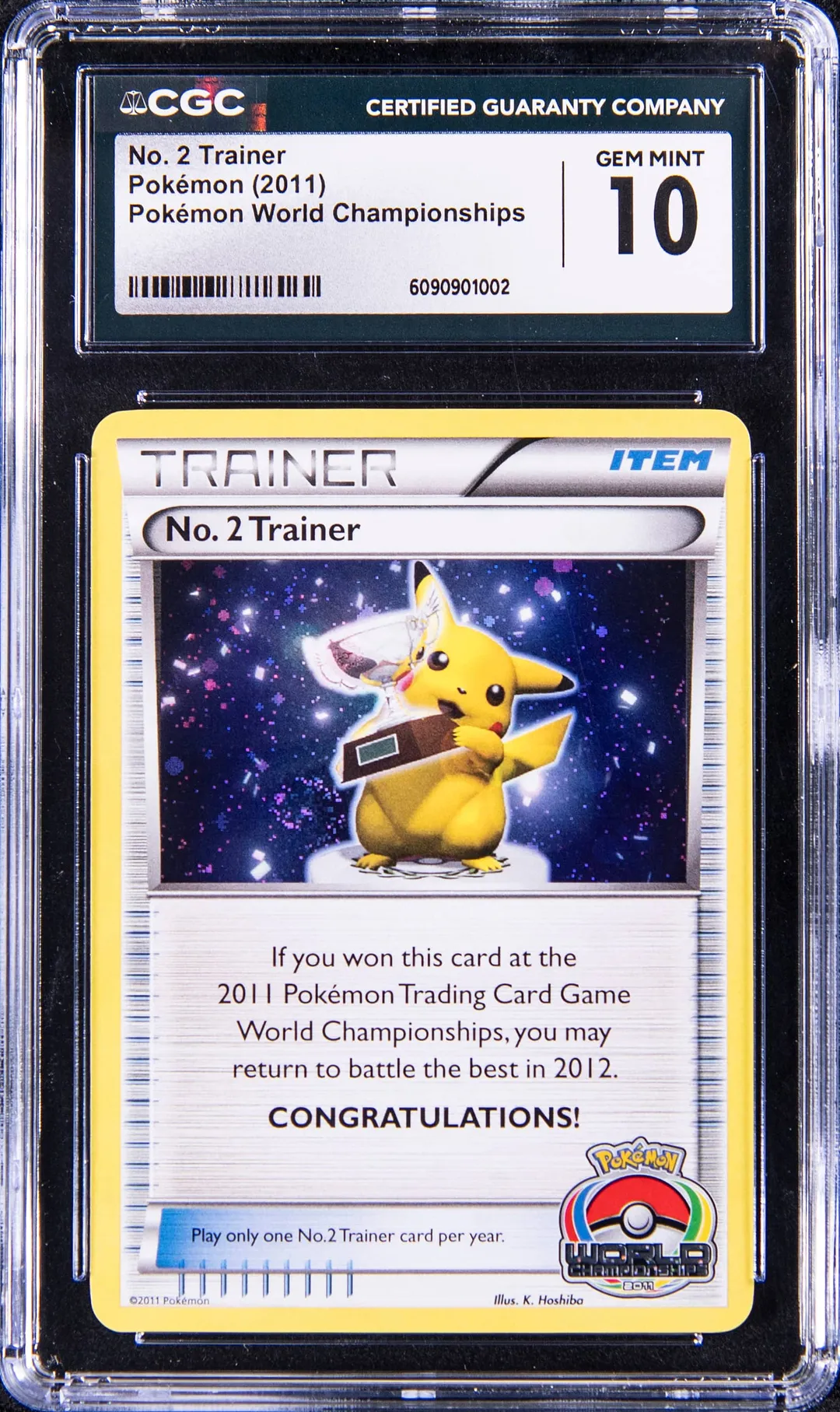
2011 No. 2 Trainer Pikachu Trophy CGC 10 Sells
A CGC 10 copy of the 2011 No. 2 Trainer Pikachu Trophy Card sold for $37,200 at Goldin. See what this rare World Championships card means for collectors.
Sold Card
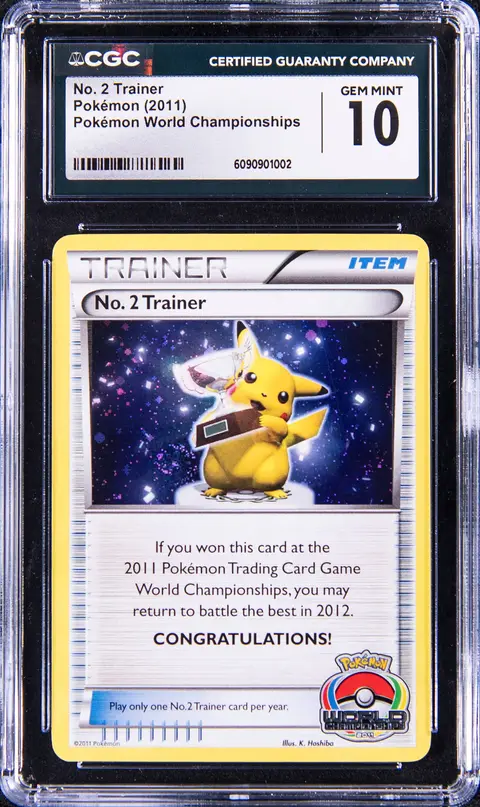
2011 Pokemon World Championships No. 2 Trainer Pikachu Trophy Card - CGC GEM MINT 10 - Pop 2
Sale Price
Platform
Goldin2011 Pokémon World Championships No. 2 Trainer Pikachu Trophy Card CGC 10 Sells for $37,200
A CGC Gem Mint 10 copy of the 2011 Pokémon World Championships No. 2 Trainer Pikachu Trophy Card just sold at Goldin on 2/16/26 for $37,200. For a niche but highly followed segment of the Pokémon market, this is a noteworthy data point that helps clarify where modern-era trophy cards are currently sitting.
In this breakdown, we’ll walk through what the card is, why it matters to collectors, and how this sale fits into the broader price picture.
What exactly is this card?
- Card: 2011 Pokémon World Championships No. 2 Trainer Trophy Card
- Character: Pikachu (trophy artwork, not a standard set Pikachu)
- Year: 2011
- Event: Pokémon World Championships
- Type: Trophy prize card (awarded to top finishers, not pack-issued)
- Variant: “No. 2 Trainer” version
- Grading company: CGC (Certified Guaranty Company)
- Grade: CGC Gem Mint 10
- Population: Pop 2 in CGC 10 (only two copies in this grade on CGC’s population report at the time of cataloging)
This is not a regular set card you could pull from a booster pack. It’s a trophy card, meaning it was awarded to top-placing competitors at the 2011 Pokémon World Championships. That event-based distribution and tiny print run are what place this card in the upper tier of rarity within the hobby.
While there isn’t a standard "rookie card" concept for Pikachu the way there is for athletes, this piece functions as a key issue for collectors who focus on high-end competitive Pokémon memorabilia and World Championship history.
Why the 2011 No. 2 Trainer Pikachu Trophy Card matters
Trophy cards and scarcity
Trophy cards are some of the hardest Pokémon cards to acquire because:
- They were never sold in packs or stores.
- They were awarded to a very small number of players at specific events.
- Many remain in private collections and rarely surface for public sale.
The 2011 No. 2 Trainer Pikachu fits this pattern. Total copies are extremely limited, and only a fraction have been submitted to grading companies. When a high-grade example comes to auction, it draws attention from focused trophy collectors as well as broader high-end Pokémon buyers.
Era: modern / early ultra-modern trophy
2011 falls into what many collectors consider the modern or early ultra-modern era of Pokémon. Compared to 1990s Japanese trophy cards, 2011 is relatively recent. However, "recent" doesn’t mean common:
- World Championship distributions stay small.
- Competitive players may keep their trophies ungraded or in personal collections.
- High-grade copies (CGC 10, PSA 10, BGS Black Label) are particularly thin on the market.
In other words, the era is modern, but the availability behaves more like vintage: very few offerings, with long gaps between public sales.
Understanding the CGC Gem Mint 10 grade and pop
A "pop report" (population report) is a grading company’s count of how many copies of a card exist in each grade. CGC’s report shows this card as Pop 2 in Gem Mint 10, meaning only two cards have achieved that top grade with CGC.
CGC’s Gem Mint 10 standard is strict. For ultra-rare trophy cards, the difference between a 9.5 and a 10 can materially affect what collectors are willing to pay, especially when population numbers are this low.
Market context: how does $37,200 fit in?
The Goldin sale closed at $37,200 USD on 2/16/26.
When we talk about "comps" (comparable sales), we’re looking at recent public transactions for the same card or closely related versions, ideally in similar grades. For this specific trophy card, comps are limited because the card:
- Surfaces at auction infrequently.
- Often changes hands privately.
Based on the available public information:
- High-grade No. 1, No. 2, and No. 3 Trainer Pikachu cards from early 2010s World Championships have historically brought five-figure prices, with top grades and stronger titles (like No. 1 Trainer) often reaching higher levels.
- Earlier Japanese trophy cards (1990s era) still sit in a different price tier, but they are also a different segment of the market.
Within that context, $37,200 for a CGC 10, Pop 2 No. 2 Trainer from 2011 is consistent with the emerging pattern for modern-era trophy pieces: strong five-figure results, with premiums for top grades and documented scarcity.
Because the sample size of auctions is small, it’s more accurate to treat this sale as one data point in a thinly traded market rather than a hard benchmark. But it does provide a useful directional signal of demand and willingness to pay for 2011 World Championships Pikachu trophies in elite condition.
Why collectors chase this card
Several factors drive interest in this 2011 trophy card:
Event provenance
It represents the 2011 Pokémon World Championships, a milestone event in the organized play calendar. For players and fans who value the competitive side of the game, owning a trophy from a Worlds event connects directly to that history.Pikachu artwork
Pikachu is the face of the franchise. Trophy cards that feature Pikachu in unique or exclusive art styles often attract broader interest beyond just gameplay or event specialists.Award tier – No. 2 Trainer
Among Worlds trophies, No. 1 Trainer is usually the most coveted because it signifies first place. However, No. 2 Trainer still represents a podium finish at a world-level event, and the card’s scarcity and design keep it in high demand.Ultra-low supply, even by trophy standards
If only a handful of copies were originally awarded and only two have achieved CGC 10 status, the supply of top-grade copies is effectively fixed. When one comes to auction, collectors who have been waiting for years often have to decide whether to stretch for it or risk not seeing another for a long time.
How this sale fits into the broader Pokémon market
The broader Pokémon market has gone through several cycles: rapid growth, corrections, and periods of consolidation. High-end segments like trophy cards often behave differently from mainstream chase cards:
- Fewer transactions but generally more stable ownership.
- Less price transparency because many deals happen privately.
- More emphasis on provenance and condition than on short-term hype.
This $37,200 Goldin result fits with the idea that serious collectors continue to prioritize:
- Unique event history.
- Confirmed low populations.
- Top-tier grading from recognized companies.
Rather than signaling a sudden spike or collapse, this sale reads more as a confirmation that modern-era Worlds trophies in elite condition still command strong prices when they do surface.
Key takeaways for collectors and small sellers
If you’re newer to trophy cards or returning to the hobby, here are a few practical points you can draw from this sale:
Not all rarity is the same
Regular set cards can be numerically scarce, but trophy cards have built-in scarcity from their distribution method. Understanding that difference helps explain why values can diverge so sharply.Grade matters more as the pool gets smaller
When there may only be a handful of graded copies, the jump from a 9 to a 10 can carry a significant premium. The CGC 10 Pop 2 label is part of why this specific card drew attention.Comps will be limited
For ultra-rare cards like this, you’re unlikely to find a long history of identical public sales. Looking at nearby trophies (other years, other placements, or equivalent grades) can help build context, but there will always be some uncertainty.Event history is a real driver of demand
As the organized play story of Pokémon becomes more documented and appreciated, cards tied directly to Worlds and other marquee events tend to stand out as long-term reference points for collectors.
Final thoughts
The 2011 Pokémon World Championships No. 2 Trainer Pikachu Trophy Card in CGC Gem Mint 10 selling for $37,200 at Goldin on 2/16/26 adds another clear marker for high-end modern Pokémon trophies. With only two copies in this grade on CGC’s population report and very few chances for collectors to buy one publicly, the sale reinforces how tightly held and highly regarded these event-issued Pikachu trophies remain.
As always, this result is one data point, not a guarantee of future prices. But for collectors tracking the health and direction of the trophy segment, it’s an important piece of the puzzle.