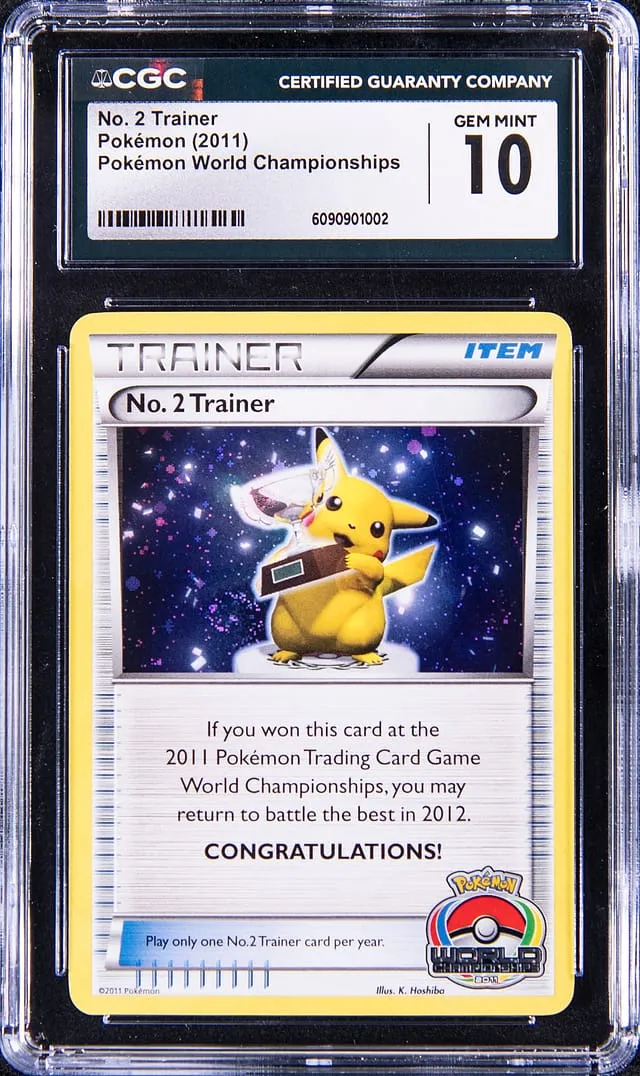
2011 No. 2 Trainer Pikachu Trophy CGC 10 Sale
Breakdown of the 2011 Pokémon No. 2 Trainer Pikachu Trophy CGC 10 that sold for $37,200 at Goldin on February 16, 2026.
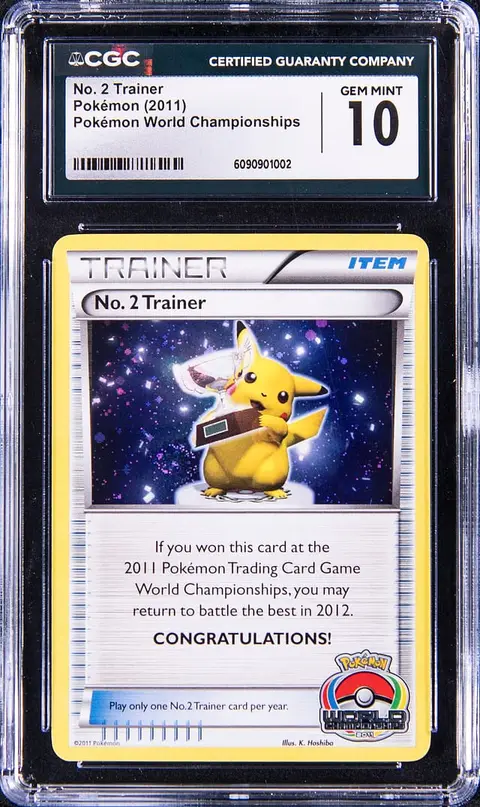
Sold Card
2011 Pokemon World Championships No. 2 Trainer Pikachu Trophy Card - CGC GEM MINT 10 - Pop 2
Sale Price
Platform
Goldin2011 Pokémon World Championships No. 2 Trainer Pikachu Trophy Card CGC 10 Sells for $37,200
On February 16, 2026, Goldin sold a 2011 Pokémon World Championships No. 2 Trainer Pikachu Trophy Card graded CGC GEM MINT 10 for $37,200. For a niche but highly followed corner of the Pokémon market – trophy and prize cards – this is a meaningful data point.
Below, we break down what this card is, why it matters to collectors, and how this sale fits into the broader market context.
What exactly is this card?
- Card: 2011 Pokémon World Championships No. 2 Trainer Pikachu Trophy Card
- Character: Pikachu (illustrated in a World Championships trophy-style design)
- Event: 2011 Pokémon World Championships
- Type: Trophy / prize card awarded to top finishers, not a pack-pulled card
- Era: Early “ultra-modern” competitive-era trophy card
- Grading company: CGC Trading Cards
- Grade: GEM MINT 10
- Population note: Labeled as Pop 2 in CGC’s census (only two examples at this grade in their database at the time referenced)
- Special attributes: Extremely low print run, event-only distribution, and competitive achievement tied to the World Championships
This is not a standard set card with a pack odds ratio. It was awarded to players who placed second in their division at the 2011 Pokémon World Championships. That combination of performance-based scarcity and event history is what puts it into the “trophy card” category.
Why collectors care about World Championships Pikachu trophy cards
Pokémon World Championships Pikachu trophy cards sit at the intersection of:
- Competitive achievement – These cards are tied to actual tournament performance. A No. 2 Trainer card represents a finalist, not just an attendee.
- Low print runs – Only a handful were awarded across divisions in any given year, so the original population starts extremely small.
- Event history – World Championships cards chronicle the growth of the organized play scene and the Pokémon brand beyond video games and TV.
Within the broader hobby, these are closer in spirit to sports award items (like game-used championship memorabilia) than to standard base or chase cards. The appeal is less about a specific set checklist and more about owning a physical piece of the game’s competitive history.
Where this card sits in the Pokémon timeline
2011 is comfortably into the post-WOTC, modern competitive era. By this point:
- The World Championships had an established identity and a consistent yearly structure.
- Trophy cards were already recognized by deep-pocketed collectors as some of the hardest Pokémon items to replace once they disappear into collections.
- The player base was global, so awards like the No. 2 Trainer Pikachu were already international hobby artifacts, not regional oddities.
For that reason, 2011 trophy cards tend to appeal to:
- Long-time competitive players who either chased these prizes or remember the format.
- Advanced collectors mapping out World Championships Pikachu runs by year and placement.
- Market participants focusing on supply-constrained, event-tied pieces instead of mass-printed set cards.
Grade, scarcity, and the CGC GEM MINT 10 factor
This example is graded CGC GEM MINT 10, which denotes a top-tier condition assessment by CGC’s standards. A few important notes:
- Trophy cards often live rough lives. They were handed to players, transported home, sometimes displayed or carried in decks or binders before the grading era fully took off. Finding them in truly gem-mint condition is not automatic.
- Pop 2 at CGC means there are only two examples at this grade in CGC’s population report (their public census of graded cards). For a card that was already printed in very small numbers, this reinforces the idea that high-grade, slabbed copies are especially thin on the ground.
- Cross-grading and fragmentation. High-end Pokémon is split across PSA, BGS, and CGC. That means you can’t get the full universe of graded copies from one pop report, but you can still use each company’s numbers as a rough indicator of how often these surface in top condition.
In short, a CGC 10 for this card is not just a small numerical bump over a 9. It represents one of the best-preserved known examples in a category that may have only dozens of surviving copies worldwide, in any grade.
The sale: $37,200 at Goldin on February 16, 2026
- Auction house: Goldin
- Sale date (UTC): 2026-02-16
- Realized price: $37,200
Goldin has become one of the primary venues for high-end Pokémon, especially six-figure and trophy-level pieces. Seeing a World Championships No. 2 Trainer Pikachu Trophy Card run there places it in front of a mix of:
- Dedicated Pokémon trophy collectors
- Crossover collectors from sports and other TCGs
- Market participants tracking scarce, event-tied assets rather than high-pop chase cards
How does $37,200 fit into recent price context?
Because these cards are:
- Extremely low population, and
- Often locked away long-term once they find a home,
there are relatively few direct, apples-to-apples comps ("comps" are comparable sales used by collectors to benchmark value).
Instead, collectors tend to look at:
- Other years’ World Championships Pikachu trophy cards in similar grades and placements (No. 1 / No. 2 / No. 3).
- Other grading companies’ high-grade examples of the same or related years.
- Adjacent trophy pieces (like older No. 1 Trainer or Secret Super Battle trophies) to frame how the market is currently valuing elite, competition-only cards.
Across those broader benchmarks, a realized price of $37,200 for a 2011 No. 2 Trainer Pikachu in a CGC GEM MINT 10 range sits in line with what you would expect for:
- A later-era, but still pre-2020s, World Championships trophy card.
- A second-place variant rather than the absolute top prize.
- A top-pop grade in a grading company that has gained credibility in the TCG space.
Without an abundance of identical CGC 10 sales to line up side by side, it’s more useful to see this as one more data point supporting the idea that:
- Modern-era trophy cards continue to clear meaningful five-figure marks.
- Condition, provenance, and auction venue all matter when thinly traded items do come to market.
What this sale suggests for collectors
A single auction never tells the whole story, but this Goldin result reinforces a few themes that have been visible in the Pokémon space for several years:
Event-tied scarcity still carries weight. Cards earned on the tournament floor continue to command a different level of attention than mass-distributed promos or chase cards, even when those are popular.
Ultra-low supply leads to irregular sales. With only a handful of copies and even fewer graded at the top level, price discovery happens sporadically. When a CGC GEM MINT 10 Pop 2 trophy appears, it may be the only chance at that specific card in that condition for years.
Grading diversity is now normal. Where PSA once dominated almost completely in the Pokémon high-end, CGC and BGS slabs are now regularly accepted in major auctions for six-figure and high five-figure TCG pieces. That gives collectors more options but also means they need to be comfortable reading multiple pop reports.
Buying, selling, or just researching cards like this
If you’re newer to trophy and prize cards, a few practical takeaways:
- Focus on provenance and documentation. Because these were awarded personally to players, understanding how a copy moved from the original winner to the current holder can matter a lot.
- Use pop reports as a guide, not a guarantee. Not every copy has been graded, and some may still be sitting raw. Population reports are best treated as a floor on scarcity, not a ceiling.
- Expect long gaps between comps. Unlike set cards with frequent sales, you may not see the same World Championships trophy come up for public auction more than once every few years.
The 2011 Pokémon World Championships No. 2 Trainer Pikachu Trophy Card CGC GEM MINT 10 that sold for $37,200 at Goldin on February 16, 2026, is a clear reminder of how deep and specialized the Pokémon market has become. For collectors building World Championships runs, or anyone studying how scarcity and history intersect in TCGs, this is a sale worth bookmarking.
At figoca, we track these thinly traded, historically meaningful pieces so collectors can navigate the high end of the market with clearer data and context.