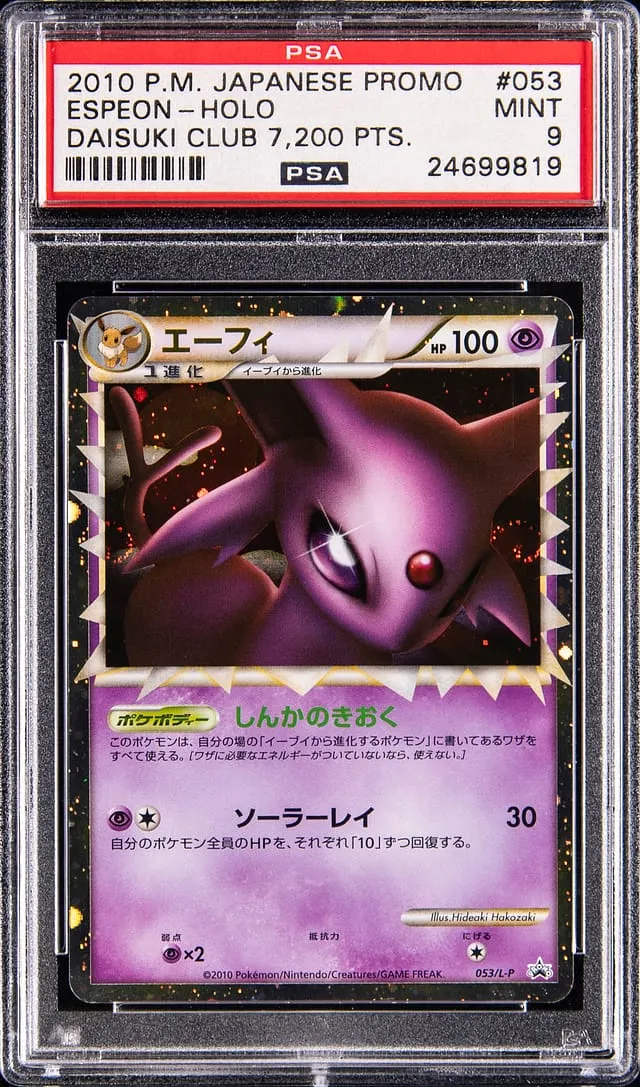
2010 Daisuki Club Espeon PSA 9 Sells for $18,300
Breaking down the 2010 Pokémon Daisuki Club Espeon #053 PSA 9 sale at Goldin for $18,300 and what it means for Eeveelution promo collectors.
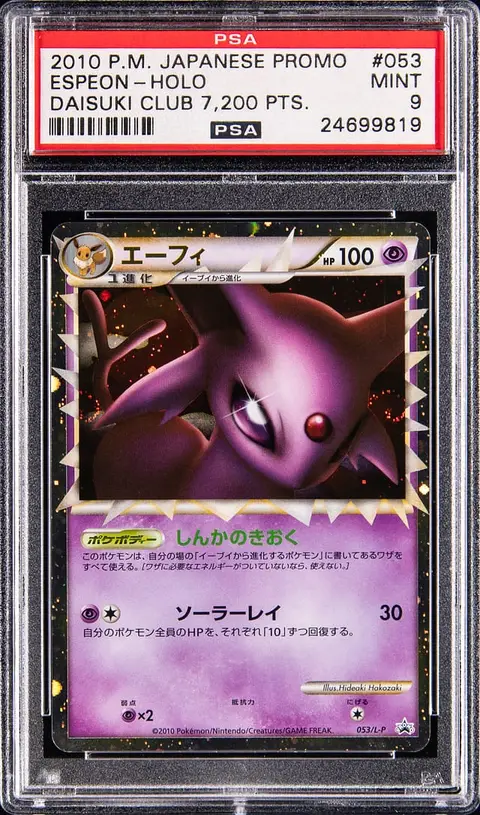
Sold Card
2010 Pokemon Japanese Promo Daisuki Club 7,200 Points Holo #053 Espeon - PSA MINT 9
Sale Price
Platform
Goldin2010 Pokémon Japanese Daisuki Club Espeon PSA 9 Sells for $18,300
On May 18, 2026, a 2010 Pokémon Japanese Promo Daisuki Club 7,200 Points Holo Espeon #053, graded PSA MINT 9, sold at Goldin for $18,300. For a niche, ultra-rare Japanese promo, this is a meaningful data point that helps clarify where high-end Eeveelution cards are sitting in today’s market.
In this post, we’ll unpack what this card is, why collectors care about it, and how this sale fits into recent price action.
What exactly is this Espeon card?
Card details
- Character: Espeon (Eeveelution)
- Year: 2010
- Origin: Japan-only promo
- Program: Pokémon Daisuki Club member rewards
- Requirement: 7,200 Daisuki Club points redemption
- Card: 2010 Pokémon Japanese Promo Daisuki Club 7,200 Points Holo Espeon
- Card number: #053
- Language: Japanese
- Finish: Holofoil
- Grading company: PSA (Professional Sports Authenticator)
- Grade: PSA MINT 9
- Attributes: Extremely limited distribution, non-pack promo
This is not a pack-pulled card. It was obtained through the Japanese Pokémon Daisuki Club, a fan club where members earned points through online activities and campaigns. The Espeon and its companion Umbreon promo required a very high point total (7,200 points), which effectively capped how many copies could realistically be redeemed.
Among collectors, the 2010 Daisuki Club Espeon and Umbreon are viewed as some of the most desirable modern-era Japanese Eeveelution promos because of their combination of:
- Difficult acquisition (time-intensive point grind)
- Japan-only distribution
- Low supply relative to demand
- Strong character collecting base (Espeon/Eeveelutions)
It’s not a rookie card in the sense of first appearance, but it is considered a key issue for people who collect Espeon, Eeveelutions, or high-end Japanese promos.
Why this promo matters to collectors
1. Daisuki Club promos are inherently constrained
The Daisuki Club system rewarded sustained engagement, not just a one-time purchase. That has a few practical effects:
- Fewer casual players ever reached the 7,200-point threshold.
- Many who did earn the card likely kept it as a memento rather than grading or selling.
- A portion of raw copies has been lost, damaged, or sits in Japan in collections unlikely to hit the market.
That combination often leads to low PSA populations ("pop" refers to how many copies have been graded by a company). While exact pop numbers can change as more cards are submitted, this Espeon has historically had a relatively small total census compared with mass-released set cards from the same era.
2. Eeveelution and Espeon demand
Eeveelutions (Espeon, Umbreon, Sylveon, etc.) are a core character group in the hobby. Many collectors build character-focused collections, and Espeon has a devoted following thanks to:
- Its presence in the Johto era (Gold/Silver)
- Strong art history across Japanese promos and sets
- Long-standing fan-favorite status alongside Umbreon
When you combine a global Eeveelution collector base with a difficult Japanese-only release, cards like this Espeon tend to be chased well beyond the traditional Japanese-only buyer pool.
3. Modern/ultra-modern era with vintage-style scarcity
2010 falls into what many hobbyists call the modern era, on the border with what some refer to as ultra-modern. Unlike mass-produced set cards from the mid-to-late 2000s onward, this Daisuki Club Espeon behaves more like a short-print promo:
- It wasn’t opened by the booster box.
- It required intentional effort to obtain.
- Supply has not meaningfully grown over time.
So while the card is relatively new compared with 1990s vintage, its functional scarcity and character appeal push it into a premium lane.
Recent market context and comps
When collectors talk about “comps,” they’re referring to comparable recent sales that help frame what a card tends to sell for in the current market.
For this specific card – the 2010 Japanese Daisuki Club 7,200 Points Holo Espeon #053 in PSA 9 – public sales are relatively thin compared with more common promos. Based on available auction and marketplace data over the last couple of years:
- PSA 10 copies of this card and its Umbreon counterpart have historically pushed into significantly higher ranges when they surface, reflecting the challenge of achieving a gem mint grade on a card that was not pack-fresh in the usual way.
- PSA 9 copies have typically traded at a meaningful discount to PSA 10 but still well above many other modern Espeon cards because of the rarity and collector importance of the Daisuki Club release.
Given that the latest Goldin result is $18,300 on May 18, 2026, this sale:
- Sits on the high end of the PSA 9 range compared with earlier public results from a few years prior.
- Narrows, but does not erase, the gap between many known PSA 9 and PSA 10 results for high-end Eeveelution promos.
Because this card surfaces so infrequently, it’s more accurate to treat each appearance as a data point rather than to insist on a precise “market value.” Thin supply means:
- One motivated bidder can move the realized price noticeably.
- Results can vary from sale to sale without necessarily signaling a long-term trend.
How this Goldin sale fits into the broader picture
1. Auction house and timing
This card sold through Goldin on May 18, 2026 (UTC). Large auction houses can concentrate demand because:
- They market to a global high-end collector base.
- They often line up multiple notable lots in a single event, drawing more eyeballs.
For scarce, high-end promos like this Espeon, selling through a major platform can reveal what serious collectors are currently willing to pay.
2. Signals for Japanese promo and Eeveelution markets
This result lines up with a few broader themes seen in recent years:
Sustained interest in Japanese exclusives: Collectors continue to differentiate between mass-printed English set cards and truly scarce Japanese promos. Cards like this Espeon remain strong reference points for that segment of the market.
Character-driven demand: Espeon sits in the middle of one of the most actively collected character groups. High-end Eeveelution cards – especially unique releases like the 7,200 Points Daisuki Club pair – are often used as benchmarks when people talk about “top tier” character cards beyond the usual Charizard focus.
Preference for strong grades with reasonable pop: A PSA 9 on a difficult promo still offers near-gem eye appeal with a lower entry point than a PSA 10, which can attract both high-end collectors and advanced character-focused buyers.
What this might mean for collectors and small sellers
This sale does not tell anyone what they should buy or sell, but it does offer some practical takeaways:
Documented scarcity matters
Cards with low documented population reports, limited distribution methods, and strong character appeal tend to hold collector attention even as broader market conditions shift.Condition remains a key differentiator
The spread between PSA 9 and PSA 10 on rare promos can be large, but strong PSA 9 results like this show there is robust demand for high-grade copies beyond just the absolute top grade.Niche Japanese promos are increasingly tracked
Not long ago, some of these Daisuki Club cards traded mostly in Japanese domestic circles. Now, major Western auction houses like Goldin are part of their price history, which makes it easier for collectors everywhere to reference past sales.Thin-supply cards require a long view
Because so few copies appear each year, a single high or low result shouldn’t be over-interpreted. For cards like this 2010 Daisuki Club Espeon, building a view of value usually means looking at:- Multiple years of sales when available
- Grade distributions (how many PSA 8/9/10 exist)
- The health of the broader Eeveelution and Japanese promo segments
Summary
The 2010 Pokémon Japanese Promo Daisuki Club 7,200 Points Holo Espeon #053, PSA MINT 9 reaching $18,300 at Goldin on May 18, 2026 reinforces this card’s position as one of the key modern-era Espeon and Eeveelution promos.
For collectors, it’s another concrete reference point:
- A high-grade example of a tough Japanese-only promo
- Sold through a major auction house
- At a level that reflects both its scarcity and the sustained demand for premium Eeveelution cards
As always, it’s best viewed as one more data point in a small but growing record of sales, rather than a definitive ceiling or floor. But for anyone building an Espeon, Eeveelution, or Japanese promo collection, this Goldin result is worth bookmarking in your notes.