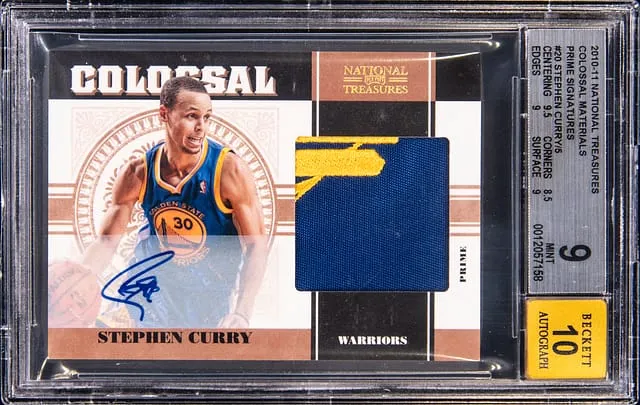
2010-11 NT Colossal Curry Patch Auto BGS 9 Sells
Goldin sold a 2010-11 National Treasures Colossal Stephen Curry /5 BGS 9, Auto 10 for $15,250. See how this early high-end patch auto fits the Curry market.
Sold Card
2010-11 Panini National Treasures Colossal Materials Prime Signatures #20 Stephen Curry Signed Patch Card (#3/5) - BGS MINT 9, Beckett 10
Sale Price
Platform
GoldinWhen a low-numbered, on-card Stephen Curry patch autograph from his earliest premium years surfaces at public auction, collectors pay attention.
On April 3, 2026, Goldin sold a 2010-11 Panini National Treasures Colossal Materials Prime Signatures #20 Stephen Curry patch autograph, serial numbered 3/5, graded BGS MINT 9 with a Beckett 10 autograph, for $15,250.
Below, we break down what this card is, why it matters, and how this sale fits into the broader market for early high-end Curry cards.
Card at a glance
Full card name
2010-11 Panini National Treasures Colossal Materials Prime Signatures #20 Stephen Curry
Key details
- Player: Stephen Curry, Golden State Warriors
- Season: 2010-11 (Curry’s second NBA season)
- Product: Panini National Treasures Basketball
- Subset: Colossal Materials Prime Signatures
- Serial numbering: Hand-numbered 3/5 (five-copy run)
- Autograph: On-card (signed directly on the card), Beckett 10 auto grade
- Patch: Prime patch (multi-color game-used memorabilia)
- Grading: BGS MINT 9, Autograph 10
- Era: Early ultra-modern, high-end Panini era
This is not Curry’s true rookie patch auto (that’s from 2009-10 sets like National Treasures and Exquisite), but it is an early, premium, low-serial-numbered patch autograph from Panini’s flagship high-end line. For many collectors who focus on star players, early National Treasures “Colossal” and RPA-style cards run a close second tier behind the true rookie cards.
What sold at Goldin and for how much
- Auction house: Goldin
- Sale date (UTC): April 3, 2026
- Final price: $15,250 USD
- Grade: BGS 9 (with 10 autograph)
A BGS 9 / 10 grade is important here. In the high-end market, the premium goes not just to the player and card, but to condition and eye appeal. While we don’t have public pop report (population report, i.e., how many have been graded) broken out by subgrades for this exact Card + Serial pairing, any card numbered to /5 is inherently scarce, and the combination of:
- On-card auto
- Prime patch
- National Treasures branding
- Early Curry (pre-MVP explosion)
creates a niche but established collector lane.
Market context and comps
In hobby language, “comps” are comparable sales of the same or very similar cards, used to understand the normal price range.
For this exact card — 2010-11 National Treasures Colossal Materials Prime Signatures #20 Curry /5 — public sales are understandably sparse. A print run of five copies means that years can pass between public auctions.
Based on recent Curry high-end results and closely related cards:
- Other early-2010s National Treasures Curry patch autos (not rookies, but low-numbered, on-card, prime patches) tend to land in the mid-four-figure to low-five-figure range depending on:
- Serial number (e.g., /10 vs /5 vs 1/1)
- Patch quality (three-color, logo pieces tend to carry premiums)
- Autograph condition and grade
- Overall card grade
- Curry’s true rookie patch autos (2009-10) in high grades often sit in a significantly higher tier, sometimes multiples of this realized price, reflecting their “core PC” status for many Curry-focused collectors.
Within that broader ecosystem, $15,250 for a BGS 9 /5 Colossal Materials Prime Signatures looks consistent with the idea that:
- This card is a premium, but secondary-tier issue relative to a true rookie RPA.
- The low serial number, patch, and on-card auto still command a substantial multiple over base, insert, or sticker-autographed cards from the same time.
Because public transactions for this exact card are limited, it’s more accurate to say that this result fits within the known range for comparable early high-end Curry issues rather than calling it “cheap” or “record-breaking.” It confirms steady demand more than anything else.
Why collectors care about this card
1. Early National Treasures Curry
2010-11 National Treasures sits at the early stage of Panini’s high-end basketball era. For many modern collectors, National Treasures is the spiritual successor to Exquisite: it represents the top of the pyramid for licensed patch autographs.
Curry’s 2009-10 rookie cards are the main chase, but early follow-up years are still important for player collectors who:
- Build a year-by-year “high-end ladder” for a star player.
- Focus on prime patch autos across multiple seasons rather than only rookies.
- Prefer Panini’s top-tier releases over mid-tier products.
2. Colossal Materials Prime Signatures subset
The Colossal Materials Prime Signatures cards are recognizable for:
- Oversized patch window (the “colossal” swatch)
- Prime patch pieces with multiple colors or breaks
- Clean on-card autographs that usually command better long-term attention than stickers
That combination gives the card strong visual presence, which matters especially if a collector is building a display or a PC (personal collection) built around a single player.
3. Serial number to 5
Numbering to /5 sits in an interesting middle ground:
- More obtainable than a 1/1, so there’s at least a small chance that multiple copies circulate over time.
- Still low enough that most collectors will never see more than one or two examples in person.
For player collectors, /5 is often a “grail lane”: not impossibly rare, but scarce enough that once one surfaces, it may be the only realistic shot for years.
4. BGS 9 with 10 auto
For modern, high-end patch autos, many buyers now look at two things:
- The overall grade (e.g., BGS 9, 9.5, PSA 10)
- The auto grade (10 is preferred; smudged or streaky autos can hurt demand)
A BGS 9 with a 10 auto is a strong outcome for a thick, patch-based card from 2010-11. These thicker cards are naturally prone to edge and corner issues, which can make gem mint grades rarer.
How this sale fits into the Curry market right now
Stephen Curry’s status in the hobby is well-established:
- Multiple championships
- Revolutionized three-point shooting
- High visibility and strong off-court profile
In the years leading up to this sale, the Curry market has generally shown:
- A clear separation between true rookies and non-rookie issues.
- Solid demand for low-serial, on-card patch autos, especially from Exquisite and National Treasures.
- Greater selectivity on mid-tier products and higher print-run inserts.
This Goldin result on April 3, 2026 reinforces a few patterns:
- Early, low-serial Panini Curry autos remain relevant. Even though this is not a rookie card, the combination of brand, patch, and autograph keeps it in the conversation for serious Curry PCs.
- Condition and auto grade matter. If this card were an 8.5 with a 9 auto, it’s reasonable to expect softer demand; the strong BGS 9 / 10 configuration helps underpin the realized price.
- Supply is structurally limited. With a print run of five, there simply are not many of these to trade hands, which reduces the number of comps and can widen the expected price range when one does surface.
Takeaways for collectors and small sellers
Whether you are new to the hobby or returning after a long break, a sale like this can help you frame where different types of Curry cards sit in the overall hierarchy.
If you’re a Curry collector:
- Expect true rookies and flagship RPAs to remain the primary targets.
- Early National Treasures and other premium patch autos from 2010-11 onward offer a second tier of high-end options, often at a fraction of rookie RPA prices but still commanding five-figure results in strong grades.
If you’re a small seller or investor-minded collector:
- Use comps across adjacent cards, not just the exact serial number, to gauge interest and realistic ranges. With /5 cards, there may be years between identical sales.
- Pay attention to eye appeal (patch quality, autograph strength, centering) in addition to the numeric grade. Two BGS 9s are not always treated equally by buyers.
If you’re newer to the hobby:
- Terms like “National Treasures,” “RPA,” “prime patch,” and “on-card auto” tend to signal the top end of modern/ultra-modern products.
- Low serial numbers (like /5) generally mean the card is intentionally scarce from the start, very different from the mass-produced base cards you might remember from earlier eras.
How this sale might guide your research
When tracking cards like this 2010-11 National Treasures Colossal Materials Prime Signatures Curry:
- Look beyond just one sale. Because print runs are so small, it’s better to consider a basket of sales from nearby years, sets, and serial numbers.
- Check multiple marketplaces. Major auction houses, fixed-price marketplaces, and peer-to-peer deals can all show different sides of demand.
- Track condition trends. If high-grade copies dry up, even a BGS 9 can start to feel “top tier,” especially on thick card stock.
The April 3, 2026 Goldin sale at $15,250 doesn’t rewrite the Curry market on its own. Instead, it adds another data point to a steady narrative: early, low-serial, on-card National Treasures Curry patch autos continue to occupy a stable lane among serious collectors.
For figoca users and researchers, it’s a reminder to pay close attention to set, year, and configuration details—because on cards like this, those subtleties are exactly where the value lives.