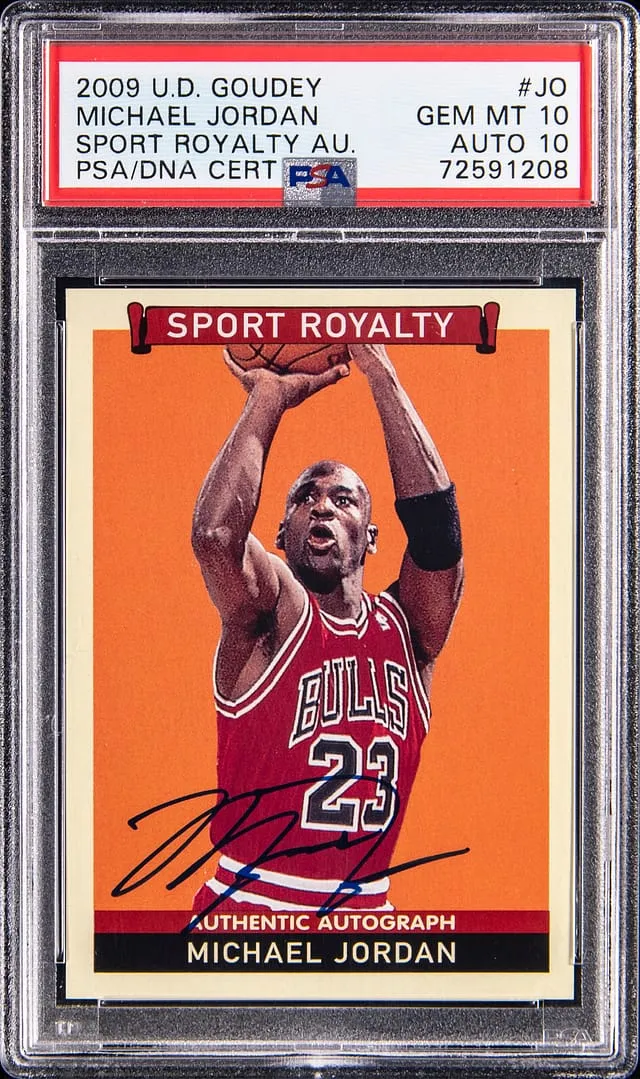
2009 Goudey Michael Jordan Auto PSA 10 Sells for $40K
Goldin sold a 2009 Upper Deck Goudey Sport Royalty Michael Jordan auto PSA 10 / PSA-DNA 10 (Pop 2) for $40,531. A data-driven look at this MJ market result.
Sold Card
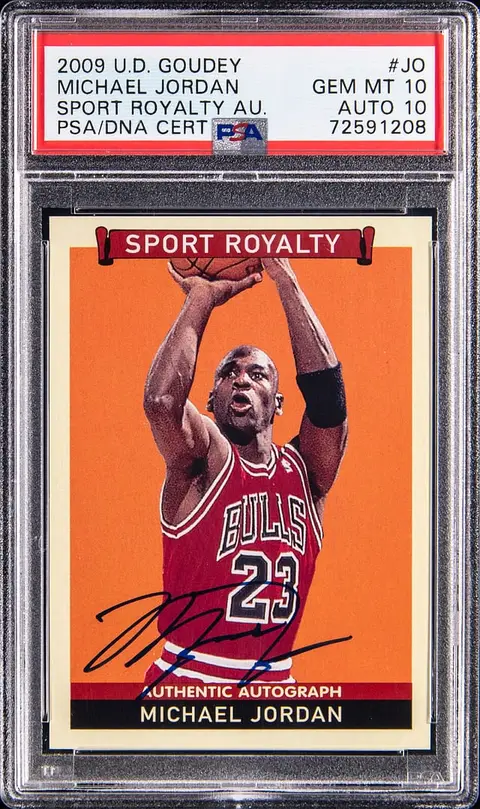
2009 Upper Deck Goudey Sport Royalty Autographs #JO Michael Jordan Signed Card - PSA GEM MT 10, PSA/DNA GEM MT 10 - Pop 2
Sale Price
Platform
GoldinOn May 10, 2026, Goldin closed a notable modern Jordan sale: a 2009 Upper Deck Goudey Sport Royalty Autographs #JO Michael Jordan, graded PSA GEM MT 10 with a PSA/DNA GEM MT 10 autograph, realized $40,531.
For a non‑rookie, non‑patch card from the late 2000s, that number stands out. Let’s unpack why this specific copy matters to collectors, how it fits into the broader Michael Jordan market, and what this sale might be telling us.
The card at a glance
Card: 2009 Upper Deck Goudey Sport Royalty Autographs
Player: Michael Jordan, Chicago Bulls
Card #: JO
Set: 2009 Upper Deck Goudey – Sport Royalty Autographs subset
Autograph: On‑card (signed directly on the card surface)
Grading: PSA GEM MT 10 (card), PSA/DNA GEM MT 10 (auto)
Population: Pop 2 in this dual GEM MT 10 configuration
Sale: $40,531 via Goldin on May 10, 2026
This is not a rookie card, nor is it Jordan’s most expensive signature overall, but within the lane of on‑card, licensed Upper Deck Jordan autographs in high grade, it checks a lot of boxes.
The 2009 Goudey line is a modern throwback, loosely inspired by the 1930s Goudey gum cards. The Sport Royalty Autographs subset brings in stars across sports, with Jordan positioned as one of the top basketball names. Collectors usually chase these for three reasons:
- On‑card autograph – No sticker; Jordan signed directly on the card, which most collectors prefer.
- Clean, retro design – The classic portrait layout frames the signature well, so eye appeal is high when centered and well‑cut.
- Upper Deck Jordan pedigree – Since Upper Deck has long held Jordan’s auto rights, their signed Jordan issues are a core part of the MJ market.
Why the PSA 10 / PSA‑DNA 10 combo matters
In hobby shorthand, this copy is a “dual GEM 10”: both the card itself and the autograph received PSA’s top grade.
- PSA GEM MT 10 (card) means sharp corners, strong centering, and minimal, if any, visible flaws.
- PSA/DNA GEM MT 10 (auto) focuses on the signature: bold, well‑placed, and free of smudges or streaks.
The population report (“pop report”) is PSA’s count of how many copies have achieved each grade. A pop of 2 for this dual 10 configuration signals:
- Even if the card isn’t numbered, true top‑end examples are scarce.
- Upgrading from a 9/10 or 10/9 to a 10/10 can be a big price jump because high‑end collectors and set builders often pay a premium for the absolute best available example.
In modern and ultra‑modern eras, where print runs are higher, grade scarcity (how few copies reach a top grade) often matters as much as raw card scarcity. That’s what’s happening here.
Market context: how does $40,531 stack up?
Because this is a niche, high‑grade variant of a specific Jordan auto, public sales in this exact dual‑GEM configuration are limited. Instead of guessing, it’s more useful to anchor this sale against:
- Other grades of the same card
- Comparable Upper Deck on‑card Jordan autos
- Broader MJ autograph trends
1. Other grades of this exact card
Public sales of the 2009 Goudey Sport Royalty Jordan in PSA 9 or BGS 9/9.5 with 10 autos have generally landed in a lower band than this Goldin result. In recent cycles, you’ll often see:
- PSA 9 / PSA‑DNA 10 or equivalent: typically well under this $40K mark.
- Raw / ungraded autos: meaningfully lower again, with price depending heavily on centering and autograph quality.
The Goldin sale at $40,531 reflects both:
- The scarcity of the dual 10 population (pop 2).
- The premium some collectors are paying to secure the very best example of a non‑rookie, on‑card Jordan auto from a respected Upper Deck era.
While it’s hard to call it a “record” without a perfect database of past results for this exact slab configuration, the price is clearly toward the upper end for this issue.
2. Comparable Upper Deck Jordan on‑card autos
Looking across the Upper Deck Jordan autograph landscape, there are a few key lanes:
- Iconic inserts and SPs from the 1990s (e.g., early on‑card autos)
- Exquisite and high‑end jersey/patch autos from the 2000s
- Clean, portrait‑style on‑card autos like Goudey, SP Signature Edition, etc.
The 2009 Goudey Sport Royalty sits below Exquisite and top‑tier patch autos in the Jordan hierarchy, but above many mass‑produced, later‑era autograph products in terms of collector respect. In recent years:
- Truly elite Exquisite MJ patches can reach into the mid six figures and beyond.
- More common MJ Upper Deck signatures might land in the mid‑four to low‑five‑figure range depending on design, numbering, and grade.
A $40K+ result places this card firmly in the upper mid‑tier of Jordan autos: not the rarest grail in the catalog, but clearly treated by the market as a premium piece.
3. Jordan market tone in 2025–2026
Jordan’s card market has matured into something closer to a blue‑chip collectible segment:
- He’s long retired, so no new on‑court events change his legacy.
- Demand is driven by nostalgia, GOAT debates, and a gradually expanding pool of global collectors.
- The wild volatility of the 2020–2021 boom has moderated; prices still move, but the swings are less extreme.
Within that environment, high‑grade, on‑card, licensed Upper Deck signatures have often shown relative stability compared to speculative, performance‑dependent players. Premium sales like this Goldin result fit that pattern: not parabolic, but strong and selective.
Why collectors care about 2009 Goudey Sport Royalty Jordan
This card sits at an intersection that appeals to several types of collectors:
- Jordan PC collectors – “PC” stands for personal collection. For MJ‑focused collectors, this fills the “retro‑styled, on‑card auto” slot with a clean aesthetic and a tough top grade.
- Goudey enthusiasts – 2009 Goudey is part of Upper Deck’s modern‑retro run, and the Sport Royalty autos are often viewed as the premium chase within the product.
- Set and subset builders – The Sport Royalty Autographs run includes stars across sports, and a dual GEM 10 Jordan is a centerpiece for anyone chasing graded copies across the set.
- Grade‑focused investors and high‑end hobbyists – With only two known PSA 10 / PSA‑DNA 10s, this copy is effectively a population‑capped asset within an already popular lane.
It’s not tied to a specific on‑court moment or season, but rather to a design era: late‑2000s Upper Deck, when the company still had NBA logos and Jordan autos under one roof.
What this Goldin sale may be signaling
Instead of forecasting or promising anything, it’s more useful to look at what this sale suggests about current preferences among active buyers:
On‑card still matters
Even as collectors accept stickers in some products, demand (and premium pricing) remains concentrated around on‑card signatures for legends like Jordan.Top‑pop premiums are alive and well
The jump from a strong card with a 9 or a 10/9 grade to a pop‑2 dual 10 is real. When supply is this thin, a single motivated bidder can move the needle.Non‑rookie key issues can be strong performers
Rookie cards get most of the headlines, but this sale underscores that iconic or aesthetically strong non‑rookie autos have their own mature markets.Selective strength in a normalized market
The broader hobby has cooled from peak‑hype levels, but well‑understood, high‑end pieces of all‑time greats continue to attract focused demand.
Takeaways for collectors and small sellers
If you’re newer to the hobby or returning after a break, here are practical points you can draw from this sale:
Understand the “lane” of a card, not just the price tag
Before comparing this $40,531 sale to another Jordan card, check: year, brand, on‑card vs sticker, numbering, and grade. Two cards with the same player and auto can live in different market tiers.Use comps, but look beyond the headline
“Comps” (comparable recent sales) are a useful benchmark, but they’re most accurate when the match is tight: same card, same grade, similar eye appeal, and a similar selling venue. Auction house, marketing, and timing can all influence the final hammer price.Grade scarcity can rival card scarcity
This Goudey Jordan isn’t a 1/1 or ultra‑short print, yet a dual 10 is effectively rare because so few copies are that clean. For modern and ultra‑modern cards, how many high‑grade copies exist can matter a lot.Eye appeal still counts, even at PSA 10
Within the same grade, centering, autograph placement, and color saturation can sway bidders. When browsing slabs, don’t just read the label—actually look at the card.Think in ranges, not single points
This Goldin sale is one data point. For personal buying and selling decisions, it’s often more useful to build a small sample of recent sales—across platforms and conditions—and think in ranges rather than latching onto one number.
Final thoughts
The 2009 Upper Deck Goudey Sport Royalty Autographs #JO Michael Jordan in PSA GEM MT 10 with a PSA/DNA GEM MT 10 autograph, selling for $40,531 at Goldin on May 10, 2026, is a clear example of where the modern Jordan autograph market is today:
- Mature and selective,
- Focused on on‑card, licensed issues,
- Willing to pay up when population and presentation line up.
For Jordan collectors, it reinforces the importance of understanding each card’s specific lane: design, era, brand, and grade all matter. For broader hobbyists, it’s another reminder that even outside the rookie and patch‑auto spotlight, there’s real depth—and real structure—to the high‑end MJ market.
As always, any purchase or sale decision should be based on your own collecting goals, budget, and comfort with risk. Recent sales provide helpful context, but they’re not guarantees. In a space as passionate and nuanced as Jordan collecting, the clearest signal is often your own long‑term conviction in the card you’re holding.