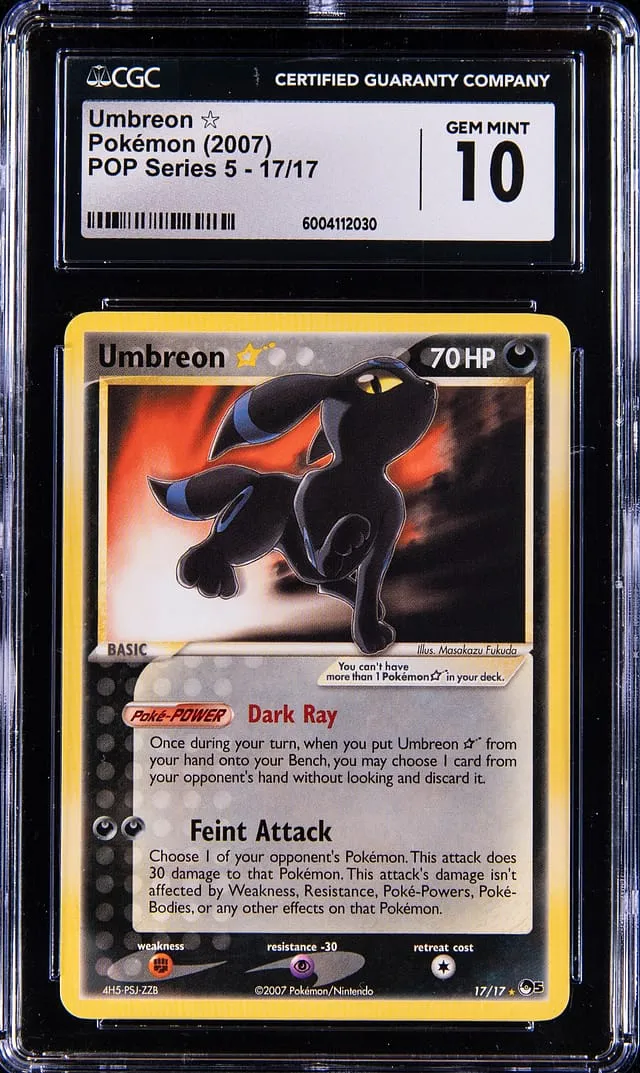
2007 POP 5 Gold Star Umbreon CGC 10 Sells for $36K
A CGC 10 copy of the 2007 POP Series 5 Gold Star Umbreon #17 sold for $36,600 at Goldin. Here’s what the sale means for Pokémon collectors.
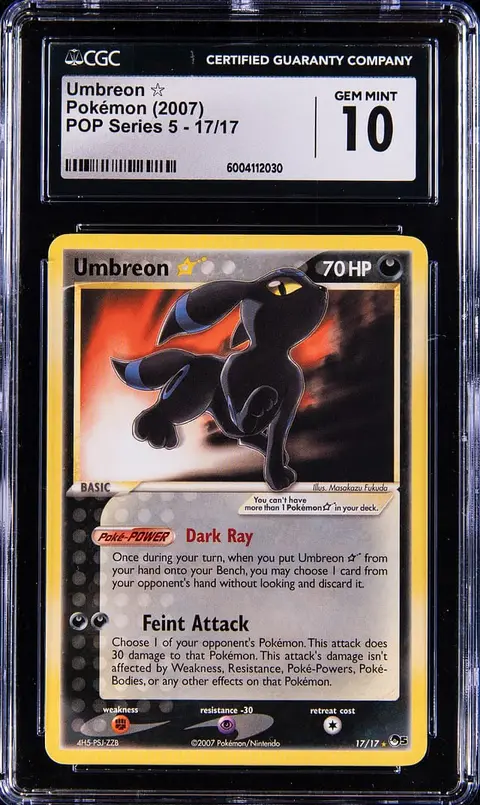
Sold Card
2007 Pokemon POP Series 5 Gold Star #17 Umbreon - CGC GEM MINT 10
Sale Price
Platform
Goldin2007 Pokémon POP Series 5 Gold Star Umbreon #17 (CGC GEM MINT 10) quietly remains one of the key non-trophy cards in the entire Pokémon hobby. A recent sale through Goldin on 2026-03-30 for $36,600 underscored just how much collector demand still exists for this card at the highest grade levels.
In this post, we’ll break down what the card is, why it matters, and how this sale fits into the broader market context.
The card at a glance
- Character: Umbreon (Gold Star)
- Year: 2007
- Set: Pokémon POP Series 5
- Card number: #17
- Rarity/type: Gold Star (shiny, alternate-color artwork)
- Era: Mid-2000s, ex-era promo/POP era
- Grading company: CGC (Certified Guaranty Company)
- Grade: GEM MINT 10
- Attributes: Non-holo foil pattern with Gold Star rarity indicator; one of the chase cards of POP Series 5
This is not a rookie card in the sports sense, but for many Pokémon collectors, Gold Star Umbreon is a “key issue” – a foundational, top-tier chase card from the mid-2000s that anchors serious collections.
POP Series 5 was a promotional set distributed through Pokémon Organized Play (POP) packs, commonly given out at leagues and events. That distribution model kept supply relatively thin compared with mass-release booster boxes. Umbreon Gold Star (and its counterpart, Espeon Gold Star) became the defining chase cards of the set.
Why Gold Star Umbreon is so important
Several factors make this Umbreon one of the most talked-about non-trophy Pokémon cards:
Gold Star rarity
Gold Star cards, released primarily in the mid-2000s, feature shiny (alternate-color) Pokémon depicted bursting out of the card art frame, with a gold star next to the Pokémon’s name. They were inserted at very low odds relative to typical rares, making them significantly harder to pull.Umbreon’s fanbase
Umbreon is one of the most popular Eeveelutions and has a strong, long-running fanbase. Cards that combine a highly collected character with a notoriously low-pull-rate rarity tend to become long-term hobby staples.POP Series 5 distribution
Unlike mainline sets sold through boosters, POP Series 5 packs were attached to organized play and promotional programs. Packs were often opened casually, handled roughly, or never stored with grading in mind. That contributes to the difficulty of finding clean, gradable copies today.Condition scarcity at the top end
High grades of this card are significantly limited. While exact CGC population numbers can change over time, the general pattern across grading companies has been consistent: GEM MINT 10 examples are a small fraction of total submissions. For cards like this, the gap between a high near-mint grade (for example, a 9) and a true gem (10) can be substantial in both population and price.
Taken together, these factors have pushed POP Series 5 Umbreon Gold Star into the same conversation as other elite mid-2000s chase cards.
Market context and recent sales
When collectors talk about “comps,” they’re referring to comparable recent sales that help frame what a card tends to sell for. For this Umbreon, useful comps include:
- The same card in different grades (CGC 9, 9.5, BGS, PSA equivalents)
- Parallel population tiers within a single grader (10 vs 9.5 vs 9)
- Cross-grader comps (how a CGC 10 has compared historically to PSA 10 or BGS 9.5 / 10 for the same card)
Across auction houses and major marketplaces over the past few years, POP Series 5 Umbreon Gold Star has consistently commanded strong prices in high grade. The very highest grades across any grading company tend to cluster in a relatively narrow and thinly traded price band, given how few copies ever come to market.
At $36,600, this Goldin sale on 2026-03-30 lands in line with the broader trend of:
- Significant premiums for true gem copies: GEM MINT 10s have routinely sold at a meaningful step up from 9 and 9.5 grades, reflecting grade scarcity.
- Stable interest in mid-2000s chase cards: While the broader modern Pokémon market has experienced cooling and re-pricing in various segments, mid-2000s Gold Stars – especially headline characters like Umbreon – have held collector attention.
Not every sale sets a record, and not every auction clears at the top of recent ranges. Instead of reading this result as a promise of future values, it’s more useful to think of it as one more data point showing that fully gem POP 5 Umbreons remain highly contested when they appear in public auction.
CGC GEM MINT 10: what the grade means
CGC’s GEM MINT 10 label is reserved for cards with:
- Sharp corners and edges
- Strong centering within CGC’s gem tolerances
- Clean surfaces with no major flaws visible under standard inspection
For older promotional releases like POP Series 5, getting a card into this condition is not straightforward. Many copies were:
- Pulled and handled at league events
- Stored in non-ideal conditions (binder pockets, loose in boxes)
- Subject to edge whitening, print lines, or surface wear
This makes GEM MINT 10 more than just a label; for this card, it’s a strong signal that the copy has survived the usual pitfalls that plague POP-era promos.
How this sale fits into the broader Umbreon / Eeveelution market
Umbreon does not exist in a vacuum. Collectors often track it alongside:
- Espeon Gold Star from the same POP Series 5 set
- Earlier and later Umbreon chase cards (e.g., Neo-era, modern alt arts)
- Other Eeveelution key cards (Espeon, Sylveon, Leafeon, etc.)
The consistent theme is that Eevee and its evolutions are perennial favorites with a collector base that extends beyond competitive players or short-term hype cycles. Over time, that broad demand has helped support prices for the most important Umbreon and Espeon cards, particularly in their toughest variants and grades.
While individual auction results can fluctuate based on timing, exposure, and bidder mix, high-end Umbreon pieces have repeatedly attracted multiple serious bidders whenever they surface.
What this means for different types of collectors
This Goldin result doesn’t dictate what anyone should buy or sell, but it does offer some practical takeaways depending on where you are in the hobby.
New or returning collectors
- Use this as a reference point, not a target. You don’t need a GEM 10 Gold Star Umbreon to enjoy the hobby. Lower grades, raw (ungraded) copies, or other Umbreon cards can offer the same character connection at more approachable levels.
- Learn how rarity and condition interact. POP-era cards illustrate how distribution, print quality, and handling history can make top grades meaningfully scarcer than mid-grades.
Active hobbyists
- Watch grade gaps. Price differences between 9, 9.5, and 10 can be substantial on key cards like this. Population reports ("pop reports" – counts of how many copies exist in each grade) can help explain those gaps.
- Follow cross-grader trends. As more collectors become comfortable with CGC alongside PSA and BGS, relative pricing between equivalent high grades can shift over time.
Small sellers and traders
- Use verified auctions as anchors. Prominent auction results, like this one from Goldin, give you a well-documented reference point when discussing condition tiers with buyers or trade partners.
- Photograph and describe condition carefully. For cards where small flaws dramatically change value, clear scans and honest descriptions help avoid mismatches in expectations.
Final thoughts
The 2007 Pokémon POP Series 5 Gold Star Umbreon #17 remains one of the defining non-trophy cards of the ex-era. The $36,600 CGC GEM MINT 10 sale at Goldin on 2026-03-30 reinforces a long-standing pattern: when truly top-tier copies of historically important chase cards surface, there is still deep collector interest.
For most collectors, this card is a north star rather than a checklist item – a way to understand how scarcity, condition, and character popularity can combine to create enduring hobby landmarks.
As always, it’s best to treat high-end sales as context, not instruction. Let them inform your understanding of the market while you build a collection that fits your own goals, budget, and long-term enjoyment of the hobby.