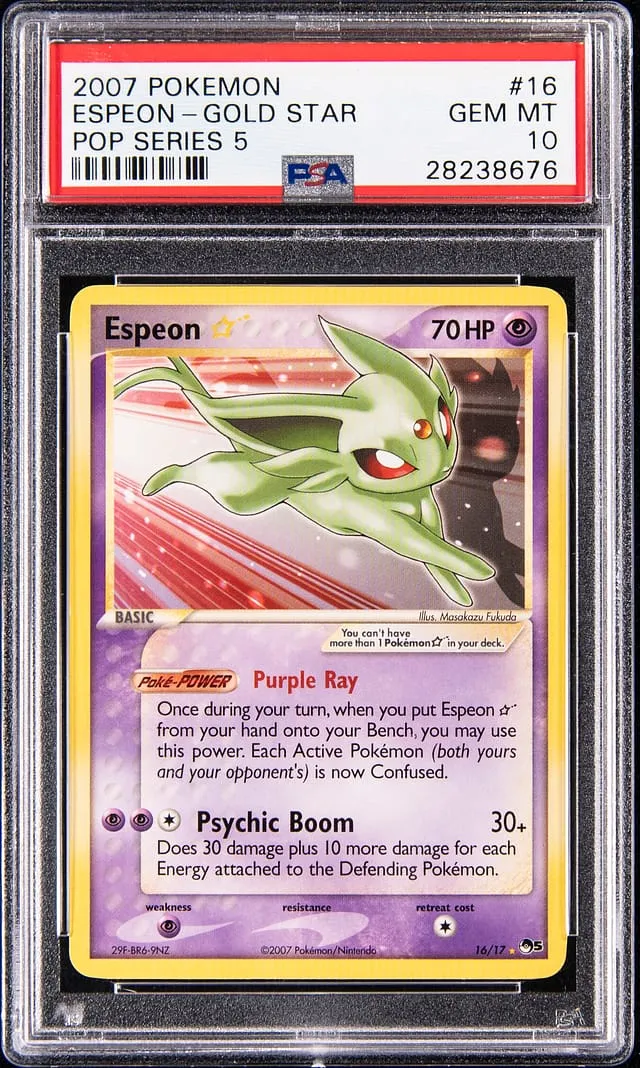
2007 POP 5 Gold Star Espeon PSA 10 sells for $56K
Goldin sold a 2007 Pokémon POP Series 5 Gold Star Espeon PSA 10 for $56,120. See why this low-pop Espeon is a key high-end Pokémon grail.
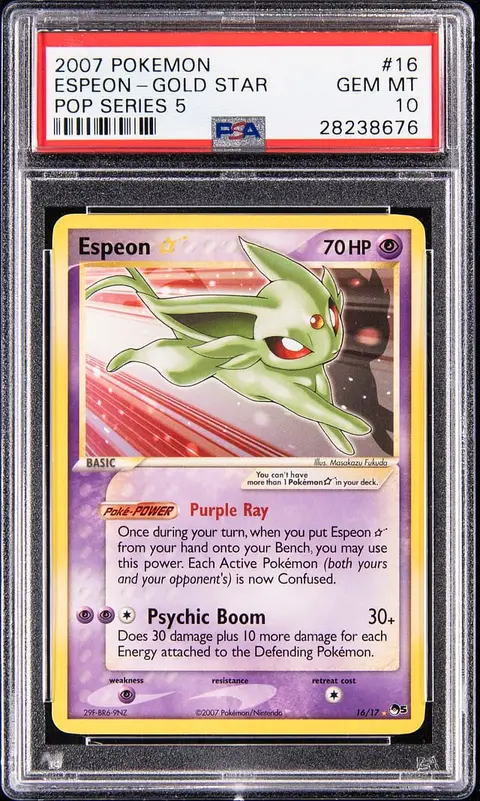
Sold Card
2007 Pokemon POP Series 5 #16 Gold Star Espeon - PSA GEM MT 10
Sale Price
Platform
Goldin2007 Pokémon POP Series 5 Gold Star Espeon in a PSA 10 is one of those cards that quietly sits near the top of many collectors’ wishlists. On April 20, 2026, a copy of the 2007 Pokémon POP Series 5 #16 Gold Star Espeon graded PSA GEM MT 10 sold at Goldin for $56,120, underscoring just how important this card has become in the broader Pokémon market.
In this figoca market breakdown, we’ll look at what this card is, why it matters, and how this sale fits into recent price history.
Card snapshot
- Card: 2007 Pokémon POP Series 5 #16 Espeon ★ (Gold Star)
- Character: Espeon
- Set: POP Series 5 (Pokémon Organized Play reward set)
- Year: 2007
- Card number: 16/17
- Variant: Gold Star (shiny Espeon, alternate color artwork)
- Era: Mid-2000s, EX-era / early competitive-era promo
- Rookie / key issue? Not a rookie in the sports-card sense, but widely treated as a key Espeon card and a top-tier Gold Star grail
- Grading: PSA GEM MT 10 (PSA’s highest standard grade)
- Special attributes: Extremely tough in top grade, distributed via POP packs rather than traditional booster boxes
- Sale: Goldin, April 20, 2026, for $56,120
Gold Star Espeon and its counterpart, Gold Star Umbreon, are among the most chased non-trophy Pokémon cards of the 2000s. They sit in a small group of “grail tier” cards that bridge casual collectors, competitive players from the era, and serious Pokémon investors.
Why POP Series 5 and Gold Star Espeon matter
POP Series 5: Organized Play reward packs
POP (Pokémon Organized Play) Series packs were not sold like normal boosters. They were rewards tied to league play and events, mainly in the mid-2000s. POP Series 5, released in 2007, is the final POP set and has:
- A small checklist (17 cards)
- Limited, reward-based distribution
- High demand from players at the time, which often meant cards were handled and played, not stored carefully
The combination of low organic supply and casual storage is a big reason truly clean, gradable copies of Gold Star Espeon are rare.
Gold Stars: the shiny chase of the EX era
Gold Star cards are known for:
- Featuring shiny (alternate color) Pokémon
- A small gold star symbol next to the Pokémon’s name
- Very low pull rates when they appeared in mainline sets
Espeon Gold Star in POP Series 5 is part of this broader Gold Star family, which includes Charizard, Rayquaza, and other marquee names. Even in that company, Espeon stands out because:
- It’s an Eeveelution, a sub-collection with very dedicated followers
- It pairs with Umbreon Gold Star from the same POP set, making a high-end two-card chase
Mid-2000s scarcity
The card sits in what many consider a low-print era. The mid-2000s Pokémon TCG did not have the same mass production as modern sets. Combine that with the organized play distribution model, and you get:
- Fewer sealed POP 5 packs floating around today
- Many surviving Espeon copies showing edge wear, scratching, or centering issues
This is why high-graded examples command such a premium.
PSA 10 population and grading difficulty
While population reports (a “pop report” is a grading company’s count of how many copies exist in each grade) change over time, Gold Star Espeon in PSA 10 has consistently remained a low-pop card relative to demand.
Typical issues that hold cards back from GEM MT 10 include:
- Edge chipping on the borders
- Print lines or surface scratches (especially visible on holo areas)
- Centering that falls just outside PSA’s tolerance for a 10
Because POP packs were opened casually and these Espeons were often collected or played long before today’s grading boom, most surviving raw copies do not meet GEM MT 10 standards. That naturally concentrates demand on the small number of confirmed PSA 10s.
Market context: where does $56,120 fit?
figoca’s focus is on data, so it’s helpful to position this sale alongside recent activity. While exact numbers vary by date and platform, historical patterns for this card generally look like this:
- PSA 10 copies have historically been among the highest-valued non-trophy Espeon cards, selling in the tens of thousands of dollars at major auction houses.
- PSA 9 copies often trade at a significant discount to 10s, sometimes roughly half or less of the 10 price, depending on eye appeal and market sentiment.
- Lower grades (PSA 8 and below) and raw copies tend to see much larger price swings, as condition sensitivity is high for collectors targeting this card.
The $56,120 result at Goldin in April 2026 sits firmly in the “elite” tier of Pokémon card sales. It is:
- Consistent with the card’s status as a grail-level Gold Star
- In line with the pattern that top-pop, low-supply Pokémon chase cards can support very strong prices even when broader market sentiment moves up or down
Instead of reading this as a guarantee of future prices, it’s more useful to view it as a marker of current market confidence in POP 5 Gold Star Espeon at the top grade.
Comparing to related cards
When looking at comps (short for “comparables,” meaning recent sales of similar items), it helps to benchmark against very close relatives:
Gold Star Umbreon (POP Series 5)
- Usually priced in a similar or slightly higher band than Espeon in equivalent grades
- Often collected as a duo with Espeon
Other Gold Star Eeveelutions (e.g., Jolteon, Flareon, Vaporeon)
- Important cards, but typically below POP 5 Espeon and Umbreon in price, reflecting lower demand and different print/distribution patterns
Other top Gold Stars (Charizard, Rayquaza, Mewtwo, etc.)
- This is the cohort where serious collectors often compare relative value
- Espeon’s price history shows that Eeveelution demand can rival even some of the biggest names when supply is constrained
Across these lanes, POP 5 Espeon PSA 10 consistently ranks near the top.
Why collectors chase this card
Collectors tend to cite the same core reasons repeatedly:
Art and character choice
- Espeon has stable, long-term popularity, not just short-term hype
- The shiny purple/green palette makes the Gold Star art visually distinct
Set narrative
- POP Series 5 is the last POP set, with a small, almost boutique checklist
- There is nostalgia among players and judges who earned these packs through organized play
Relative scarcity in high grade
- Low PSA 10 population
- Limited raw supply with upgrade potential as time goes on
Cross-collector appeal
- Appeals to:
- Espeon and Eeveelution character collectors
- Gold Star set collectors
- POP-series completionists
- General high-end Pokémon collectors seeking a small number of centerpiece cards
- Appeals to:
Market signals from the Goldin sale
The Goldin April 20, 2026 sale doesn’t rewrite the story of Gold Star Espeon, but it does reinforce several existing themes:
- High-grade scarcity still commands a premium. The gap between PSA 10 and PSA 9 remains wide for truly low-pop grails.
- Mid-2000s promos have matured. What was once a niche interest (POP packs from league days) is now recognized as a core part of Pokémon’s high-end history.
- Demand is character driven. Espeon’s enduring popularity, paired with the Gold Star treatment, continues to support strong prices without relying solely on short-lived hype cycles.
For active hobbyists and small sellers, the main takeaway is not that every Espeon or every promo card will follow this path, but that context matters:
- Distribution method (league reward vs booster box)
- Condition sensitivity and grading difficulty
- Character strength and collector narratives
All of these factors interact to create today’s price levels.
Takeaways for different types of collectors
New or returning collectors
- This sale is a reminder that Pokémon has its own blue-chip tier, much like key rookie cards in sports.
- Gold Star Espeon is one of those reference points: you don’t need to own it, but understanding it helps you read the broader market.
Active hobbyists
- When evaluating high-end cards, it helps to look beyond just the latest sale and into:
- Population reports
- Grade distribution
- How often a card actually comes to market
- Gold Star Espeon in PSA 10 comes up rarely enough that each sale tends to get attention and is used as a benchmark for the card’s tier.
Small sellers
- The POP 5 Espeon result highlights how graded condition and set context can multiply value.
- Even if you’re not dealing in five-figure cards, understanding why this card performs well can help in spotting underappreciated promos or low-print-era cards in more accessible price ranges.
Final thoughts
The 2007 Pokémon POP Series 5 #16 Gold Star Espeon – PSA GEM MT 10 sale for $56,120 at Goldin on April 20, 2026, reinforces the card’s status as a top-tier Pokémon grail. It brings together a scarce distribution method, a fan-favorite character, the prestige of the Gold Star designation, and a very tight high-grade population.
For the broader market, it’s another data point showing that well-understood, historically important Pokémon cards from lower-print eras can maintain a strong position, even as trends shift elsewhere in the hobby. For collectors, it’s a reminder that some cards don’t just tell the story of a set—they help tell the story of an entire era.