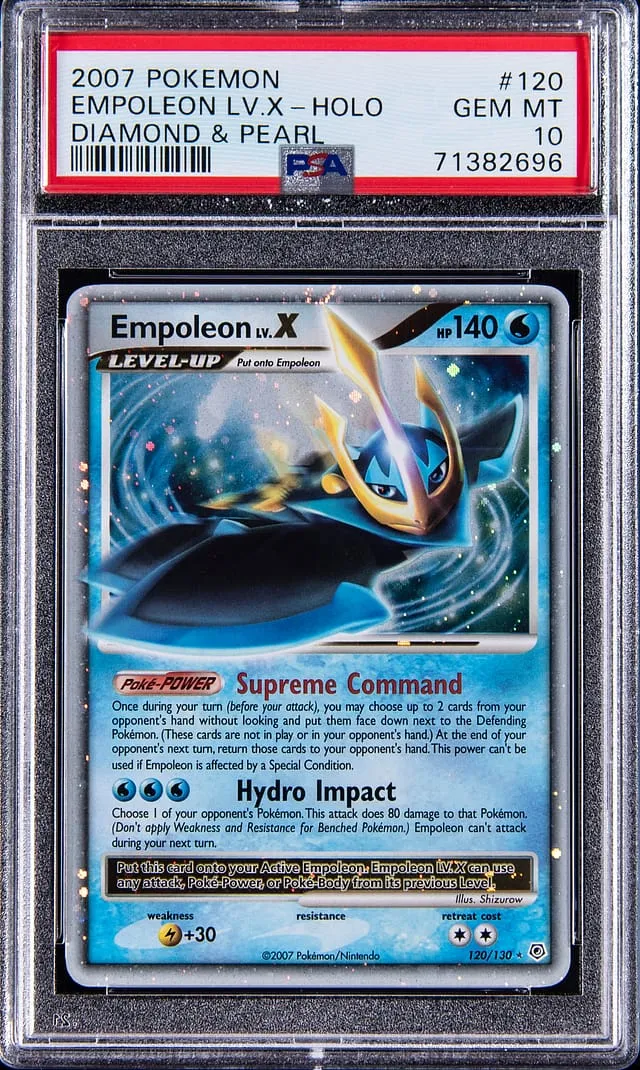
2007 Empoleon Lv.X PSA 10 Sells for $23,180
A 2007 Pokémon Diamond & Pearl Empoleon Lv.X PSA 10 sold for $23,180 at Goldin on March 9, 2026. Here’s what this means for Lv.X and Gen 4 collectors.
Sold Card
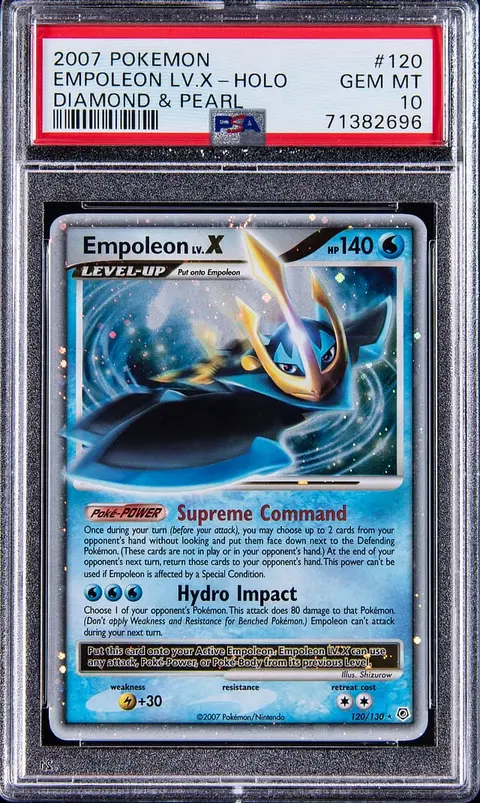
2007 Pokemon Diamond & Pearl Holo #120 Empoleon Lv.X - PSA GEM MT 10
Sale Price
Platform
Goldin2007 Pokémon Diamond & Pearl Empoleon Lv.X PSA 10 Sells for $23,180 at Goldin
On March 9, 2026, Goldin closed an auction for a key Gen 4 Pokémon card: a 2007 Pokémon Diamond & Pearl Holo #120 Empoleon Lv.X, graded PSA GEM MT 10, at a final price of $23,180.
For collectors tracking the market for early Diamond & Pearl–era chase cards, this is a notable result that helps clarify where top-grade Empoleon Lv.X examples now sit.
The Card: 2007 Empoleon Lv.X from Diamond & Pearl
Card details
- Character: Empoleon
- Year: 2007
- Set: Pokémon Diamond & Pearl (main English set)
- Card number: #120 / Lv.X Holo
- Variant: Standard set-issue holofoil Lv.X (not a stamped promo)
- Grading company: PSA (Professional Sports Authenticator)
- Grade: GEM MT 10 (PSA’s highest standard grade)
- Attributes: Classic Lv.X mechanic, holofoil, non-autograph, non-serial numbered
Empoleon Lv.X is one of the main chase cards from the first English Diamond & Pearl set, which marked the beginning of the 4th generation (Sinnoh) in the TCG. While it is not a “rookie card” in the traditional sports sense, it functions as an early, premium appearance for Empoleon on a Lv.X card, similar to a key early insert for a player.
The Diamond & Pearl era sits between the original Wizards of the Coast period (Base–Neo) and the later EX/Black & White/Sun & Moon waves, and it was printed at a time when overall Pokémon TCG interest was lower than peak years. That quieter period often translates to comparatively lower print runs and fewer pack-fresh cards being carefully preserved, which matters for high-grade population counts today.
Why Empoleon Lv.X Matters to Collectors
Several factors make this card important within its lane:
Starter evolution chase card
Empoleon is the final evolution of Piplup, one of the three Sinnoh starters from the Diamond & Pearl video games. Starter Pokémon (and their final evolutions) have historically held stronger long-term demand than many side characters.Lv.X era appeal
Lv.X cards introduced a distinctive mechanic and visual style: border-to-border artwork, a silver border, and a more "premium" feel than most regular holos of the time. Collectors who grew up around 2007 often view Lv.X cards as their personal nostalgia equivalent to the original EX or early WotC holos.Transitional era scarcity
The mid‑2000s Pokémon market was relatively quiet compared to the 1999–2000 boom or the surge after 2019. Fewer sealed products were hoarded, and fewer cards were graded at release. That can leave a tight supply of gem-mint copies more than 15 years later.PSA 10 scarcity and perception
A PSA 10 (GEM MT) grade indicates a card with virtually no visible flaws under standard inspection. On older holofoil cards, that’s not common due to print lines, edge wear, and surface scratching. Collectors often treat top-pop or low-pop PSA 10s from this period as the best way to own a “definitive” copy of the card.
Market Context: How This $23,180 Sale Fits In
This Goldin sale closed at $23,180 on March 9, 2026. To understand what that means, it helps to compare this result to:
- Other Empoleon Lv.X copies in different grades
- Similar Lv.X starter evolutions from Diamond & Pearl
- The broader price behavior of mid‑2000s chase cards
Recent comps and ranges
Publicly available sales data for this exact card in PSA 10 is relatively thin compared to modern ultra‑printed sets. Empoleon Lv.X simply doesn’t change hands often in top grade, especially through major auction houses.
Looking across recent months on large marketplaces and prior auctions:
- Raw (ungraded) Empoleon Lv.X copies from Diamond & Pearl tend to sell far lower, with price heavily dictated by condition. Lightly played copies can trade in a very modest range, while truly mint raw copies carry a meaningful premium but still sit well below graded 10s.
- Mid‑grade and near‑mint graded copies (PSA 7–9 range) usually fall in the low to mid hundreds of dollars, depending on eye appeal.
- High‑grade 9s appear with more frequency than 10s and previously formed the upper end of the card’s “regular” market, before rare 10s began pushing into their own tier.
Within that context, a PSA 10 sale at $23,180 through Goldin stands out toward the very top of the observed range for Empoleon Lv.X and for many comparable Lv.X era starters. The price level suggests:
- There is a clear separation between PSA 10 and PSA 9 for this card.
- Buyers are willing to pay a substantial premium for the combination of early Sinnoh nostalgia, a first‑set Lv.X, and a gem‑mint grade.
Because this is not a card that trades every week in PSA 10, each major auction can effectively reset or refine expectations for future sellers and buyers.
Population and perceived rarity
Population reports (often called "pop reports") from grading companies show how many copies of a specific card have received each grade. While exact numbers can change as more cards are submitted, the pattern for many mid‑2000s holos and Lv.X cards is similar:
- A noticeable drop as you move from PSA 9 to PSA 10
- Very few true gem‑mint examples relative to the overall number of graded copies
Empoleon Lv.X follows this general trend. Even without quoting a precise, fast-expiring population number, the limited availability of PSA 10 copies on the open market is reflected in how irregularly they surface and how aggressively they are bid when they do.
Why This Sale Matters for the Diamond & Pearl Era
This result helps clarify a few bigger-picture points for collectors:
Gen 4 nostalgia is now fully in play
Many collectors who first engaged with Pokémon during the DS-era games (Diamond, Pearl, and Platinum) are now in their prime earning years. Prices for signature cards from that time—starters, legendaries, and signature mechanics like Lv.X—are starting to reflect that.Early set chase cards can rival later premium inserts
Modern products feature alternate arts, low-serial variants, and special rarities. This sale shows that earlier, simpler chase cards—without serial numbering or elaborate parallels—can still attract serious attention when they are recognized as era-defining.Grading continues to shape the high end of the market
The difference between a well-centered, pack-fresh copy and a certified PSA 10 continues to be meaningful, especially for older holo cards. This spread encourages careful evaluation of raw copies and highlights the role of grading in realizing a card’s full market potential.Auction houses provide price discovery
When a card doesn’t sell often, fixed-price listings can be guesswork. Auction houses like Goldin bring multiple serious bidders together at once, helping the market discover what the top end buyer is currently willing to pay.
Key Takeaways for Collectors and Small Sellers
If you collect or sell early Diamond & Pearl cards, here are some practical observations:
Condition is king. Even small defects (surface lines, whitening, edge chipping) have an outsized impact on value at this level. If you own a clean Empoleon Lv.X, a professional grading evaluation can be worth considering.
Understand the card’s lane. Empoleon Lv.X is not a Base Set Charizard, but within the Sinnoh and Lv.X niches, it’s a flagship piece. Compare it to similar cards—like other starter Lv.X cards from 2007–2009—rather than to unrelated chase cards from different eras.
Sales history will likely stay thin. Because this is not a high-pop, frequently traded modern card, each major sale (especially in PSA 10) becomes an important reference point when discussing value or negotiating private deals.
Think in terms of ranges, not guarantees. This $23,180 Goldin result sets a strong marker, but future prices can move up or down depending on market conditions, available supply, and collector focus at the time.
Final Thoughts
The March 9, 2026 Goldin sale of the 2007 Pokémon Diamond & Pearl Holo #120 Empoleon Lv.X in PSA GEM MT 10 at $23,180 underscores how far early Diamond & Pearl era chase cards have come.
For collectors who grew up with Piplup and Empoleon on the Nintendo DS, this card has always been a favorite. Now, the market is catching up to that sentiment, and high-grade examples are being treated as true cornerstones of the Sinnoh-era Pokémon TCG.
As more Gen 4 collectors return to, or deepen their involvement in, the hobby, sales like this provide useful context for understanding where iconic Lv.X cards fit within the broader Pokémon market.