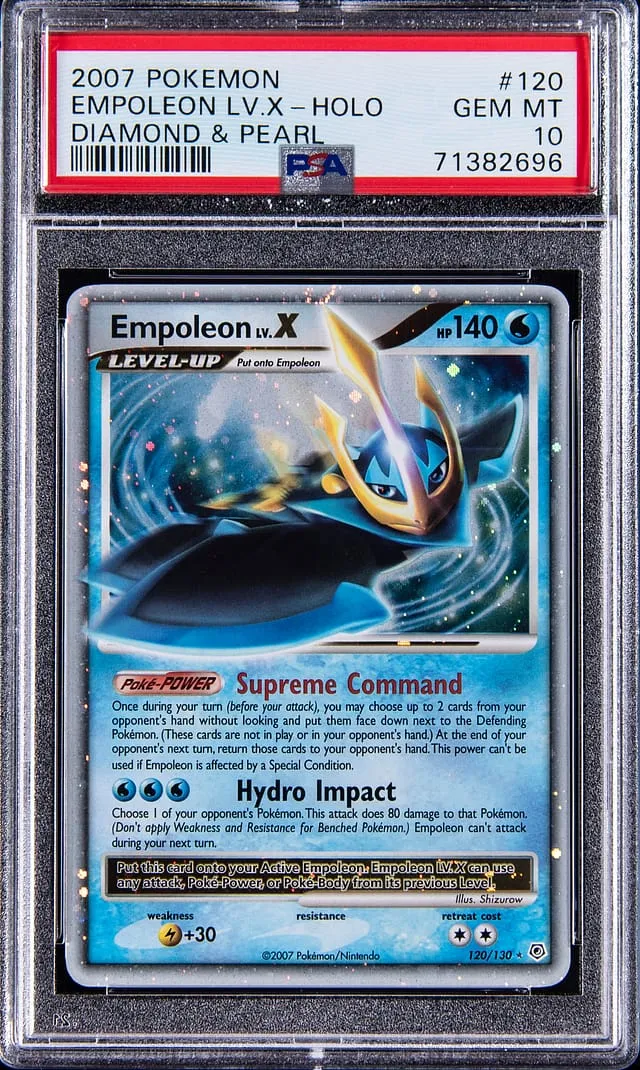
2007 Empoleon Lv.X PSA 10 Diamond & Pearl Sale
A 2007 Pokemon Diamond & Pearl Empoleon Lv.X PSA 10 sold for $23,180 at Goldin on March 9, 2026. Here’s what it means for Diamond & Pearl collectors.
Sold Card
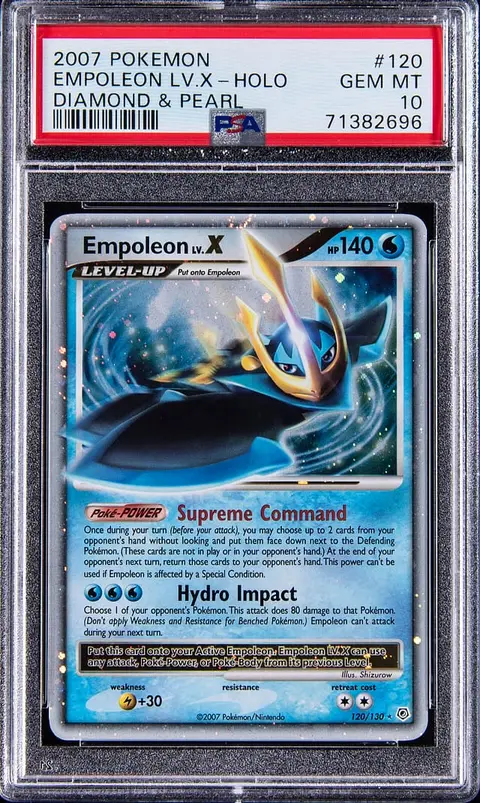
2007 Pokemon Diamond & Pearl Holo #120 Empoleon Lv.X - PSA GEM MT 10
Sale Price
Platform
Goldin2007 Pokemon Diamond & Pearl Holo #120 Empoleon Lv.X in a PSA GEM MT 10 holder quietly drew serious attention at Goldin on March 9, 2026, closing at $23,180.
For a mid‑2000s Pokemon card that isn’t Charizard, Pikachu, or a trophy card, that final price is notable. Let’s walk through why this Empoleon matters, how this result fits into the broader market, and what collectors can take away from the sale.
The card at a glance
Card details
- Character: Empoleon Lv.X
- Year: 2007
- Set: Pokemon Diamond & Pearl (English)
- Card number: #120
- Rarity/variant: Holo Lv.X
- Grading company: PSA (Professional Sports Authenticator)
- Grade: GEM MT 10 (PSA’s highest standard grade)
- Attributes: No autograph, no serial numbering – significance comes from era, artwork, and grade.
This is not a rookie card in the sports sense, but for Pokemon it functions as an early, era‑defining premium card for Empoleon. The Diamond & Pearl era introduced a new generation to the TCG and marked a design shift away from the early Wizards of the Coast years.
Lv.X cards in Diamond & Pearl were the chase pulls of the product. They extended a Pokémon’s power beyond its regular evolution line and were printed at lower rates than the standard holos. Empoleon, as the fully evolved form of the Water‑type Sinnoh starter Piplup, occupies a special place with fans who grew up on the Nintendo DS games.
Why collectors care about Empoleon Lv.X
1. Diamond & Pearl era nostalgia
The 2007 Diamond & Pearl set sits in what many collectors think of as the “post‑Wizards, pre‑modern boom” window. It’s not vintage, but it’s also not part of the massive print runs of some Sword & Shield products.
For a lot of returning collectors, Diamond & Pearl was their first set, not Base Set. As those collectors enter their prime earning years, they are rediscovering the chase cards they never pulled as kids. Empoleon Lv.X is one of those chase pieces.
2. Starter Pokémon status
Empoleon is the final evolution of Piplup, a Sinnoh starter Pokémon. Starter lines (Fire/Water/Grass from each generation) tend to hold cultural weight in the TCG:
- They’re heavily featured in the games and anime.
- Kids associate them with their first playthrough.
- Their premium cards (Lv.X, EX, GX, VMAX, etc.) often become set headliners.
While Empoleon isn’t as globally iconic as Charizard, it has a strong, focused fan base. High‑grade, early‑era premium Empoleon cards do not surface often compared with the headliners of earlier generations.
3. Condition scarcity
A PSA GEM MT 10 grade means the card is essentially flawless by PSA’s standards: sharp corners, strong centering, clean edges, and a surface free from noticeable print or handling defects.
Diamond & Pearl cards often present:
- Edge chipping from dark borders on some releases.
- Minor factory scratching on the holo.
- Centering issues, especially on higher‑rarity cards.
Because of this, the population report (PSA’s published count of how many copies have been graded at each grade) for Empoleon Lv.X in PSA 10 is relatively low compared to standard holos and commons from the same era. Even if exact figures move over time, the pool of true gem copies remains small.
Market context: where does $23,180 fit?
The card sold at Goldin on March 9, 2026 for $23,180.
When we talk about comps (short for “comparables”), we mean recent recorded sales of the exact same card or very similar ones—same card in different grades, or closely related variants. These help frame what’s typical in the market without predicting the future.
Based on recent public records and available auction data:
- Lower grades of this Empoleon Lv.X (PSA 9 and below) have tended to sell in a much lower range, often a fraction of this PSA 10 result.
- Raw (ungraded) copies and BGS/CGC graded examples have historically lagged PSA 10 pricing, especially when subgrades or centering aren’t pristine.
- Earlier sales of PSA 10 copies, where recorded, have generally been significantly lower than $23,180, reflecting a growing appreciation for high‑end Diamond & Pearl era chase cards.
For this specific card, the $23,180 sale stands toward the upper end of its known market history. It may not be the single highest price ever achieved for an Empoleon card across all languages and variants, but within the English Diamond & Pearl Lv.X lane, it’s a major data point.
Because individual sales can be influenced by bidder competition, timing, and lot visibility, it’s more useful to treat this as a strong benchmark rather than an absolute new normal.
How this compares to related cards
To understand what this sale might be signaling, it helps to look at cousins in the same neighborhood:
- Other Diamond & Pearl Lv.X starters (like Infernape Lv.X or Torterra Lv.X in high grade) typically sell for less than Empoleon, but they have also seen upward movement as collectors focus on completing trio sets.
- Other premium Empoleon cards (such as later‑era EX/GX, alt‑art prints, or Japanese promos) generally trade at lower values, unless they combine attributes like limited distribution and top grade.
- Gen 1 and Gen 2 chase cards still command much higher absolute prices in many cases, but the growth rate in mid‑generation, mid‑2000s cards has been catching attention.
In that context, this Goldin sale looks like a confirmation of demand for:
- High‑grade, early premium cards of non‑Charizard starters.
- Gen 4 nostalgia now maturing into real bidding power.
What could be driving interest right now
A few broader hobby and franchise trends help explain why a 2007 Empoleon Lv.X in PSA 10 would draw strong competition:
- Renewed focus on mid‑2000s sets as collectors who missed the early Wizards boom look for an era that feels both nostalgic and attainable.
- Steady popularity of the Sinnoh region in games and media refreshes, keeping characters like Piplup and Empoleon in circulation.
- A shift in some advanced collectors’ strategies from chasing only the top 1–2 mascot Pokémon toward building deeper era or set runs—for example, “all Sinnoh starters in PSA 10 Lv.X.”
These are context clues rather than direct causes, but they line up with the pattern of stronger realized prices for choice Diamond & Pearl era pieces.
Takeaways for collectors and small sellers
1. Condition and certification matter
The gap between PSA 10 and everything else is particularly wide for 2000s holo and Lv.X cards. If you’re holding a clean copy of Empoleon Lv.X—or similar cards from that era—taking a close look at centering, edges, and surface before submitting to grading can be worth the time.
2. Mid‑generation isn’t “junk” by default
The Goldin sale on March 9, 2026 shows there is real, measured demand for cards outside the usual headliners. The key ingredients tend to be:
- A beloved character or starter line.
- A premium or chase variant (Lv.X, EX, etc.).
- Strong condition with third‑party grading.
3. Use multiple data points, not one headline
This $23,180 result is an important comp, but any one auction—especially at a major house like Goldin—can sit a bit above or below the broader market range.
When you’re evaluating your own cards:
- Look at several recent sales across platforms.
- Consider differences in grade, auction vs. fixed price, and timing.
- Treat each new high sale as context, not a promise.
Final thoughts
The 2007 Pokemon Diamond & Pearl Holo #120 Empoleon Lv.X in PSA GEM MT 10 that sold for $23,180 at Goldin on March 9, 2026, is a quiet landmark for Diamond & Pearl era collectors.
It reflects:
- A growing respect for Gen 4 chase cards in top condition.
- The maturing nostalgia of a generation that grew up with the DS games.
- The continuing role of major auction houses in surfacing and setting benchmarks for niche‑but‑beloved characters.
For collectors and small sellers, the key message isn’t that every Empoleon is now a five‑figure card. It’s that early, premium, well‑preserved pieces from under‑appreciated eras are firmly on the radar—and that careful attention to condition, grading, and timing can make a meaningful difference when it’s time to bring a card to market.