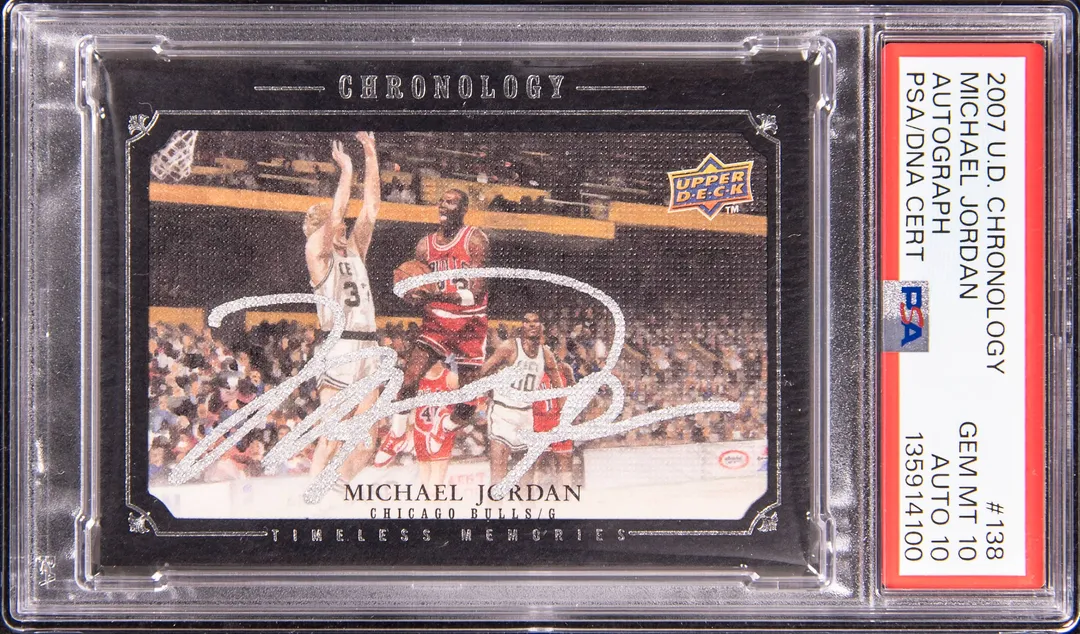
2007-08 MJ Chronology Auto PSA 10/10 Sells for $866K
Deep dive on the 2007-08 Upper Deck Chronology Michael Jordan Auto /99, PSA 10/10 (pop 2) that sold for $866,200 at Goldin on 02/08/26.
Sold Card
2007-08 Upper Deck Chronology Autograph #138 Michael Jordan Signed Card (#14/99) - PSA GEM MT 10, PSA/DNA GEM MT 10 - Pop 2
Sale Price
Platform
Goldin2007-08 Upper Deck Chronology Autograph #138 Michael Jordan Signed Card (#14/99) - PSA GEM MT 10, PSA/DNA GEM MT 10 - Pop 2 Sells for $866,200 at Goldin (02/08/26)
Michael Jordan autograph cards sit near the top of many basketball want lists, but not all MJ autos are created equal. On February 8, 2026 (UTC), Goldin sold a 2007-08 Upper Deck Chronology Autograph #138 Michael Jordan, serial numbered 14/99, graded PSA GEM MT 10 with a PSA/DNA GEM MT 10 autograph for $866,200. With a PSA population ("pop") of just 2 in this dual-GEM configuration, this result offers a useful snapshot of how high-end Jordan ink is currently being valued.
In this breakdown, we’ll look at what this card is, why Chronology matters, how this sale fits into recent price context, and what it may signal for collectors building long-term Michael Jordan collections.
Card overview: 2007-08 Upper Deck Chronology Autograph #138 Michael Jordan
Key details:
- Player: Michael Jordan
- Team: Chicago Bulls (pictured in Bulls uniform)
- Year: 2007-08
- Set: Upper Deck Chronology
- Card number: #138
- Type: Autograph card (on-card signature)
- Serial numbering: Hand-numbered 14/99
- Rookie card? No – this is a later-career/legend-focused auto, not a rookie
- Grading company: PSA
- Card grade: PSA GEM MT 10
- Autograph grade: PSA/DNA GEM MT 10
- Population: Pop 2 (only two copies with this exact dual-GEM 10 configuration in PSA’s census at the time of sale)
Upper Deck’s Chronology line is known for its clean, premium design aimed at retired greats and key stars, with a strong emphasis on on-card autographs. Unlike sticker autos, an on-card autograph means Jordan signed directly on the card surface, which many collectors consider more desirable and “personal.”
This isn’t a rookie or a core playing-days base card. Instead, it’s a numbered autograph from a high-end mid-2000s product—part of what many consider the golden era of Upper Deck’s basketball licensing.
Why 2007-08 Upper Deck Chronology matters
Chronology is often discussed in the same breath as other premium 2000s Upper Deck products. A few reasons it stands out:
Era and manufacturer
By 2007-08, Upper Deck had already produced some of the hobby’s most respected Jordan and LeBron cards. Chronology arrived in an era when UD still had an NBA license and deep access to legends, allowing them to pair strong photography with on-card signatures.Legend-focused checklist
Chronology put heavy emphasis on all-time greats. Jordan autos from this set aren’t casually inserted; they’re treated as headliners. That context matters when collectors compare this card to more routine MJ autos from mass-produced sets.On-card autograph, numbered to 99
A print run of 99 isn’t ultra-low by modern one-of-one standards, but in the context of a hard-signed Jordan auto from a premium licensed product, it’s a notably controlled supply. Once you narrow further to high-grade examples, true availability shrinks fast.A clean, autograph-first design
Chronology gives Jordan’s signature room to breathe. Collectors of Jordan autos often prioritize cards where the autograph is centered, unobstructed, and doesn’t compete with busy foil or background art. That design philosophy supports long-term collector interest.
Grading breakdown: why PSA 10 / PSA/DNA 10 matters
When we talk about “GEM MT 10,” we’re referring to PSA’s top standard grade, indicating a virtually flawless card in terms of corners, edges, surface, and centering.
This example received:
- Card grade: PSA GEM MT 10
- Autograph grade: PSA/DNA GEM MT 10
Many Jordan autos from the 2000s surface in PSA 8 or PSA 9 holders, or they may have strong card grades but no separate autograph grade. A dual GEM 10 (card and auto) significantly tightens the available supply.
The PSA population report ("pop report" – a public count of how many copies PSA has graded at each grade level) shows just 2 copies in this dual-GEM configuration. That doesn’t mean only two exist, but it does mean only two have met this standard at PSA so far.
For collectors, that combination of:
- Numbered to 99
- On-card Jordan auto
- PSA 10 card grade
- PSA/DNA 10 auto grade
- Pop 2
makes the card sit near the top tier of this specific issue.
The sale: $866,200 at Goldin on 02/08/26 (UTC)
- Auction house: Goldin
- Sale date (UTC): 02/08/26
- Realized price: $866,200 USD
Goldin regularly handles high-end Jordan, LeBron, and key vintage pieces, so seeing a rare Jordan auto in a top grade there is consistent with how the highest-end items find market.
Market context and recent sales
For a card like this, comps (short for comparables—recent sales of the same or similar item) can be tricky:
- The exact card: 2007-08 Upper Deck Chronology Autograph #138 Michael Jordan, /99, PSA 10 with PSA/DNA 10, Pop 2
- Deal size: $866,200 places it in the high-end Jordan auto tier, but below the very top of the Jordan market (like the best 1986 Fleer rookies in PSA 10 or important 1990s PMG / key exquisite pieces at record times).
From available public data across auction archives and major marketplaces:
Lower grades of the same card
- Copies in PSA 9 or BGS 9/9.5 (with strong subs but not perfect) have historically realized significantly less, often in a much lower six-figure or high five-figure range depending on timing and auction venue.
- Raw or PSA 8-level copies typically fall well below that, reflecting both card condition and softer demand at those grades.
Comparable Jordan autos from the same era
- Other 2000s Upper Deck on-card Jordan autos numbered to /50–/100, particularly from premium products, usually cluster in a broad band that runs from mid-five figures into low six figures for strong but non-top-pop grades.
- Top-pop, dual-GEM examples (PSA 10 + auto 10) tend to command a significant multiple over PSA 9s, especially when pops are in the single digits.
How this $866,200 result fits in
- This price is meaningfully above what non-GEM versions of similar cards have brought, reflecting both condition scarcity and the importance collectors place on the best-graded copies.
- It sits below the absolute record-setting Jordan pieces, which are typically earlier, more historically central issues (key rookies or groundbreaking 1990s inserts and Exquisite patches).
In other words, within the lane of mid-2000s Jordan on-card autos numbered to 99, this sale lands at the high end due to the dual-GEM 10 grading and tiny population. It doesn’t rewrite the overall Jordan market, but it reinforces a familiar pattern: the very best examples continue to stretch away from the pack.
Why collectors care about this card
Several factors make this a notable piece for Jordan-focused collectors:
Jordan plus Upper Deck, in their prime partnership window
Jordan’s long-term exclusive autograph and memorabilia relationship with Upper Deck defines a big part of his modern card catalog. Mid-2000s UD is viewed as a sweet spot: strong design, on-card signatures, and a deep retired-legend focus.On-card autograph vs. sticker autos
Many later-era MJ autos use stickers—pre-signed labels applied to cards. Chronology’s hard-signed approach is typically preferred because the signature is integrated into the design and feels more direct.Numbered to 99: accessible yet scarce
A run of 99 is large enough that collectors can realistically find one over time, but small enough to keep long-term supply tight, especially once you adjust for grading. When only 2 sit at the dual GEM 10 level, the practical supply for collectors targeting the very best is extremely limited.High-end grading as a differentiator
In an era where many Jordan autos exist, condition and eye appeal have become decisive. A PSA 10/10 example stands out not only in registry competition (where collectors track sets and best-graded examples) but also for those building tight, curated Jordan PC (personal collection) showcases.Era classification: modern, not ultra-modern
The 2007-08 season sits solidly in the “modern” category—after the 1990s insert boom and before the explosion of ultra-modern low-serial parallels and high-print-run products. That in-between nature can be attractive to collectors who want something more refined and limited than junk-wax-era cards but less chaotic than today’s parallel-heavy releases.
How this sale fits into the broader Jordan market
The Michael Jordan card market has matured into several distinct lanes:
- Flagship rookies (1984-85 Star, 1986-87 Fleer)
- Iconic 1990s inserts and parallels (e.g., PMG, Essential Credentials, Jambalaya)
- Exquisite and high-end patch autos
- On-card autograph issues like Chronology, SP Authentic, and other UD legends-driven sets
This Chronology auto clearly sits in the last lane. Within that category, the card’s appeal is boosted by:
- Clean, simple design
- On-card signature
- Numbered run
- Top-tier grading
The $866,200 result doesn’t make Chronology the new flagship of Jordan collecting, but it does:
- Reaffirm that high-end, on-card Jordan autos with top grades are treated as long-term cornerstones.
- Show continuing separation between the best-graded examples and the "middle of the pack."
For collectors tracking trends, the lesson here is less about chasing this specific pop-2 card and more about understanding how condition, scarcity, and set reputation interact in the Jordan market.
Takeaways for collectors and small sellers
Whether you’re a long-time Jordan collector or someone coming back to the hobby, a few practical points stand out from this sale:
Set quality and autograph type matter
Chronology is a respected, premium set, and the autograph is on-card. That combination is generally more favored than sticker autos from less focused products.Grading can change the tier of a card
The gap between a strong raw copy and a PSA 10/10 example can be enormous, especially when pops are in the single digits. For autograph cards, grading both the card and the signature often matters.Pop reports help explain price differences
Two cards numbered to /99 can perform very differently if one has a population of 2 in a top grade and the other has a population of 25 or 30. Checking PSA’s pop report (and, where relevant, other grading companies) is a basic step before making big decisions.Use comps as guideposts, not guarantees
This $866,200 sale at Goldin on 02/08/26 sits in a specific context: top auction venue, top grade, and low population. It’s a useful reference point, but not a promise that other copies or grades will achieve similar levels.
Final thoughts
The 2007-08 Upper Deck Chronology Autograph #138 Michael Jordan, #14/99, PSA GEM MT 10 with a PSA/DNA GEM MT 10 autograph, is a textbook example of how the hobby treats premium, modern Jordan autos at the very top of the grading scale. With only two known in this configuration at PSA and a realized price of $866,200 at Goldin on 02/08/26 (UTC), it underscores how condition, scarcity, and set reputation combine to create true modern grails.
For most collectors, this card will remain a reference point rather than a direct target. But understanding why it sold where it did can help inform decisions across the entire Jordan market—from more accessible Chronology autos to other on-card Upper Deck signatures from the same era.
If you’re mapping out your own Jordan PC, this sale is a reminder to look beyond the headline price and study the ingredients: era, set, serial numbering, autograph type, and grading. That’s where the real story—and the real collecting satisfaction—usually lives.