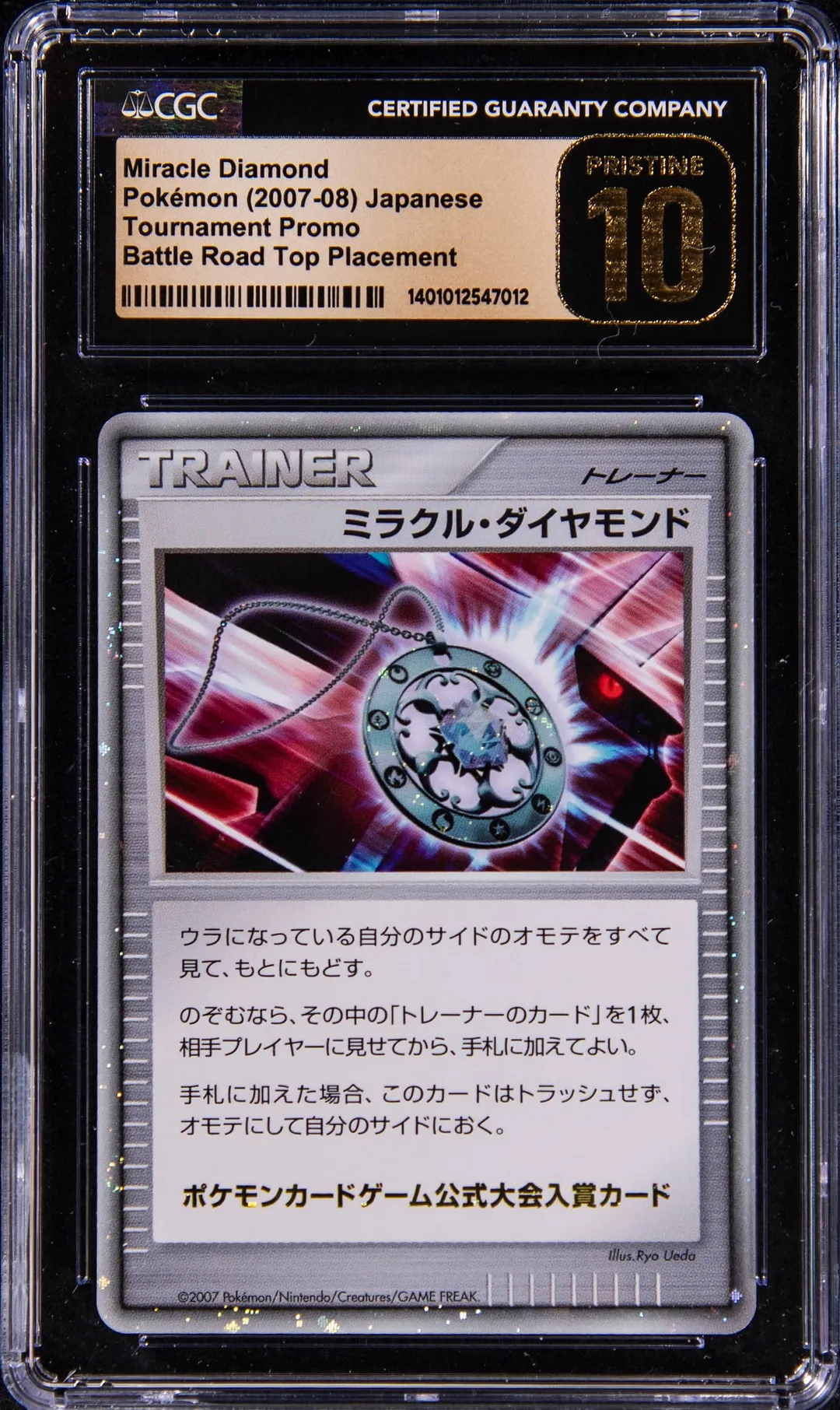
2007-08 Miracle Diamond CGC 10 Battle Road Sale
Goldin sold a CGC Pristine 10 2007-08 Miracle Diamond Battle Road promo for $37,200. A key data point for high-end Japanese Pokémon promos.
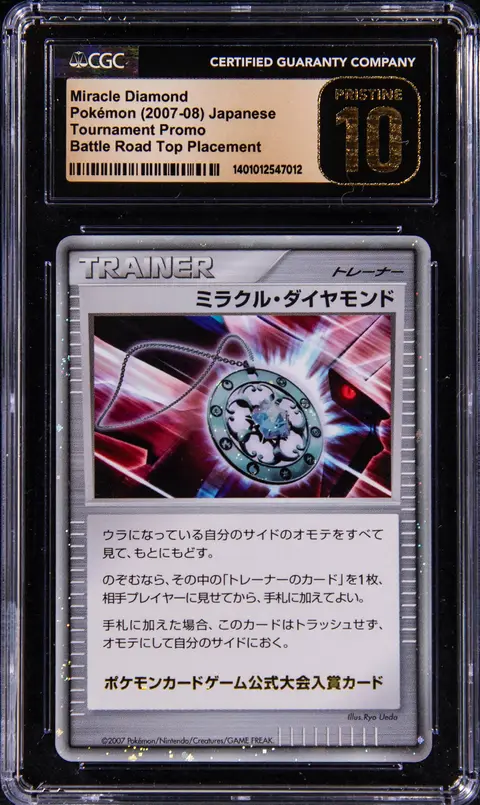
Sold Card
2007-08 Pokemon Japanese Tournament Promo Battle Road Top Placement Miracle Diamond - The Dubsy Collection - CGC PRISTINE 10 - Pop 1
Sale Price
Platform
Goldin2007-08 Pokémon Japanese Tournament Promo “Miracle Diamond” isn’t the kind of card that quietly slips through an auction.
On February 16, 2026, Goldin sold a 2007-08 Pokémon Japanese Tournament Promo Battle Road Top Placement Miracle Diamond – The Dubsy Collection – CGC PRISTINE 10 (Pop 1) for $37,200. For a niche, mid‑2000s Japanese promo, that’s a meaningful result—and an instructive one for collectors paying attention to pre-Black & White era Japanese cards.
Below, we’ll unpack what this card is, why it matters, and how this sale fits into the current market.
What exactly is this Miracle Diamond card?
Let’s break down the title piece by piece:
- Year: 2007–08
- Game: Pokémon TCG (Japanese)
- Card: Miracle Diamond (often grouped with the other “Miracle” cards, like Miracle Crystal, etc.)
- Release type: Tournament promo, specifically awarded during Battle Road events in Japan
- Event tier: Top Placement prize promo (not participation-level)
- Grading company: CGC (Certified Guaranty Company)
- Grade: Pristine 10 (CGC’s second-highest tier, just below Perfect 10)
- Population: Pop 1 in CGC’s population report (only one example in this grade at the time of sale)
- Pedigree: “The Dubsy Collection” – a named collection, which typically signals a curated, high-end group of cards with strong provenance.
This card is not a “rookie card” in the sports sense, but it is a key issue within the small, highly focused world of Japanese tournament promos from the late 2000s. Battle Road promos were awarded based on competitive performance, which naturally kept print runs low and survival rates even lower, especially in top grades.
Release background: Battle Road Top Placement promos
Battle Road was a major official tournament series in Japan, run during the Diamond & Pearl era. Prize cards from these events generally fell into two tiers:
- Participation or lower-tier promos – handed out to a wider pool of players.
- Top Placement promos – reserved for finalists or winners (often very limited and more condition-sensitive due to travel, play, and storage).
Miracle Diamond comes from this second category. While exact print numbers aren’t publicly confirmed, these cards are widely understood by collectors to be significantly scarcer than set cards or mass-market promos from the same period.
Combined with the mid-2000s timeline—long before grading and long-term storage were widespread in Japan—high-grade survivors are genuinely hard to find.
Grading, pop, and why CGC Pristine 10 matters
This copy is graded CGC Pristine 10, with a population of 1 in that grade at the time of sale.
A few quick definitions:
- Grading is the process of having a third-party company evaluate condition and encapsulate the card.
- A pop report (population report) is the census of how many copies of a specific card exist in each grade at that grading company.
In CGC’s scale:
- Gem Mint 9.5 is already an elite grade.
- Pristine 10 generally means near-flawless centering, corners, edges, and surface.
Pristine (and especially Perfect) 10s for older Japanese promos are notably tough because:
- They were often transported and handled at events.
- Many were stored casually before grading was common.
- Survivors that do surface are frequently off-center or show handling wear.
The Pop 1 status tells us that, within CGC’s ecosystem, this is currently the single best example they’ve seen. PSA and BGS may have their own top-graded copies, but within CGC’s registry, this card stands alone at the top.
Market context: how strong is $37,200?
The Goldin result came in at $37,200 on February 16, 2026.
Because this is a niche, event-only Japanese promo with a population of one at the top grade, there are very few direct, apples-to-apples comps (comparable sales). Instead, collectors look at a cluster of related market signals:
- Other Battle Road prize promos in PSA 10 / CGC 10 have increasingly drawn five-figure prices in recent years, especially for well-known art or cross-over favorites.
- Mid-2000s Japanese trophy/prize cards—while not all at the six-figure level of true “trophy Pikachus”—have shown a consistent premium over set cards, especially in top grades.
- Non-trophy, high-end Japanese promos from the same era (like certain PLAY promos and event-only cards) have moved into the mid-to-high four-figure range in top grades, with outlier examples crossing into five figures when pedigree and grade line up.
Within that context, $37,200 for a Pop 1 Pristine 10, named-collection, top-placement tournament promo positions this card toward the upper end of the non-trophy Japanese promo market, but below the true headline trophy cards.
Because public sales of this exact card in this exact grade are scarce or non-existent prior to this auction, it’s more accurate to view this as a fresh benchmark than as a continuation of a long-standing price trend.
Why collectors care about Miracle Diamond and Battle Road promos
For many Pokémon collectors, the appeal of cards like Miracle Diamond doesn’t rest on a single iconic character (like Charizard) but on a combination of:
Scarcity by design
Battle Road Top Placement prizes were never meant for mass distribution. Their small, competitively awarded print runs set a natural ceiling on supply.Competitive history
These cards are physically tied to the organized play scene of the Diamond & Pearl era, which gives them a historical footprint beyond pure nostalgia.Era positioning (mid-2000s)
The 2007–08 window sits between early WotC-era nostalgia and modern, heavily produced ultra-modern sets. Many collectors see this as an underexplored, under-printed stretch of the hobby.Condition scarcity
Even when raw copies turn up, they often miss top grades. Cards that were actually earned and transported at events tend to show wear.Pedigree
The “Dubsy Collection” tag matters to some collectors, similar to how named collections in comics or coins can command extra attention and confidence in provenance.
How this sale fits into the broader market
For context, the Pokémon market in the mid‑2020s has been characterized by:
- A cool-down from 2020–21 peak pricing, followed by more selective strength in scarce, historically important cards.
- Greater segmentation between mass-printed, easily accessible cards and genuinely rare or competition-only releases.
- Growing respect for Japanese promos and prize cards, especially as the English side of the market has matured and collectors look deeper.
This Miracle Diamond sale lines up with a few clear themes:
High-end buyers are focusing on true scarcity, not just nostalgia
A card like this doesn’t benefit from mainstream character recognition the way a Charizard or Pikachu trophy card might. The price instead reflects structural rarity (Battle Road, Top Placement, mid-2000s) and grade scarcity (CGC Pristine 10 Pop 1).Grade premiums are very real at the top
Within Japanese promos, the difference between a strong 9, a gem 9.5/10, and a Pristine 10 can be dramatic. This sale underscores how aggressively the market can value a true top-pop example.Non-PSA ecosystems are maturing
While PSA still commands the most attention, this result shows that CGC-labeled population leaders—especially with a named pedigree—can attract serious bidding.
What this might signal for collectors
None of this is financial advice, but as collectors and small sellers look at this sale, a few practical takeaways stand out:
- Documented rarity and provenance matter. Tournament promos with clear event ties and limited print runs continue to distinguish themselves from mass-produced chase cards.
- Data on comps will be thin for niche promos. You’ll often be triangulating from nearby cards (similar events, similar eras, similar grades) rather than finding a perfect past match.
- Condition is king for mid-2000s Japanese promos. If you’re chasing these cards, centering, edges, and surfaces should be scrutinized carefully before grading.
- Auction house selection can affect visibility. A card like this going through Goldin, rather than an obscure venue, likely put it in front of the right cross-section of high-end Pokémon and alternative-asset collectors.
Final thoughts
The 2007-08 Pokémon Japanese Tournament Promo Battle Road Top Placement Miracle Diamond – CGC Pristine 10 (Pop 1) sale at Goldin on February 16, 2026 for $37,200 is a clean example of where serious Pokémon money is flowing in the mid‑2020s: toward structurally scarce, historically anchored, top-of-population cards.
For newer or returning collectors, this card is a reminder that not all high-end Pokémon value is concentrated in the same handful of characters or sets. Event-only Japanese promos—especially from the relatively lean print years of the mid‑2000s—continue to carve out their own lane.
As more of these Battle Road and similar prize cards surface in high grades, results like this Miracle Diamond will serve as useful reference points for understanding how the market prices rarity, grade, and provenance in a segment where hard data is still emerging.