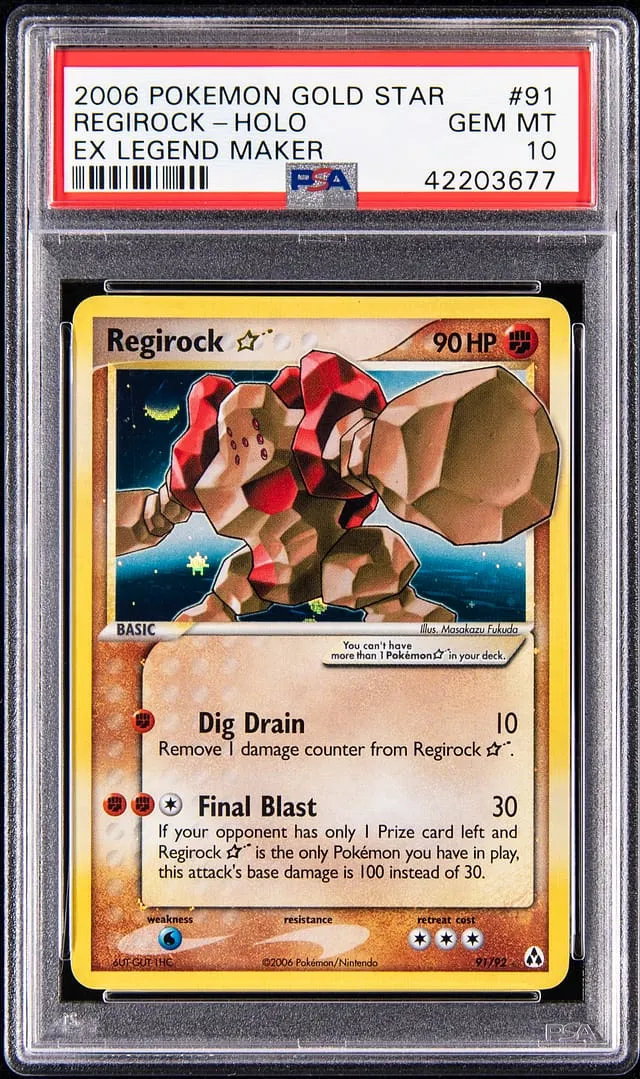
2006 Gold Star Regirock PSA 10 sells for $14,640
Goldin sold a 2006 Pokémon EX Legend Maker Gold Star Regirock PSA 10 for $14,640. See how this result fits the EX-era Gold Star market.
Sold Card
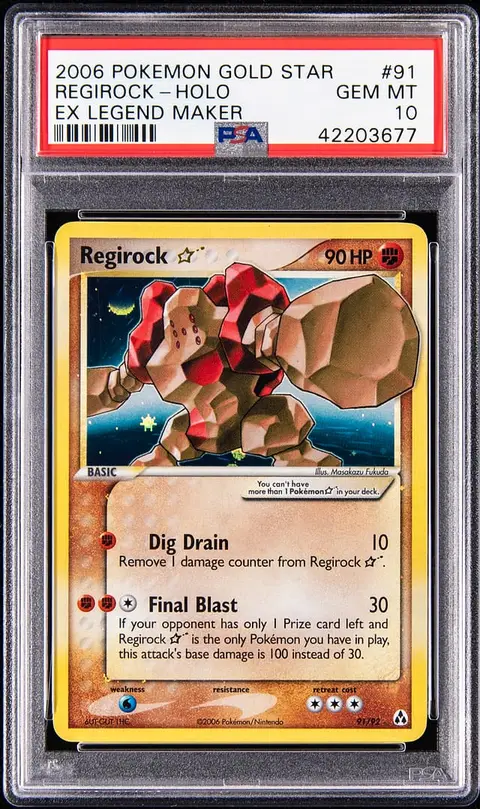
2006 Pokemon EX Legend Maker Gold Star Holo #91 Regirock - PSA GEM MT 10
Sale Price
Platform
Goldin2006 Pokémon EX Legend Maker Gold Star Holo #91 Regirock (PSA GEM MT 10) Just Sold for $14,640
On April 20, 2026, Goldin auctioned a key mid-2000s Pokémon card: a 2006 Pokémon EX Legend Maker Gold Star Holo #91 Regirock, graded PSA GEM MT 10, which closed at $14,640.
For collectors who track the Gold Star era closely, this is a meaningful data point for one of the tougher Hoenn legendaries in top grade.
The card at a glance
- Card: 2006 Pokémon EX Legend Maker Gold Star Holo Regirock
- Set: EX Legend Maker (English)
- Card number: #91
- Parallel/variant: Gold Star (shiny, alternate-color artwork)
- Character: Regirock (Legendary Pokémon from Generation III)
- Release era: EX Series / mid‑2000s (often treated as “post‑WotC vintage” by many collectors)
- Grading company: PSA (Professional Sports Authenticator)
- Grade: GEM MT 10 (their highest standard grade)
- Special attributes: Gold Star rarity, holofoil, non-serialized but low supply in high grade
- Auction house: Goldin
- Sale date (UTC): 2026‑04‑20
- Sale price: $14,640
This is not a rookie card in the sports sense, but it is a key issue for Regirock. Within the hobby, Gold Stars are widely treated as the premium chase cards of the EX era, and EX Legend Maker is one of the more respected mid‑2000s sets.
Why Gold Star Regirock matters
The Gold Star concept
“Gold Star” cards were a short‑printed, high‑difficulty pull type in the mid‑2000s Pokémon TCG. They are instantly recognizable by the small gold star next to the Pokémon’s name and the shiny, often alternate‑color artwork.
Collectors care about Gold Stars because:
- They were notably hard to pull, even by chase-card standards at the time.
- Many feature shiny or alternate‑color Pokémon, which overlap with shiny hunting culture from the video games.
- The EX era had lower production than modern sets, so sealed product is scarcer and raw copies are harder to source in clean condition.
Regirock shares this Gold Star status with its counterpart legendaries Regice and Registeel in EX Legend Maker, forming a three‑card legendary trio that completionists often chase together.
Set context: EX Legend Maker (2006)
EX Legend Maker is a 2006 English set from the EX era. While it doesn’t have the mainstream fame of EX Deoxys or EX Team Rocket Returns, it is well‑regarded because:
- It sits in a lower‑print, transitional window between classic WotC sets and the high‑print contemporary era.
- Its chase cards (including the Gold Star Regis) have proven sticky collector demand over time.
- Condition-sensitive holofoil and age make true gem‑mint copies harder to find.
For many returning collectors, EX Legend Maker is a nostalgia set from childhood, but for newer hobbyists it’s now old enough to feel “semi‑vintage.”
Population and grading: why PSA 10 matters
When collectors talk about a "pop report", they mean the grading company’s population report: how many copies of a specific card exist in each grade.
For EX‑era Gold Stars, the population curve typically looks like this:
- A modest overall graded population (relative to modern ultra‑modern sets)
- A much smaller slice in PSA 10 due to surface scratching, edge wear, and print defects common to the era
For Gold Star Regirock specifically, PSA 10s represent only a fraction of total graded copies. The card’s dark background and holofoil make small flaws more visible, which naturally caps the number of gem‑mint examples.
So when we see a PSA GEM MT 10 selling, we’re really looking at the top of the supply pyramid for this card.
Recent sales and price context
In the trading card world, “comps” are comparable recent sales: what similar cards have actually sold for, not what people are asking.
For Gold Star Regirock, recent comps (across major marketplaces and auctions) show a familiar pattern:
- PSA 9 copies: have tended to sell at a clear discount to 10s, reflecting the usual premium for top grade.
- Raw (ungraded) copies: vary widely based on condition. Centering, surface scratching, and edge whitening have a major impact.
- PSA 10 copies: when they appear, they attract strong bidding from set collectors and Gold Star specialists.
Within that context, the $14,640 realized at Goldin on April 20, 2026, sits in the upper range of what collectors have been willing to pay for top‑grade Legend Maker Gold Stars. It reflects:
- The scarcity of PSA 10 examples
- Ongoing demand for EX‑era Gold Stars as a defined, widely recognized chase segment
- The appeal of completing the Regi trio in high grade
It is useful to think of this sale as part of a longer‑term pricing band rather than an isolated outlier. EX Gold Stars have shown periods of strong appreciation followed by consolidation; this price fits into that broader pattern rather than breaking completely new ground.
How this sale fits into the broader Gold Star market
Over the last few years, the market has settled into some informal tiers for Gold Stars:
- Top iconic characters (Charizard, Rayquaza, Umbreon, etc.)
- Second‑tier favorites and legendaries (Mew, Espeon, certain dogs and birds)
- Thematically important or set‑anchoring cards like the Regi trio
Regirock typically lives in Tier 3 by character popularity but benefits from:
- Being part of a thematic trio (Regirock, Regice, Registeel)
- A well‑regarded EX set
- A visually distinct, era‑defining Gold Star template
This means that while Regirock may not command the absolute highest Gold Star prices, it still sees strong, steady demand from:
- Set builders trying to finish EX Legend Maker in high grade
- Gold Star specialists assembling full Gold Star runs
- Collectors who grew up during the Hoenn era and focus on those legendaries
The $14,640 result reinforces the idea that even outside the top two or three Gold Star names, high‑grade examples can sit at a premium level when supply is as tight as it is here.
Market drivers to keep in mind
A few broader trends help explain why this card continues to matter:
EX era re-evaluation
As modern print‑to‑demand sets have grown, more collectors have moved backwards into eras where sealed product is genuinely scarce. The EX era sits in that sweet spot—old enough to feel established, but still relatively accessible compared with early WotC grails.Shiny and alternate‑color appeal
As the video games continue to highlight shiny hunting and alternate forms, cards that visually capture that concept—like Gold Stars—retain a built‑in appeal for both card and game fans.Grading scarcity at the top
The PSA GEM MT 10 label is still viewed as a meaningful differentiator for mid‑2000s holos. Each confirmed strong auction sale helps anchor expectations for what collectors are willing to pay for true top‑end copies.
It’s also worth noting what this sale doesn’t represent: it is not a speculative rocket based on short‑term hype around Regirock. Instead, it looks more like a continuation of an established pattern—focused, informed collectors competing over a rare, known quantity.
Takeaways for collectors and small sellers
For collectors considering this card or similar EX‑era Gold Stars, this sale highlights a few practical points:
- Condition inspection matters: Small surface scratches and edge wear are common on EX‑era holos. When raw, these often mean the difference between a mid‑grade and a true 9 or 10.
- Grade gaps are meaningful: The price spread between PSA 9 and PSA 10 is substantial. If you are buying raw with grading in mind, it’s useful to be realistic about how hard a true 10 is to achieve.
- Set and trio dynamics add demand: Cards that anchor a set or complete a trio—like Regirock alongside Regice and Registeel—often perform better than character popularity alone would suggest.
For small sellers, this Goldin result is a relevant benchmark rather than a guaranteed target:
- It demonstrates that authenticated, top‑grade copies can achieve five‑figure prices in the right auction environment.
- It also underscores the importance of accurate grading; buyers at this level are typically focused on certification and population data.
Where this leaves Gold Star Regirock
The April 20, 2026 Goldin sale of a 2006 Pokémon EX Legend Maker Gold Star Holo #91 Regirock – PSA GEM MT 10 for $14,640 is another confirmation that:
- EX‑era Gold Stars remain a firmly established high‑end segment of the Pokémon market.
- Even outside the most iconic names, PSA 10 Gold Stars can command meaningful premiums.
- Population scarcity in true gem mint continues to drive competition when a clean copy surfaces at auction.
For collectors tracking mid‑2000s Pokémon, this sale is a helpful reference point—one more data‑rich comp to add to the long‑term picture of how EX Legend Maker and the Gold Star archetype continue to be valued over time.
At figoca, we follow these kinds of sales so you don’t have to sift through every auction result yourself. Watching how cards like Gold Star Regirock behave in the market helps build a clearer, more grounded view of where the EX era sits today—and where attention from collectors continues to concentrate.