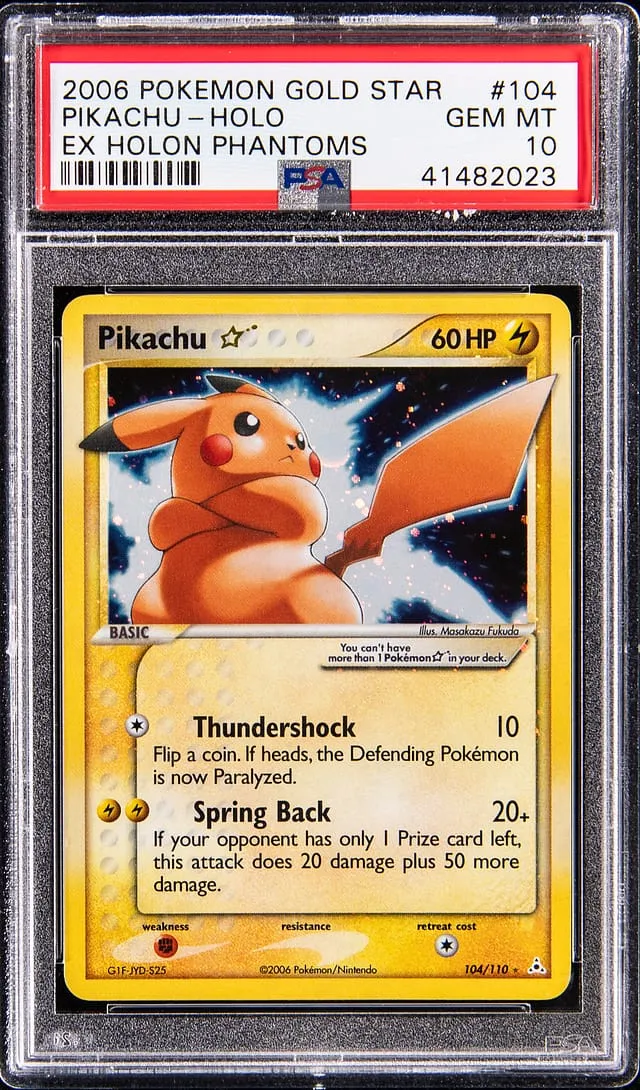
2006 Gold Star Pikachu PSA 10 sells for $93,940
Breakdown of the 2006 EX Holon Phantoms Gold Star Pikachu PSA 10 sale for $93,940 at Goldin on April 20, 2026, and what it means for collectors.
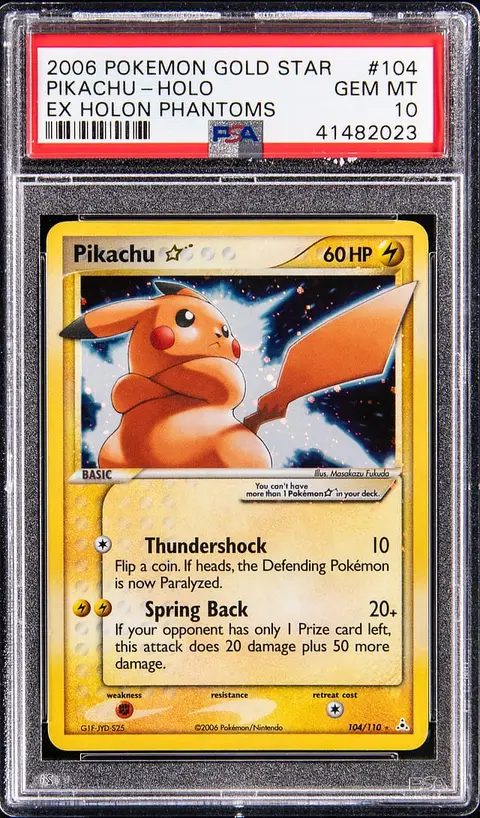
Sold Card
2006 Pokemon EX Holon Phantoms Holo #104 Gold Star Pikachu - PSA GEM MT 10
Sale Price
Platform
GoldinWhen a Gold Star Pikachu in a PSA 10 surfaces, collectors pay attention. On April 20, 2026, Goldin sold a 2006 Pokémon EX Holon Phantoms Holo #104 Gold Star Pikachu graded PSA GEM MT 10 for $93,940.
This sale gives us a useful reference point for one of the hobby’s most recognizable Pikachu chase cards.
Card overview: 2006 EX Holon Phantoms Gold Star Pikachu
Let’s break down exactly what this card is:
- Character: Pikachu (Gold Star variant)
- Year: 2006
- Set: EX Holon Phantoms (English release)
- Card number: #104
- Rarity / parallel: Gold Star (shiny Pokémon, special rarity tier)
- Holo: Yes
- Manufacturer: The Pokémon Company / Nintendo
- Era: EX era (mid‑2000s, often seen as a key transitional period between WotC and modern)
- Grading company: PSA (Professional Sports Authenticator)
- Grade: GEM MT 10 (PSA’s highest standard grade)
Gold Star Pikachu from EX Holon Phantoms is not a rookie card in the traditional sports sense, but it is widely seen as a key issue for Pikachu collectors and for EX-era set builders. Gold Stars were short-printed chase cards, featuring shiny Pokémon with the signature gold star next to their name.
Why this card matters to collectors
1. Gold Star status
Gold Star cards sit near the top of many Pokémon want‑lists. They were intentionally difficult pulls from EX‑era packs, and they feature alternate-color (shiny) versions of popular Pokémon.
Pikachu’s Gold Star is important because:
- Pikachu is the franchise mascot and a core character for both casual fans and dedicated collectors.
- Gold Star Pikachu appears in a well-regarded EX set rather than a promo or side product.
- The card’s artwork and shiny coloration make it easy to recognize even across a binder page or display.
2. EX Holon Phantoms: a respected mid‑2000s set
EX Holon Phantoms (released 2006) is part of the EX era, sandwiched between early Wizards of the Coast (WotC) sets and later modern releases.
Collectors care about this set because:
- It was printed in lower quantities than many modern sets, making sealed product hard to find.
- It includes multiple Gold Stars and a strong lineup of EX cards.
- Holon‑themed sets have a distinct identity, which tends to age well with collectors who like building complete runs of a specific era.
3. PSA 10 scarcity
A PSA pop report (population report) is PSA’s public count of how many copies of a card exist in each grade. For mid‑2000s EX sets, high-end grades are not easy:
- Centering and print quality can be inconsistent.
- Edges and corners are prone to whitening, especially on darker borders.
- Many copies were handled and played before grading was common.
While exact, current population numbers can change as more cards are graded, Gold Star Pikachu in PSA 10 has historically been a low‑population card relative to overall demand for Pikachu and Gold Stars. That combination—popular character plus tough grade—underpins prices at the top of the market.
Market context: how does $93,940 fit in?
This Gold Star Pikachu sold at Goldin on April 20, 2026, for $93,940.
To put that in context, we can look at:
- Recent comps – “Comps” are comparable recent sales of the same card or very close variations (for example, the same card in different grades). These give a real‑world sense of the current range collectors are actually paying, rather than list prices.
- Grade tiers – The same card in PSA 9, PSA 8, and ungraded condition, to see how pricing increases with condition.
- Historical highs – Past notable public auctions.
For high-end cards like Gold Star Pikachu in PSA 10, verified public sales are relatively infrequent. Over the last few years, auction results have shown a wide range depending on:
- Market sentiment at the time (strong bull runs vs. quieter periods)
- Auction house, marketing, and timing
- Whether multiple serious bidders were active in the same sale
Within that context, a realized price of $93,940 sits in the upper tier of known public sales for this card in PSA 10, but it is consistent with the broader pattern for top‑grade Gold Stars featuring marquee characters. It reflects both the scarcity of PSA 10 copies and ongoing demand for EX‑era trophy pieces.
Lower grades (PSA 8–9) typically trade at a significant discount to PSA 10s, illustrating how much of the value is driven by that final step to a gem mint grade. Raw (ungraded) copies tend to occupy a much wider price range depending on condition risk.
Because the market has cooled and stabilized compared to peak‑hype years, this auction result is useful as a current reference point rather than an outlier spike.
Why this sale matters for the broader Pokémon market
1. Signal from a mature segment
EX‑era Gold Stars are not ultra‑modern chase cards riding short‑term hype. They sit in what many consider a more mature segment of the Pokémon market:
- Supply is largely known; sealed product is scarce.
- Many high‑grade copies are already in long‑term collections.
- Demand is driven by character and era nostalgia rather than only the newest release cycle.
A nearly six‑figure sale for Pikachu Gold Star in PSA 10 at Goldin signals that collectors continue to place strong value on established, historically important chase cards.
2. Pikachu as a long‑term anchor
Pikachu cards—especially key issues like Gold Stars, early WotC holos, and major promos—often act as an anchor for the franchise:
- They attract both character collectors and high‑end set builders.
- They help define price structure for other cards in the same set or tier.
When a flagship Pikachu performs well at auction, it often reinforces the perceived importance of that era and rarity pattern across the market.
3. PSA 10 premiums and condition sensitivity
This sale also highlights how sharply prices can curve upward at the very top of the grading scale:
- The jump from PSA 9 to PSA 10 can be many multiples, not just a small step.
- That premium is driven by the combination of low population and collector preference for “best available” copies, especially for display pieces.
For newer or returning collectors, it’s a reminder that:
- Eye appeal matters – Centering, holo scratches, and edges can dramatically affect value.
- Grade distribution is not linear – There may be plenty of PSA 7–8 copies but very few true gem mint examples.
Takeaways for collectors and small sellers
If you collect or sell Pokémon cards, here are some practical lessons from this sale:
- Know your key issues. Within any era, there are cards that act as benchmarks. For EX Holon Phantoms, Gold Star Pikachu is one of those benchmarks.
- Check comps across grades. Don’t just look at PSA 10 sales. Compare 8s, 9s, and raw copies to understand how condition translates to price.
- Use auction results as reference, not guarantees. A single high or low sale doesn’t define a permanent value, but it does give a grounded data point for negotiations and listing decisions.
- Understand era dynamics. Mid‑2000s EX cards combine older print runs with more modern design. That mix often means fewer high‑grade survivors than newer sets.
Final thoughts
The April 20, 2026 Goldin sale of the 2006 Pokémon EX Holon Phantoms Holo #104 Gold Star Pikachu in PSA GEM MT 10 at $93,940 underscores how established chase cards from the EX era continue to command serious attention.
For collectors, it’s another data point confirming the long‑term significance of Gold Star Pikachu as a centerpiece card. For small sellers and newer hobbyists, it’s a reminder that understanding set history, rarity tiers, and grading can dramatically change how you view the cards in your own boxes and binders.
As more sales surface and the market continues to mature, tracking results like this helps build a clearer, more realistic picture of where high‑end Pokémon cards sit today.