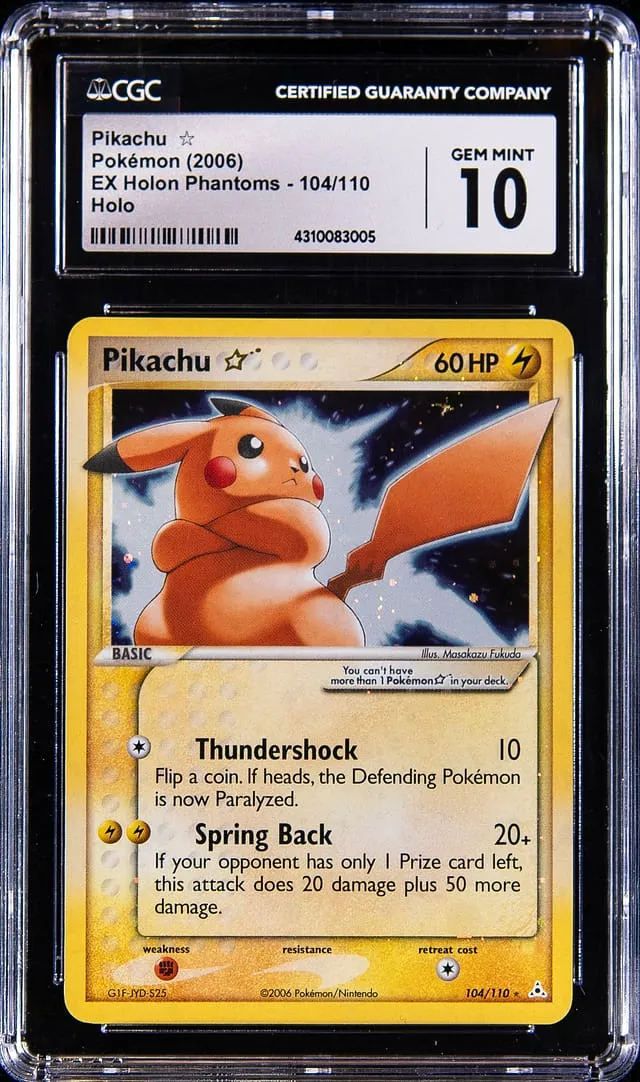
2006 Gold Star Pikachu CGC 10 sells for $22,570
A 2006 EX Holon Phantoms Gold Star Pikachu CGC Gem Mint 10 sold for $22,570 at Goldin. Here’s what it means for EX-era Pokémon collectors.
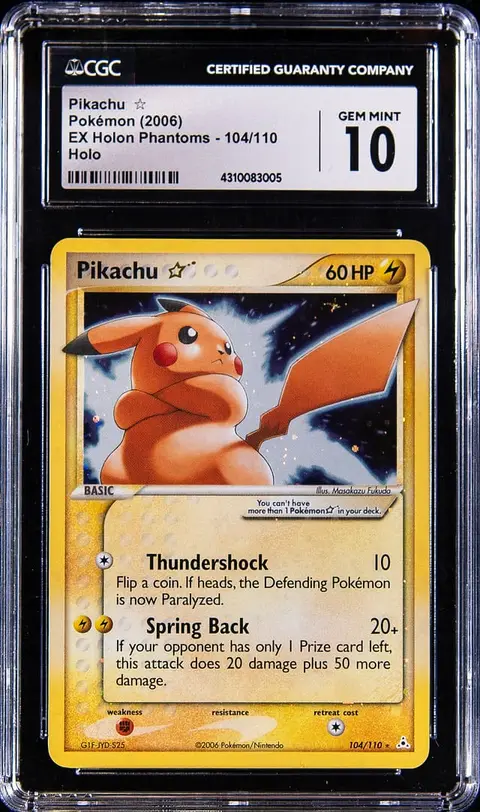
Sold Card
2006 Pokemon EX Holon Phantoms Holo #104 Gold Star Pikachu - CGC GEM MINT 10
Sale Price
Platform
Goldin2006 Pokémon EX Holon Phantoms Gold Star Pikachu CGC 10 Sells for $22,570
On March 30, 2026, a 2006 Pokémon EX Holon Phantoms Holo #104 Gold Star Pikachu graded CGC Gem Mint 10 closed at $22,570 via Goldin. For a card from the mid‑2000s era, this result reinforces how strongly collectors continue to value Gold Star Pikachu as a key, high‑end vintage‑adjacent chase.
In this breakdown, we’ll look at what the card is, why it matters, and how this sale fits into recent market data.
Card overview
- Character: Pikachu
- Year: 2006
- Set: EX Holon Phantoms (English)
- Card: Gold Star Pikachu, set number #104 (secret rare)
- Foiling: Holo
- Subset: Gold Star (shiny Pokémon, alternate color)
- Rarity: Secret rare, limited pull rate from hobby product
- Era: EX-era / mid‑2000s (often grouped with late “vintage” or early “modern”)
- Grading company: CGC
- Grade: Gem Mint 10
- Attributes: No autograph, no serial number, but a notoriously tough card to find in top grade due to EX-era print and condition issues.
This is not a rookie card in the sports sense, since Pikachu predates 2006 by many years. Instead, it’s viewed as a key issue: an important, premium version of one of the hobby’s flagship characters.
What makes Gold Star Pikachu important?
1. Gold Star status
Gold Star cards were a limited subset in several EX-era Pokémon sets. They depict shiny (alternate-color) Pokémon with a small gold star next to the name. Pull rates were extremely low relative to the rest of the set, which created a natural scarcity.
Among Gold Stars, Pikachu stands out because:
- It’s the hobby’s mascot and one of the most globally recognizable characters.
- Holon Phantoms is a well‑regarded EX-era set with multiple popular Gold Stars.
- Condition sensitivity (edge chipping, print quality, holo scratching) makes high‑grade copies genuinely hard to source.
2. EX Holon Phantoms set context
EX Holon Phantoms (2006) belongs to the EX-era run that many collectors view as a bridge between classic WotC vintage (Base–Neo) and modern Pokémon.
For collectors returning to the hobby, Holon Phantoms often falls into a nostalgic sweet spot:
- Older enough to feel scarce compared to today’s large print runs.
- Newer enough that sealed product and graded copies still surface with some regularity, but at a premium.
Within the set, Gold Star Pikachu (#104) is one of the main chase cards. When collectors talk about “chase” or “hit” cards, they’re referring to the most desirable pulls from a product—the ones people buy boxes hoping to hit.
3. Grade scarcity and CGC Gem Mint 10
While specific population report numbers can change over time, patterns are consistent:
- Gold Star Pikachu has a relatively low population in true gem grades (PSA 10, BGS 9.5/10, CGC 10) compared to how many collectors would like to own one.
- Many raw (ungraded) copies show whitening, print lines, or holo scratching, limiting their ceiling in grading.
CGC’s Gem Mint 10 is a strict grade. For some EX-era cards, it can be a bit more difficult to achieve than a typical PSA 10, which matters to collectors who track condition deeply.
Market context and recent sales
This Goldin result at $22,570 on March 30, 2026 sits within a broader trend of high‑end EX-era cards stabilizing after the sharp post‑2020 run‑up and subsequent cooling.
Because realized prices move over time, it’s more useful to think in ranges and context rather than exact comp-by-comp guarantees.
How this sale compares
Looking at recent public auction data and marketplace listings for:
This exact card and grade:
CGC 10 Gold Star Pikachu sales have been limited, which is important. Low transaction counts mean each sale can move the perceived market more than if there were weekly comps. When similar CGC 10 copies have come up, they’ve tended to land in a high four‑figure to low five‑figure range, with strong examples and good auction visibility pushing higher.Neighboring grades and grading companies:
- PSA 10 examples have historically led the way in price, followed by BGS and then CGC, but the spread between grading companies has tightened in some segments, especially when the underlying card is scarce in any gem grade.
- PSA 9 / BGS 9.5 / CGC 9 copies generally transact at a noticeable discount to true gems, reflecting how condition‑sensitive this card is at the top end.
Within that context, $22,570 is on the strong side for this card in CGC 10, aligning it more with premium outcomes seen when:
- The auction is run by a major house (in this case Goldin).
- The card has eye‑appeal consistent with the grade.
- Timing lines up with broader confidence in high‑end Pokémon.
Record or not?
This sale is competitive with other strong public results for high‑grade Gold Star Pikachu, though the all‑time top prices for the card have typically been associated with PSA 10 examples during peak Pokémon cycles.
Rather than focusing on whether this is a record, the takeaway is that the card continues to command:
- A clear five‑figure level in elite grade.
- Healthy bidding interest in a market that is more selective than it was at the height of the 2020–2021 boom.
Why collectors care right now
Several steady factors support interest in this card:
- Iconic character: Pikachu is central to the brand and resonates across age groups, languages, and regions.
- EX-era nostalgia: Many collectors who grew up with EX-era sets are now in their prime earning years, revisiting the cards they couldn’t afford to chase as kids.
- Set and subset prestige: Holon Phantoms and Gold Stars in general have become recognized pillars of the Pokémon hierarchy, alongside Base Set holos and early Neo chase cards.
- Grade scarcity: Top‑graded examples remain thinly traded; each confirmed gem on the market has a ready audience.
There hasn’t been a single news event—like a major anniversary or Pokémon media release—that fully explains this specific sale. Instead, the result looks like the outcome of:
- A historically important card.
- In a premium grade.
- Exposed on a major platform (Goldin) to serious Pokémon buyers.
Takeaways for collectors and small sellers
If you’re new or returning to the hobby, here’s how to frame this sale:
Understand tiers: High‑end Gold Star Pikachu in gem grades (PSA/BGS/CGC) sit in a completely different tier than played raw copies or mid‑grades. The price difference reflects both condition and long‑term collector demand for top‑shelf examples.
Use comps carefully: “Comps” means comparable recent sales used as reference points. For thinly traded cards like this, a single strong or weak result shouldn’t be treated as a hard benchmark, but it does give a data point for the current appetite at the top end.
Focus on condition: With EX-era holos, centering, edges, surface scratches, and silvering all matter. Even small defects can move a copy from gem territory into a very different price band.
Know your grading lanes:
- If you’re collecting for long‑term enjoyment, any reputable grader is fine—choose the aesthetic and price point you like.
- If you’re more market‑oriented, it’s worth checking population reports (public counts of graded copies by grade) and recent sales to see how each label performs for a given card.
Final thoughts
The March 30, 2026 Goldin auction of a 2006 Pokémon EX Holon Phantoms Holo #104 Gold Star Pikachu – CGC Gem Mint 10 at $22,570 underlines how stable demand has been for cornerstone EX-era chase cards.
For serious Pikachu or Gold Star collectors, this sale reaffirms that top‑graded copies remain firmly in the high‑end category. For everyone else, it’s a useful reference point: a clear, recent, public data point showing where one of the hobby’s most recognizable EX-era cards currently sits in the market.
As always, it’s best to use sales like this as context, not as a promise of where prices will go next. But in terms of significance, this Goldin result keeps Gold Star Pikachu exactly where many collectors have long seen it: near the top of the EX-era pyramid.