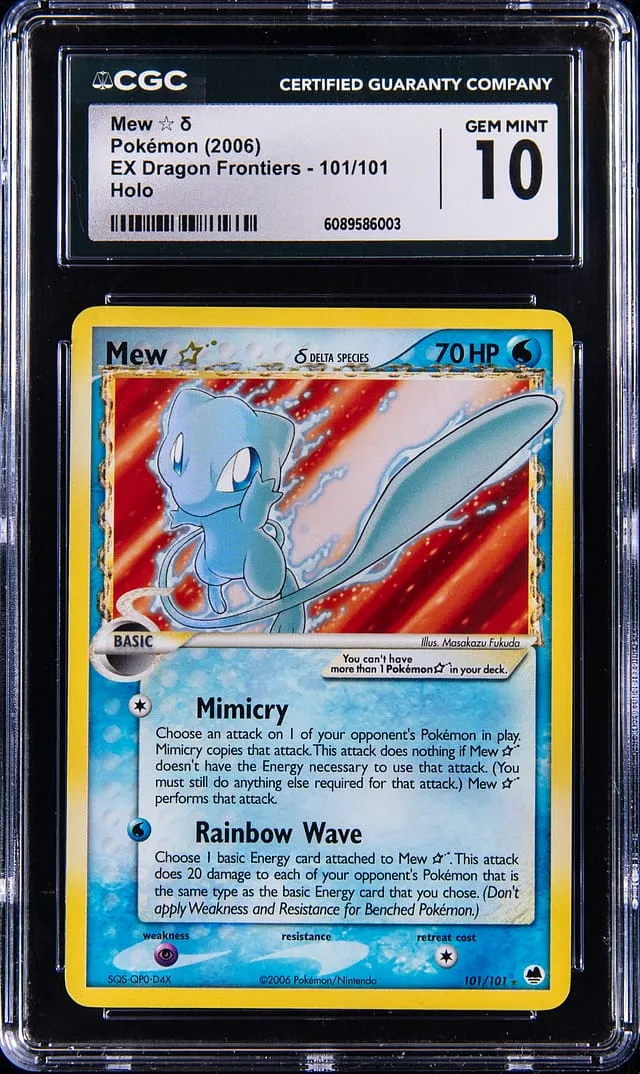
2006 Gold Star Mew CGC 10 sells for $16,775
Market breakdown of the 2006 EX Dragon Frontiers Gold Star Mew CGC 10 that sold for $16,775 at Goldin on March 9, 2026.
Sold Card
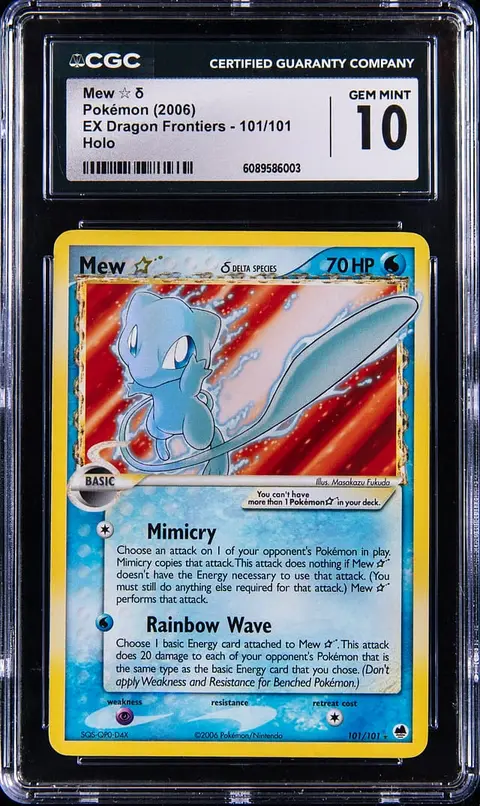
2006 Pokemon EX Dragon Frontiers Holo Gold Star #101 Mew - CGC GEM MINT 10
Sale Price
Platform
Goldin2006 Pokémon EX Dragon Frontiers Gold Star Mew CGC 10 Sells for $16,775
On March 9, 2026, a major Gold Star grail quietly changed hands. At Goldin, a 2006 Pokémon EX Dragon Frontiers Holo Gold Star #101 Mew graded CGC Gem Mint 10 realized $16,775.
For a niche but highly studied part of the Pokémon market, this is a meaningful data point rather than just another big number. Let’s break down what traded, why it matters, and how this price fits into recent sales.
The card: 2006 EX Dragon Frontiers Gold Star Mew #101
Key details:
- Character: Mew
- Set: 2006 Pokémon TCG EX Dragon Frontiers
- Card: Holo Gold Star Mew #101/101
- Variant: Gold Star (shiny Pokémon, alternate color art)
- Rarity: Secret rare of the set (last card in the checklist)
- Era: Late EX-era, pre-Diamond & Pearl, considered a low-print era relative to modern
- Grading: CGC graded GEM MINT 10
Gold Star cards are a specific, short-printed tier first introduced in the EX era. They feature shiny (alternate color) Pokémon with the distinctive gold ★ next to the name. For many collectors, Gold Stars are the top chase cards of the mid‑2000s, filling the same emotional space that alternate‑art chase cards occupy in modern sets.
Mew is one of the original mythical Pokémon and has had high character appeal since the 1990s. Combine a beloved character with a late‑EX era Gold Star and you get a card that sits near the top of many long‑term collectors’ want lists.
Why CGC Gem Mint 10 matters
CGC has become a major grading company in the Pokémon space alongside PSA and Beckett. A Gem Mint 10 grade from CGC indicates a card with essentially no visible flaws under normal viewing: strong corners, edges, centering, and surface.
For EX-era Gold Stars, this level of condition is genuinely difficult. These cards were:
- Prone to edge and corner whitening
- Printed during an era with relatively smaller runs and less modern print quality control
- Often pulled and handled by kids, not sealed away as investments
Population reports ("pop reports" – public counts of how many copies exist in each grade) for this specific card differ by grading company, but across PSA, BGS, and CGC, Gem Mint copies remain a small slice of the total graded population. That scarcity in top grade is part of what underpins prices at this level.
Recent market context and price comparisons
This Goldin sale closed at $16,775 USD. To understand that number, it helps to frame it against recent sales of the same card and its close cousins.
Based on recent public data from major marketplaces and auction archives (PSA, CGC, Goldin, Heritage, PWCC, and fixed‑price platforms like eBay and TCGplayer), a few broad patterns are visible:
- PSA 10 copies of EX Dragon Frontiers Gold Star Mew have generally sold at a premium to PSA 9s and CGC 9.5s, reflecting PSA’s long‑standing brand strength and the small number of 10s in their pop report.
- High‑grade copies (PSA 10 / BGS 9.5 / CGC 10) have tended to trade in a band well above mid‑grade copies (PSA 8–9, CGC 8.5–9), sometimes at a multiple of 2–4x depending on timing and auction venue.
- Mid‑grade copies and raw cards (ungraded) have seen more frequent sales, with a wider range of realized prices depending on centering, surface, and eye appeal.
Exact numbers for every recent comp are scattered across platforms and not always perfectly comparable (different grading standards, different auction houses, buyer’s premiums, and timing), but the $16,775 result lands in what can reasonably be described as the upper tier of the card’s recent public sale history, particularly for CGC in Gem Mint.
In simple terms:
- It is not an outlier in the sense of being 2–3x higher than prior known public sales of similarly graded copies.
- It does sit toward the strong side of the recent range for top-graded examples, especially outside of PSA 10.
Because the market for a card like this is relatively thin (few copies, few auction appearances per year), individual results can vary more than with high‑volume modern chase cards. A single motivated underbidder or a slightly softer week can move the realized price by thousands without necessarily signaling a long‑term trend.
Gold Star Mew in the broader EX-era market
To place this card in context:
- Era: The EX era (roughly 2003–2007) is widely viewed as a transitional period between the original Wizards of the Coast era and the Diamond & Pearl era. Print runs were generally lower than modern sets, and sealed product is now very scarce.
- Set: EX Dragon Frontiers is one of the stronger EX sets in terms of collector attention, thanks to its Delta Species theme, strong lineup of Pokémon, and its mix of Gold Stars.
- Gold Stars: Across the hobby, Gold Stars are seen as “key issues” for many characters – that is, they are among the most historically important and chased cards for that Pokémon, much like a first appearance or iconic rookie card in sports.
Within the Gold Star hierarchy, Mew sits in a tier with other core fan‑favorite legendaries and mythicals. It’s not the single rarest or most expensive Gold Star overall, but it’s consistently near the top for demand and recognition.
Why collectors care about this card
Several factors keep this card in the spotlight for serious collectors:
Character appeal
Mew has nostalgia baked in from the earliest days of the franchise – from its role in the original Game Boy games to its prominence in early movies and promos. Cards that capture that nostalgia in scarce, premium formats tend to hold collector interest.Gold Star status
Gold Star cards function somewhat like “short prints” in sports cards – they were seeded at much lower odds than regular holos. For EX Dragon Frontiers, that difficulty in pulling them has translated into long‑term scarcity.Late‑EX printing conditions
The combination of lower print runs and age means that not many pack‑fresh copies surface today, and those that do rarely grade at the very top. This supports a relatively small supply of Gem Mint examples.Condition scarcity in high grade
Across pop reports, top grades for this card are limited. Even if the total number of graded copies grows slowly over time, the Gem Mint share tends to expand much more slowly than mid grades.Crossover interest
This card appeals to several overlapping groups: Mew character collectors, EX-era set builders, Gold Star specialists, and general high‑end Pokémon collectors.
What this Goldin sale tells us – and what it doesn’t
This March 9, 2026 Goldin result adds another reference point (or “comp” – a comparable sale used for rough price context) for high-grade Gold Star Mews.
What it suggests:
- Demand at the high end remains present. A nearly $17,000 hammer plus premium for a non‑trophy, non‑1st Edition card from 2006 indicates that serious collectors still prioritize these top Gold Stars.
- CGC Gem Mint is gaining respect in this segment. While PSA still usually commands the highest premiums, this result shows that top CGC grades can compete in high‑end auctions when the card itself is desirable and scarce.
- The market has not collapsed for EX Gold Stars. Even with broader hobby cycles and cooling in some ultra‑modern segments, mid‑2000s keystone cards like this continue to clear strong numbers.
What it doesn’t tell us:
- It is not a guarantee that future copies will sell at or above this number. Thin markets cut both ways: a future auction could land several thousand dollars higher or lower depending on who shows up.
- It does not by itself set an all‑time record. Past spikes during peak hobby cycles have occasionally produced standout results in this range for PSA 10s and other top‑grade examples.
In short, this sale functions as a solid, contemporary benchmark rather than a new ceiling.
Takeaways for different types of collectors
New or returning collectors
This card is a good illustration of how condition, character, and era combine to create value:
- The same artwork in heavily played condition would be a fraction of this price.
- The same grade on a less iconic character would likely be cheaper.
- A modern chase card in huge supply, even of a popular Pokémon, often can’t match the scarcity profile of EX-era Gold Stars.
Active hobbyists and small sellers
If you are tracking EX-era prices, this sale:
- Provides an updated high‑grade comp for Gold Star Mew in a non‑PSA holder.
- Suggests that strong eye appeal and recognized grading still bring liquidity at major auction houses.
- Reinforces that timing and venue matter – high‑end Pokémon often sees better results at specialty or prestige auctions than at low‑visibility fixed‑price listings.
As always, realized prices are snapshots, not predictions. Market conditions, collector sentiment, and broader economic factors all feed into where individual auctions clear.
Final thoughts
The March 9, 2026 Goldin sale of the 2006 Pokémon EX Dragon Frontiers Holo Gold Star #101 Mew – CGC Gem Mint 10 at $16,775 is another quiet but important marker for EX-era Gold Stars.
It confirms continued respect for the card, shows strong support for high‑grade CGC examples, and offers collectors an updated reference point for one of Mew’s most important TCG appearances.
For those building EX-era or Gold Star runs, it’s a reminder: genuine scarcity plus top condition still commands attention – and serious bids – nearly two decades after release.