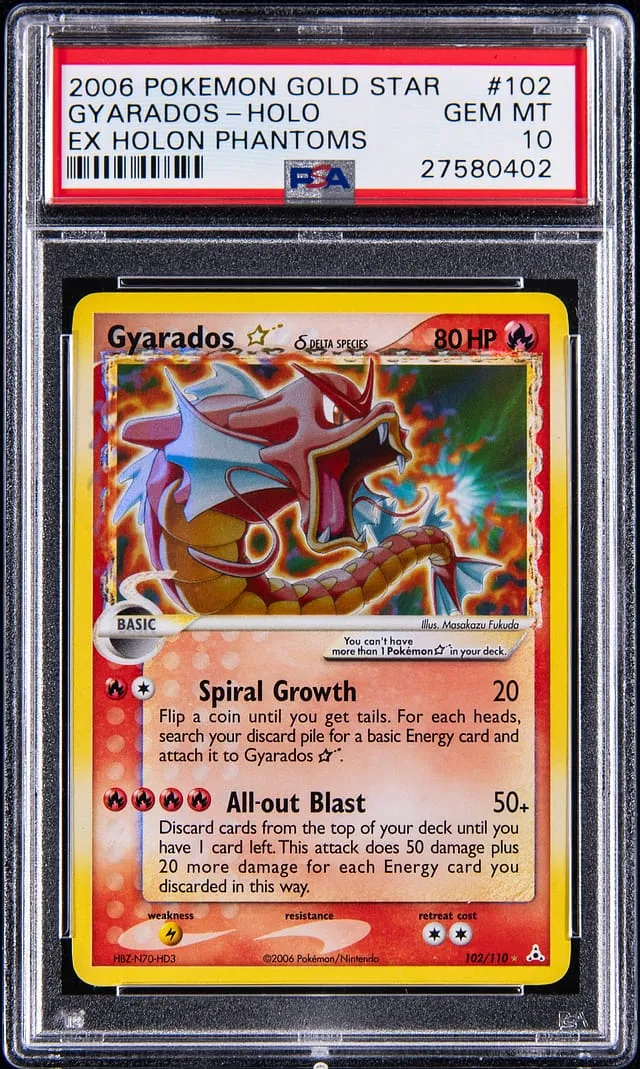
2006 Gold Star Gyarados PSA 10 sells for $915,000
Breakdown of the 2006 Pokémon EX Holon Phantoms Gold Star Gyarados PSA 10 sale for $915,000 at Goldin on March 9, 2026, and what it means.
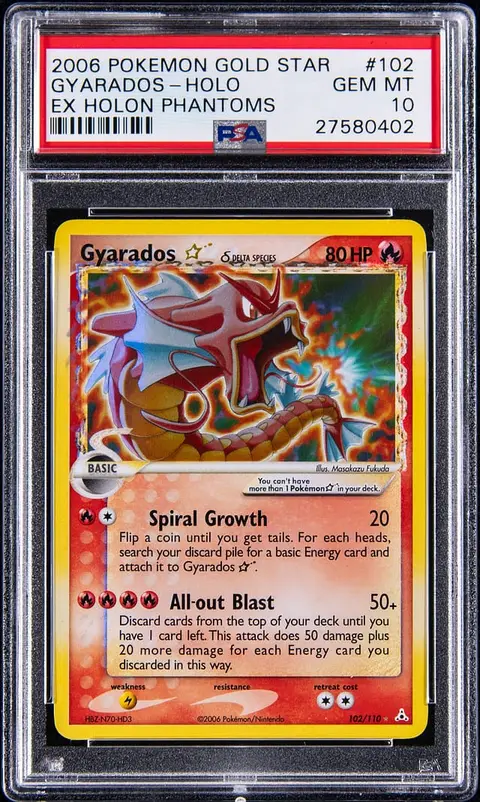
Sold Card
2006 Pokemon EX Holon Phantoms Gold Star Holo #102 Gyarados - PSA GEM MT 10
Sale Price
Platform
Goldin2006 Pokémon EX Holon Phantoms Gold Star Gyarados PSA 10 Sells for $915,000
On March 9, 2026, Goldin auctioned a major hobby landmark: a 2006 Pokémon EX Holon Phantoms Gold Star Holo #102 Gyarados graded PSA GEM MT 10, closing at $915,000.
For a mid‑2000s Pokémon card to approach seven figures says a lot about how collectors view Gold Stars, Holon Phantoms, and Gyarados as a character. Let’s break down what sold, why it matters, and how this result fits into the wider market.
The card: Gold Star Gyarados from EX Holon Phantoms
Full ID
- Character: Gyarados (Delta Species)
- Year: 2006
- Set: EX Holon Phantoms (English)
- Card: Gold Star Holo #102
- Parallel/variant: Gold Star (ultra‑short print chase rarity within the set)
- Grading: PSA GEM MT 10 (Gem Mint)
- Attributes: Non‑auto, non‑patch; the appeal is purely condition, art, rarity, and set prestige
Gold Star cards from the EX era are some of the most chased non‑tournament cards in the hobby. Each set from this period (2004–2007) had only a few Gold Stars inserted at very low pull rates. That combination of:
- Low pack odds,
- Distinct visual design (the gold ★ next to the name), and
- Fan‑favorite characters
has pushed them into the same mental bucket as vintage chase cards for many long‑term collectors.
Holon Phantoms is especially notable because of its Delta Species theme: classic Pokémon appear in unusual types. This Gyarados shows up as an Electric‑type with a striking yellow border effect and a darker, more experimental art direction than early‑WOTC holo Gyarados cards.
This is not a rookie in the strict sense (Gyarados appears much earlier in Base Set and other classic releases), but it is considered a key issue for the character in the EX era.
Why PSA 10 Gold Stars matter
PSA’s GEM MT 10 grade represents a card that, in their view, is essentially flawless: sharp corners, clean edges, virtually no print defects, and strong centering.
Gold Star print quality can be inconsistent, and pack‑fresh cards were often handled roughly back in 2006 when far fewer people were thinking about grading. That means high‑grade survivors are genuinely scarce.
A population report (often shortened to “pop report”) is the count of how many copies of a card have received each grade from a grading company. For Gold Star Gyarados, the PSA 10 population has historically been very low relative to raw copies and mid‑grade slabs. Even if exact pop figures move slightly as new subs come in, the key takeaway for collectors is: PSA 10 is meaningfully harder to find than PSA 8–9.
Market context: how does $915,000 stack up?
This Goldin sale at $915,000 (price data given in USD) places the PSA 10 Gold Star Gyarados firmly in the top tier of EX‑era outcomes.
Across the broader market, the pattern for English Gold Stars has generally looked like this:
- PSA 10 examples of top‑tier characters (Charizard, Rayquaza, Umbreon, Espeon, and select others) have repeatedly cleared six figures, with peak periods pushing well into the high six figures.
- PSA 9 copies of the same cards often sell for a fraction of PSA 10 pricing, underscoring how condition‑sensitive this segment is.
- Mid‑grades (PSA 7–8) trade closer to what many collectors think of as “advanced nostalgia” prices: still expensive, but somewhat accessible relative to the top end.
While not every Gold Star has public seven‑figure sales, high‑end results over the last few years have steadily reinforced the idea that PSA 10s sit in their own tier. Gyarados sits slightly outside the very top handful of Gold Star mascots, but it is a core first‑generation Pokémon with a strong fan base and multiple iconic cards (Base Set holo, Skyridge, etc.).
Compared with recent public EX‑era results, this $915,000 sale:
- Places Gold Star Gyarados among the most respected EX Holon Phantoms cards,
- Pushes it into a pricing neighborhood that, historically, was reserved for only the most famous Gold Stars and trophy‑level pieces,
- Signals that serious collectors and high‑end buyers continue to allocate meaningful capital to EX‑era English cards, not just early‑WOTC Japanese rarities or 1st Edition Base.
If you track comps (short for “comparables,” i.e., similar recent sales used for price context), you’ll notice that this figure sits at the very top of the observed range for this card in any grade. Lower grades have consistently transacted for dramatically less, underscoring how much of the value here sits in the PSA 10 label.
Why collectors care about Gold Star Gyarados
Several forces converge with this card:
Era significance – mid‑2000s EX period
The EX era is now old enough to feel nostalgic, but new enough to have modern design and foiling. Boxes are scarce, pack odds for Gold Stars were long, and sealed product has been steadily drying up.Set identity – EX Holon Phantoms
Holon Phantoms is part of the Holon storyline, which has its own dedicated fan following. The Delta Species twist (type‑shifted Pokémon) gives the set a unique aesthetic not replicated elsewhere.Character strength – Gyarados
Gyarados bridges generations: it’s a Gen 1 evolution line that featured heavily in early games and anime, and it appears on multiple memorable cards. Collectors who chase “character runs” (one of each key card for a single Pokémon) often circle Gold Star Gyarados as a must‑have piece.Rarity and perceived difficulty
Anecdotally, Holon Phantoms Gold Stars are remembered as tough pulls even relative to other EX sets. When you combine that with the typical wear of the time and the scarcity of sealed product, high‑grade supply feels structurally capped.Condition premium
With EX era foiling and dark backgrounds, even tiny scratches or print lines can torpedo a grade. That’s why the gap between PSA 9 and PSA 10 can be so wide: 10s offer a level of visual perfection that many collectors only realized they wanted years after the product released.
What this sale might be telling the market
While every auction is just one data point, this $915,000 result at Goldin on March 9, 2026 adds to a few trends worth watching:
EX‑era blue chips are firmly established. This result supports the idea that certain EX Gold Stars are now treated as cornerstone holdings, not just niche side‑quests for vintage collectors.
Character‑driven demand is strong. Even outside Charizard and Pikachu, key Gen 1 Pokémon with deep fanbases are seeing serious bidding when they appear in rare, high‑grade forms.
PSA 10 scarcity is central. The spread between top‑grade and everything else suggests that collectors are intentionally targeting the best possible examples rather than just “a copy.”
Auction house positioning matters. Goldin has become a regular venue for six‑figure and above Pokémon pieces. That visibility can pull in cross‑category bidders (sports, comics, etc.) and may support stronger outcomes for truly elite cards.
None of this guarantees future results. Markets move, tastes change, and liquidity can ebb and flow. But for collectors and small sellers trying to understand where EX‑era Pokémon sits today, this sale is a clear marker on the timeline.
Takeaways for collectors and small sellers
If you’re building or valuing a collection around EX Holon Phantoms and Gold Stars, here are some practical angles to consider:
Use comps as context, not targets. Look at a range of recent sales (not just record highs) to understand how grade, eye appeal, and auction venue affect realized prices.
Understand grade sensitivity. For Gold Stars in particular, the jump from raw/PSA 8 to PSA 9, and then to PSA 10, can be steep. Centering, print lines, and edge chipping all matter.
Think in terms of character and set. Even if a PSA 10 is out of reach, lower‑grade Gold Stars, related Gyarados cards, or other Holon Phantoms hits can still be interesting from a collection‑building standpoint.
Document your copies well. Clear scans, centering notes, and honest condition descriptions help when you eventually decide to sell or trade.
At figoca, we track these landmark results because they help map where different eras and characters sit in the broader Pokémon landscape. This Goldin sale of a PSA 10 Gold Star Gyarados on March 9, 2026 is one of those moments: it shows how far EX‑era collecting has come, and it provides a new reference point for anyone who cares about Holon Phantoms, Gold Stars, or Gyarados.
As more data comes in from upcoming auctions and marketplace listings, the picture will keep evolving—but this card now has a firmly established place near the top of the EX‑era hierarchy.