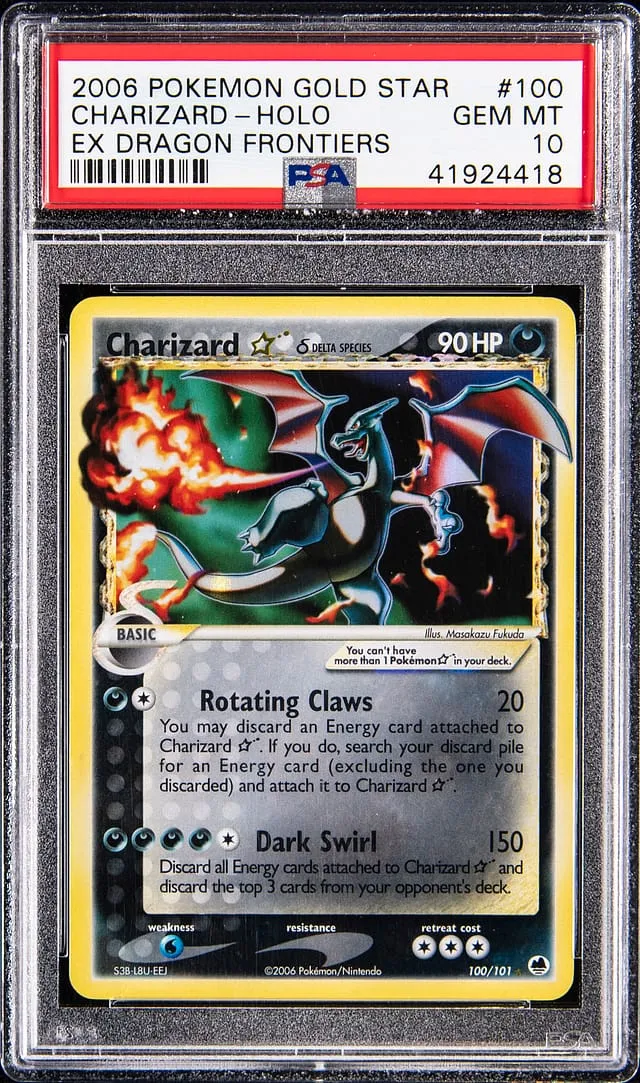
2006 Gold Star Charizard PSA 10 sells for $195,200
Figoca breaks down the $195,200 sale of a 2006 EX Dragon Frontiers Gold Star Charizard PSA 10 at Goldin and what it means for Pokémon collectors.
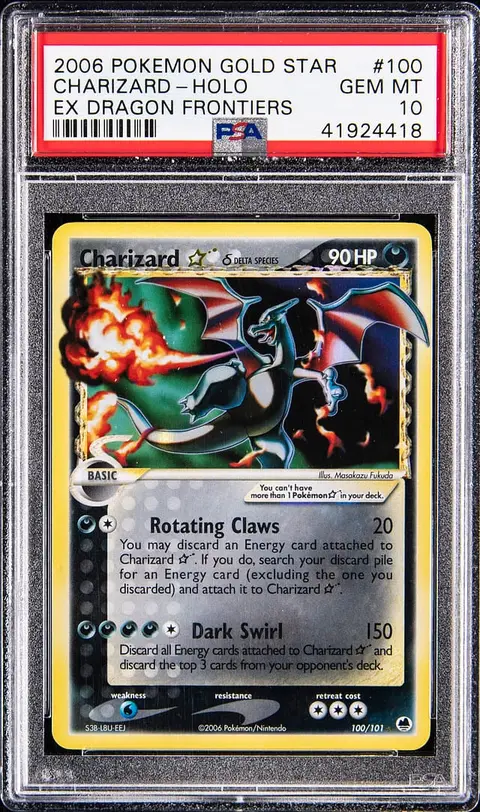
Sold Card
2006 Pokemon EX Dragon Frontiers Holo #100 Gold Star Charizard - PSA GEM MT 10
Sale Price
Platform
Goldin2006 Pokémon EX Dragon Frontiers Gold Star Charizard in PSA 10 Sells for $195,200
On May 18, 2026, a major hobby benchmark quietly slipped through the Goldin auction block: a 2006 Pokémon EX Dragon Frontiers Holo #100 Gold Star Charizard graded PSA GEM MT 10 sold for $195,200.
For collectors who track key Pokémon grails, this card needs little introduction. But for newer or returning collectors, it’s worth slowing down and unpacking why this specific Charizard matters—and what this sale might be telling us about the current market.
The Card: 2006 EX Dragon Frontiers Gold Star Charizard #100
Full identification
- Character: Charizard
- TCG: Pokémon
- Year: 2006
- Set: EX Dragon Frontiers
- Card number: #100
- Variant: Gold Star (shiny Charizard), Holo
- Language: English
- Grading company: PSA (Professional Sports Authenticator)
- Grade: GEM MT 10 (PSA 10, highest standard grade)
- Attributes: Non-numbered but short-printed Gold Star “shiny” chase card, no autograph or memorabilia, standard-size trading card
This is not a rookie card in the sports sense, but it is a key issue for Charizard collectors. Gold Star cards feature shiny (alternate-color) versions of Pokémon, illustrated by Masakazu Fukuda, and were inserted at very low pull rates in mid‑2000s EX sets. Among those, Gold Star Charizard from EX Dragon Frontiers has become one of the flagship post‑Wizards of the Coast Charizard cards.
Set and Era Context: Mid‑2000s EX Era Scarcity
EX Dragon Frontiers released in 2006, during what many see as the “EX era” of the Pokémon TCG. This period sits between the original Wizards of the Coast run and the modern boom of Sun & Moon / Sword & Shield.
A few points that matter for today’s market:
- Lower print runs vs. modern: EX-era sets generally had smaller production compared with modern Pokémon expansions, especially in English. That doesn’t automatically make every card rare, but it does help explain why sealed product is scarce and why top-tier chase cards have thinner populations.
- Gold Star chase structure: Gold Stars were intentionally very hard to pull. In many sets, they were roughly one per several booster boxes, not per box. This means genuinely limited availability, particularly for top characters like Charizard.
- Condition sensitivity: With fewer people grading Pokémon cards in the mid‑2000s and less emphasis on careful storage, finding truly pack‑fresh copies today is not trivial. That’s part of why PSA 10 populations for Gold Stars are modest even after years of submissions.
PSA 10: Why the Grade Matters
A PSA GEM MT 10 is PSA’s highest “standard” grade and signals a card that, by their criteria, is essentially flawless to the naked eye:
- Virtually perfect corners and edges
- Clean surfaces free of print lines or scratches visible under normal viewing
- Centering within tight tolerances
For a card like EX Dragon Frontiers Gold Star Charizard, the gap between PSA 9 and PSA 10 is not just cosmetic; it is market-defining. The 10s are the true “trophy” copies that many high‑end collectors target, and in a set with low raw availability, the population of 10s is especially watched.
A population report (often shortened to “pop report”) is the grading company’s public count of how many copies exist in each grade. Collectors use this to estimate relative scarcity in high grade. While exact figures shift as more cards are graded, PSA 10 Gold Star Charizards from this set have consistently remained a small fraction of total graded copies.
The Sale: $195,200 at Goldin on May 18, 2026
- Auction house: Goldin
- Sale date (UTC): 2026‑05‑18
- Realized price: $195,200 (buyer’s premium generally included in Goldin’s final reported price)
This result firmly places the card in the upper tier of Pokémon TCG sales, especially for non‑trophy, pack‑pulled cards.
Market Context and Recent Sales
When collectors talk about “comps,” they mean comparable recent sales—other sales of the same card (or very similar versions) used to understand what buyers have been willing to pay.
For EX Dragon Frontiers Gold Star Charizard in PSA 10, past public sales have included:
- Six‑figure results during the height of the 2020–2021 Pokémon boom
- Later sales that cooled off from peak levels but still remained solidly in five‑ and low‑six‑figure territory
Related versions—such as PSA 9 copies or high‑grade BGS (Beckett Grading Services) examples—typically track well below PSA 10 prices, reflecting both stricter condition standards at the top and collector preference for the highest grade available.
Within that context, a $195,200 sale in 2026 suggests:
- The card continues to be treated as a premier Charizard grail
- High‑grade Gold Stars, especially Charizard, remain highly competitive at auction
- Top‑end demand has not disappeared even as the broader market has matured and cooled from the sharp spikes of the early 2020s
Because each high‑end auction can be influenced by timing, marketing, and bidder competition, a single result is better read as a data point than a definitive new “floor” or “ceiling.” Still, it contributes to a pattern: PSA 10 Gold Star Charizard remains a six‑figure card at major houses like Goldin.
Why Collectors Care About This Card
Several factors make this card particularly important:
Charizard as a flagship character
In Pokémon, Charizard holds a role similar to Michael Jordan in basketball or Mickey Mantle in baseball: not necessarily the rarest in every set, but the character that anchors collector attention. Across eras—Base Set, Neo, EX, modern chase cards—Charizard tends to be the face of high‑end Pokémon.Gold Star status
Gold Stars are a defined, limited run of chase cards with distinct gold star icons and shiny artwork. They have a clear beginning and end as a design concept, which makes the checklist collectible as a set. Within that checklist, Charizard is one of the most demanded.Mid‑2000s nostalgia cycle
Many collectors now in their late 20s to mid 30s grew up with the EX era as “their” Pokémon. As that group gains disposable income, demand for the era’s hardest pulls—like this Gold Star—has strengthened.Condition scarcity in PSA 10
Even if raw copies surface occasionally, the combination of low pull rates, aging, and handling means relatively few make it to PSA 10. A thin PSA 10 population can concentrate demand and support stronger prices at the top.Set identity
EX Dragon Frontiers is remembered for its delta species theme and its lineup of popular Pokémon in unusual types and forms. The set has a distinct identity, and the Gold Star Charizard stands out as its headline chase.
How This Sale Fits in the Current Market
The broader trading card market has shifted from the frenzy of 2020–2021 into a more selective, research‑driven phase. Some key patterns relevant to this sale:
- Flight to quality: Collectors are increasingly focusing on cards that combine strong character demand, clear historical significance, and real scarcity. PSA 10 Gold Star Charizard checks all three boxes.
- Stronger separation between grades: Price gaps between PSA 9 and PSA 10 on key cards have widened in some cases, as high‑end buyers prioritize top populations while more casual collectors move down a grade to stay within budget.
- Auction house gravitation: Cards of this stature often gravitate to large, established auction houses like Goldin, PWCC, and Heritage, where marketing and bidder pools can support stronger realized prices.
Within that backdrop, a $195,200 sale does not feel out of place. It reinforces the idea that, while many areas of the hobby have retraced, the absolute best examples of historically important cards continue to find committed buyers.
What Collectors Can Take Away (Without Treating It as Advice)
This sale isn’t a prediction or a target—it’s simply a reference point.
For active collectors and small sellers, here are a few grounded takeaways:
- Gold Star Charizard remains a central Charizard grail. If you follow Charizard across eras, this sale underlines how strongly the market still views EX Dragon Frontiers.
- Condition and grading matter enormously at the top end. The difference between high‑grade raw, PSA 9, and PSA 10 is not just a slight bump; in cards like this, it’s a different market tier altogether.
- Auction timing and venue can influence realized prices. Major houses like Goldin bring visibility and competition that can help establish or confirm price levels for key cards.
For newcomers, this sale is a reminder that Pokémon’s high end is deeper than Base Set alone. The EX era and its Gold Stars form an important chapter in the hobby’s history, and cards like this Charizard are central to that story.
Final Thoughts
The May 18, 2026 Goldin auction result for the 2006 Pokémon EX Dragon Frontiers Holo #100 Gold Star Charizard in PSA GEM MT 10 at $195,200 is another data point in a long‑running narrative: mid‑2000s Pokémon grails, anchored by Charizard, continue to command respect—and capital—across the hobby.
Whether you’re tracking comps, building a Charizard run, or just learning the landscape of key Pokémon issues, this sale offers a clear, recent reference for what one of the strongest examples of this card can do on a major stage.