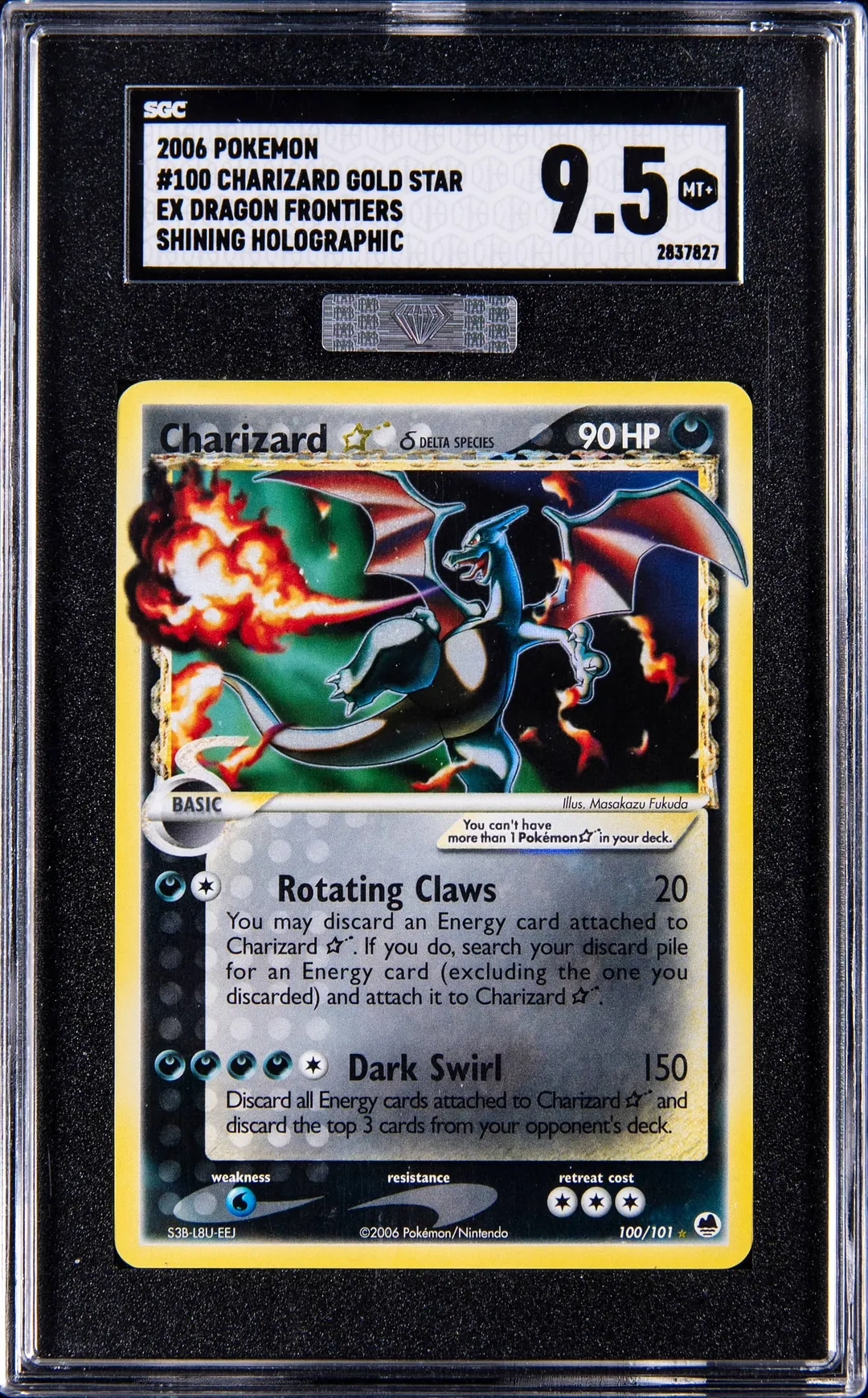
2006 EX Dragon Frontiers Charizard Gold Star Sale
A $17,360 SGC 9.5 2006 EX Dragon Frontiers Charizard Gold Star sale at Goldin and what it means for EX-era Pokémon collectors.
Sold Card
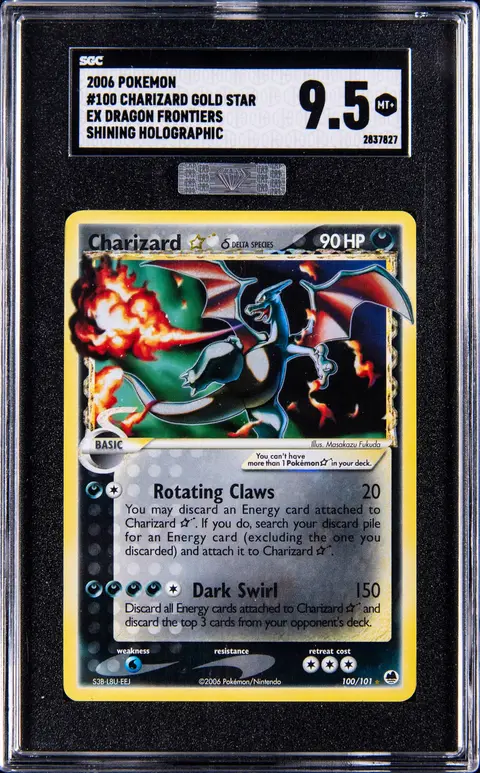
2006 Pokemon EX Dragon Frontiers Shining Holo #100 Charizard Gold Star - SGC MT+ 9.5 - MBA Silver Diamond Certified
Sale Price
Platform
GoldinFor many Pokémon collectors, 2006 EX Dragon Frontiers represents one of the high points of the mid-2000s era. Within that set, the Charizard Gold Star is widely viewed as a pillar card – a chase that bridges old-school nostalgia with the modern premium era.
On February 16, 2026, Goldin sold a copy of this card that checks nearly every box for condition-focused collectors:
- Card: 2006 Pokémon EX Dragon Frontiers Charizard Gold Star
- Card number: #100 (Shining Holo / Gold Star)
- Character: Charizard
- Set: EX Dragon Frontiers (Nintendo era, 2006)
- Variant: Gold Star Shining Holo
- Grading company: SGC
- Grade: SGC MT+ 9.5
- Additional note: MBA Silver Diamond Certified
- Auction house: Goldin
- Sale date (UTC): February 16, 2026
- Sale price: $17,360
This is not a rookie card in the sense used for sports, but it is a key issue Charizard: a Gold Star from one of the most respected EX-era sets, featuring a shiny (alternate-color) Charizard in the art. For many, it sits on the same “iconic tier” as the big Charizard cards from earlier WotC sets, but with a distinctly different mid-2000s flavor.
Why the EX Dragon Frontiers Charizard Gold Star matters
The EX-era (early to late 2000s) occupies a unique lane in the Pokémon hobby. It came after the original Wizards of the Coast boom and before the modern ultra-premium chase cards. Print runs were generally lower than during the late-90s craze, sealed product is scarcer, and many kids who opened these packs at the time did not preserve cards in gem condition.
Within that era, Gold Star cards are short-printed chase cards featuring shiny variants of popular Pokémon. Pull rates were very low relative to standard holos, which is why high-grade examples are still tough to find today.
Charizard Gold Star from EX Dragon Frontiers stands out because:
- It’s a Charizard – historically the most collected Pokémon card character.
- It’s a shiny Charizard – alternate coloration has become a hobby favorite, and this is one of the earliest shiny Charizard chase cards.
- It’s from a respected EX set – EX Dragon Frontiers is well regarded both for gameplay history and for its artwork and lineup of Gold Stars.
For many collectors who grew up during the EX-era, this card acts like a centerpiece – the card people either chased in packs or saw only in magazine price guides and early online forums.
Understanding the grade: SGC MT+ 9.5 and MBA Silver Diamond
This particular copy was graded SGC MT+ 9.5, which places it firmly in the top tier of condition. While PSA and BGS often get the most attention in the Pokémon segment, SGC has a long history in grading and is more visible today in cross-category collections that include sports, non-sports, and TCGs.
Key points about the grade and designation:
- SGC MT+ 9.5: This is a near-gem / gem-level grade, typically indicating extremely clean surfaces, sharp corners, and strong centering, with only very minor imperfections.
- MBA Silver Diamond Certified: MBA (Mike Baker Authenticated) certification is a third-party review of a graded card’s eye appeal, with designations like Silver, Gold, or Black Diamond. A Silver Diamond label signals above-average quality within the grade according to their standards.
For collectors who care about both numeric grade and eye appeal, this combination – SGC 9.5 plus a Silver Diamond label – can make a particular copy stand out among other high-grade examples.
Recent sales and price context
When collectors talk about “comps”, they mean comparable recent sales that help provide context for a card’s current market level. For a card like the EX Dragon Frontiers Charizard Gold Star, most of the available public data tends to cluster around PSA and BGS graded copies, since those have historically been more common in Pokémon submissions.
Across auction houses and large marketplaces in recent years, high-grade copies of this card have typically shown:
- Premium pricing for top grades – Gem Mint or near-gem copies (such as PSA 10s, strong BGS 9.5s, and high 9s with good subgrades) often draw outsized attention because of how tough pristine EX-era foils can be.
- Notable spreads between grade levels – As is common with key Charizard issues, there can be a sharp price drop between a true gem-level copy and mid-grade examples.
This SGC MT+ 9.5 selling for $17,360 at Goldin on February 16, 2026 positions it firmly in the high-end bracket for this card, consistent with how the market tends to treat strong near-gem and gem examples.
Because grading populations differ by company, direct one-to-one comparisons between SGC, PSA, and BGS prices can be imperfect. However, based on publicly visible sales for:
- PSA 9 and PSA 10 copies of this card, and
- BGS 9.5 and high-end BGS 9.0 examples,
this result sits in a range that makes sense for a premium high-grade copy, especially with the added MBA Silver Diamond designation and the exposure that comes from a major auction house like Goldin.
Rather than reading this as an outlier spike, it looks more like part of the ongoing pattern: top-condition EX-era Charizard chase cards drawing strong, but not irrational, attention.
Population, scarcity, and condition sensitivity
Public “pop reports” (population reports) from grading companies show how many copies of a specific card have received each grade. While SGC’s Pokémon pop data is less frequently discussed than PSA’s, the overall picture across graders is clear: gem-level copies of EX-era Gold Stars are relatively scarce.
Helping factors for values at the top end:
- Low original pull rates – Gold Stars were significantly harder to pull than regular holos.
- Mid-2000s handling – Cards from this time were often played, carried around, or stored casually, which made surface scratches and edge wear common.
- Foil and dark backgrounds – The Charizard Gold Star artwork and foil treatment make imperfections more visible, which naturally limits how many copies can realistically achieve 9.5 or 10 grades.
Put together, this means that a strong 9.5, regardless of grading company, is competing within a relatively small pool of truly high-end examples.
Where this sale fits in the broader Pokémon market
The Pokémon market has moved through several waves: the original Base Set boom, the 2020–2021 surge, and more measured collecting behavior since. Through those cycles, certain pillars have remained:
- Base Set Charizard (especially 1st Edition)
- Trophy and prize cards
- Mid-2000s EX and Gold Stars for key characters, especially Charizard
This Goldin sale aligns with a broader trend where:
- Core, historically important Charizard cards continue to attract deep collector interest.
- Condition-sensitive cards from the EX-era remain relatively stable compared with more speculative modern releases.
- High-grade, well-presented copies (backed by established graders and eye-appeal certifications) command a premium over raw or lower-grade examples.
There hasn’t been a single recent news event or milestone driving this specific card; instead, the demand appears to come from long-standing sentiment around EX-era Gold Stars and Charizard’s central place in the brand.
Takeaways for collectors and small sellers
For collectors and sellers watching this space, a few practical points emerge:
Know the variant
Not every Charizard from 2006 is a Gold Star. Understanding set, number (#100), and the shiny Gold Star designation is essential when looking at comps.Pay attention to grading company and grade tier
Prices can differ meaningfully between SGC, PSA, BGS, and CGC, even at the same numeric grade. High 9s and 9.5s are often in a different lane than 7s and 8s for this card.Eye appeal can matter within a grade
Third-party designations like MBA Silver Diamond reflect that not all 9.5s look identical. For some buyers, that distinction justifies a premium.Use recent sales as context, not a promise
This $17,360 result at Goldin on February 16, 2026 is a useful data point, but it’s one sale in a broader pattern. Market conditions, timing, and card-specific details all play roles.EX-era Gold Stars occupy a stable niche
While nothing in the hobby is guaranteed, the collecting narrative around EX-era Gold Stars – especially Charizard – has been building for years rather than months.
Final thoughts
The 2006 Pokémon EX Dragon Frontiers Charizard Gold Star #100 has long been more than just another Charizard card. This SGC MT+ 9.5, MBA Silver Diamond Certified example selling for $17,360 at Goldin on February 16, 2026 reinforces its place as a key EX-era cornerstone.
For collectors who grew up in the mid-2000s, it’s a centerpiece of nostalgia. For newer entrants, it illustrates how scarcity, condition sensitivity, and character selection intersect to create long-term hobby landmarks.
At figoca, we track these kinds of sales not as isolated headlines but as part of the evolving story of how collectors value different eras, sets, and characters over time. This Charizard Gold Star continues to be one of the clearest reference points for what serious EX-era collecting looks like today.