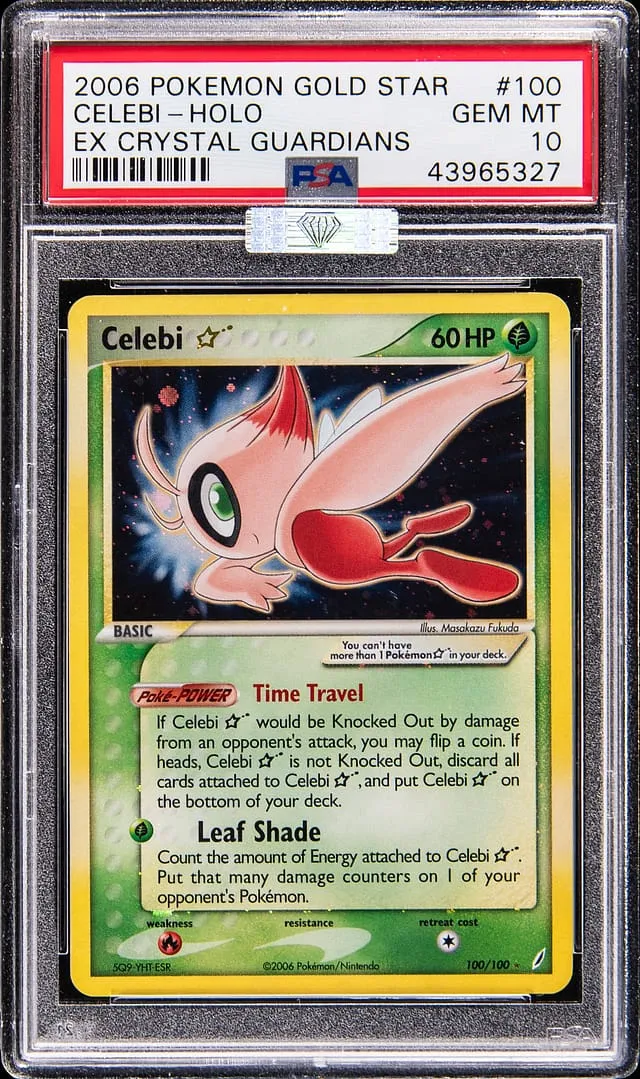
2006 EX Crystal Guardians Gold Star Celebi PSA 10 Sale
A PSA 10 2006 EX Crystal Guardians Gold Star Celebi sold for $25,010 at Goldin. See how this high-end EX-era Pokémon comp fits current market trends.
Sold Card
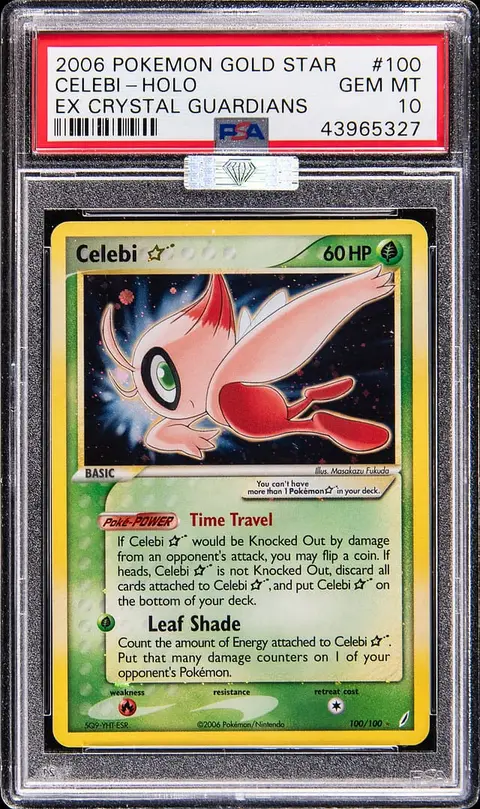
2006 Pokemon EX Crystal Guardians Gold Star Holo #100 Celebi - PSA GEM MT 10 - MBA Silver Diamond Certified
Sale Price
Platform
Goldin2006 Pokémon EX Crystal Guardians Gold Star Celebi PSA 10 Sells for $25,010
On April 20, 2026, Goldin sold a 2006 Pokémon EX Crystal Guardians Gold Star Holo #100 Celebi in a PSA GEM MT 10 holder for $25,010. The card also carried an MBA Silver Diamond certification, an additional layer of third‑party verification on top of the PSA grade.
For collectors who follow Gold Stars, EX‑era sets, or just like to track high‑end Pokémon results, this is a meaningful data point for one of the hobby’s more elusive non‑cover Gold Stars.
Card overview: what exactly sold?
Let’s break down the card details:
- Character: Celebi
- Year: 2006
- Set: Pokémon EX Crystal Guardians
- Card number: #100
- Variant: Gold Star Holo (shiny Celebi, Gold Star designation by the name)
- Rarity type: Gold Star chase card from the EX era
- Grading company: PSA
- Grade: GEM MT 10
- Additional certification: MBA Silver Diamond Certified
- Auction house: Goldin
- Sale date (UTC): 2026‑04‑20
- Realized price: $25,010
Gold Star cards are a specific type of ultra‑rare insert from mid‑2000s Pokémon sets. They feature shiny versions of Pokémon with a small gold star next to the name. Pull rates were extremely low compared to regular holos of the time, which is why they remain a core target for advanced collectors.
Celebi from EX Crystal Guardians is not a cover mascot (like Charizard or Rayquaza) but is still firmly in the “key Gold Star” conversation, especially when we are talking about the very top grade.
Why this card matters to collectors
Part of a flagship EX‑era chase
The EX era (roughly 2003–2007) sits in a sweet spot for many collectors:
- It is post‑WOTC (after the original Wizards of the Coast era) but still feels “early” and nostalgic.
- Print runs, while larger than late‑90s product, were significantly lower than today’s ultra‑modern releases.
- The Gold Star mechanic introduced a clear, premium chase that still defines how people look at mid‑2000s Pokémon.
EX Crystal Guardians is one of the better‑known EX sets, featuring Delta Species Pokémon, popular starters, and a compact Gold Star checklist. Within that checklist, Celebi is a classic shiny legendary from Johto—a fan‑favorite lane that has aged well.
Scarcity in high grade
PSA’s pop report (population report—how many copies of a card are graded at each grade) for EX Gold Stars generally shows a steep drop‑off at GEM MT 10. The combination of:
- mid‑2000s card stock,
- lower pull rates, and
- common surface and edge issues
means that true gem copies are relatively thin on the ground.
For most non‑mascot Gold Stars, PSA 10 examples represent the top fraction of surviving copies. While exact population numbers can change with new submissions, the pattern across EX Gold Stars is consistent: 10s are scarce, and demand is concentrated at that top grade.
MBA Silver Diamond Certified
Beyond the standard PSA encapsulation, this card carried MBA Silver Diamond certification. MBA (My Bargain Auction / MBA Authentication, depending on context) provides post‑grading review and verification of a slabbed card’s condition and authenticity.
In practice, this is an additional signal to some buyers that:
- the PSA 10 grade is considered strong (no obvious over‑grading), and
- the card and holder have passed another layer of inspection.
Not every collector pays a premium for this type of secondary certification, but on high‑end pieces it can matter at the margins.
Market context and recent sales
Because this is a focused card in a relatively small population, recent sales can be thin. When collectors talk about “comps” (comparable sales), they are usually looking at:
- the same card and grade (PSA 10),
- the same card in slightly lower grades (PSA 9, BGS 9.5), and
- other Gold Stars of similar tier from the same era.
For this Celebi Gold Star, recent public data over the last few years has generally shown:
- PSA 10 examples trading in a mid‑to‑high five‑figure USD range when they surface with major auction houses, depending on timing and broader market sentiment.
- PSA 9 copies landing substantially lower, highlighting the grade gap between 9 and 10 for Gold Stars.
- Uncertified or lower‑grade copies typically changing hands at a large discount to gem‑mint, reflecting both condition sensitivity and collector preference for top‑pop examples.
Within that context, the $25,010 Goldin result in April 2026 sits within the upper‑tier expectations for this card but not as an outlier record for the Gold Star segment more broadly. Charizard, Rayquaza, and a few other headliners still command materially higher numbers in the same grade.
If you zoom out to the entire Gold Star landscape, this sale reinforces a pattern:
- flagship mascots remain at the top of the price spectrum;
- secondary legendaries and fan‑favorites like Celebi form a robust middle tier;
- lower‑profile species and weaker artworks sit below that.
Celebi’s price action has historically tracked with that “middle‑tier but important” archetype.
How this sale fits into EX‑era momentum
The broader EX‑era market has gone through a full cycle:
- Low awareness / under‑appreciation in the early 2010s.
- Discovery and re‑rating as collectors who grew up with this product gained spending power.
- Acceleration during the big hobby boom of 2020–2021.
- Normalization as prices cooled and then began to stabilize.
Gold Star Celebi’s result here looks like a data point in that stabilization phase, rather than the start of a new spike. It confirms that:
- serious demand still exists at the very high end of EX‑era singles;
- PSA 10 Gold Stars, even non‑cover Pokémon, continue to attract competitive bidding when they are fresh to market and well‑presented;
- buyers are still differentiating sharply by grade.
For newer collectors, this is a useful case study in how era + scarcity + grade + character combine to shape pricing.
Key takeaways for collectors and small sellers
1. Grade remains the main lever
The spread between PSA 9 and PSA 10 on EX Gold Stars can be dramatic. For anyone considering grading raw EX‑era cards:
- Minor whitening, edge chipping, or print defects can push a card out of PSA 10 territory.
- Carefully pre‑screening raw copies is essential if you are aiming for gem‑mint outcomes.
This sale underscores that collectors will pay a premium for confirmed top‑pop caliber examples.
2. Set and character both matter
Celebi is a strong, but not top‑tier, IP draw. EX Crystal Guardians is a respected, but not the single most iconic, EX set.
Put together, they anchor this card in a solid long‑term lane:
- not a speculative modern chase,
- not a fringe character from a low‑interest set,
- but a recognizable legendary in a beloved mid‑2000s product with clear scarcity.
3. Auction house visibility can influence outcomes
This sale ran through Goldin, one of the better‑known high‑end marketplaces. For high‑value cards, visibility often matters:
- More eyes typically mean stronger bidding.
- Established auction houses can attract both collector and investor segments, increasing competition.
For smaller sellers deciding where to consign, this is a reminder that venue is one of the variables that shapes final prices.
Final thoughts
The April 20, 2026 Goldin sale of a 2006 Pokémon EX Crystal Guardians Gold Star Holo #100 Celebi – PSA GEM MT 10 – MBA Silver Diamond Certified at $25,010 adds another clean comp to the Gold Star record.
It does not reset the top of the Pokémon market, but it does quietly reaffirm a few points:
- EX‑era Gold Stars continue to hold collector attention.
- Population‑capped PSA 10s sustain meaningful premiums.
- Non‑mascot legendaries like Celebi can still command serious numbers when all the condition boxes are checked.
For anyone tracking EX Crystal Guardians or building a Gold Star run, this is a sale worth bookmarking and comparing against future results as more high‑grade copies surface.