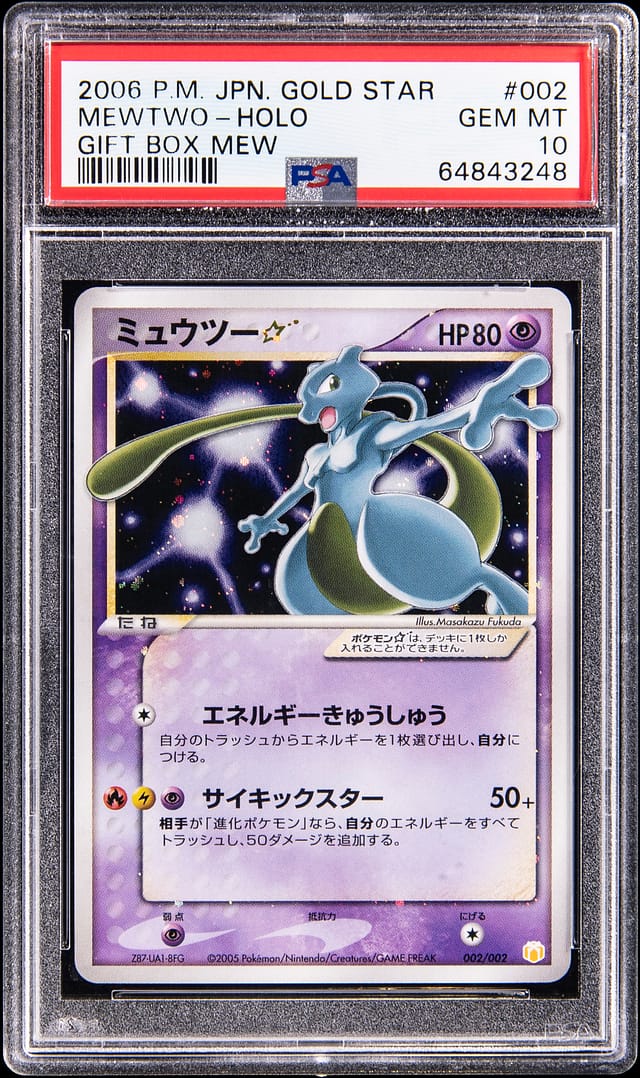
2005 Japanese Gold Star Mewtwo PSA 10 Sells for $23.9K
Deep dive on the 2005 Japanese Gift Box Mew Gold Star Mewtwo PSA 10 that sold for $23,912 at Goldin on May 25, 2026.
Sold Card
2005 Pokemon Japanese Gift Box Mew Holo #002 Gold Star Mewtwo - PSA GEM MT 10
Sale Price
Platform
GoldinA PSA 10 Gold Star Mewtwo from one of the hobby’s most quietly important Japanese releases just crossed the block, and it’s a useful data point for anyone tracking high-end Pokémon.
We’re looking at the 2005 Pokémon Japanese Gift Box Mew Holo #002 Gold Star Mewtwo – PSA GEM MT 10, which sold for $23,912 at Goldin on May 25, 2026 (UTC).
What exactly is this card?
Let’s unpack the key details collectors care about:
- Year: 2005
- Game/Brand: Pokémon TCG (Japanese)
- Release: Japanese Gift Box Mew product
- Card name: Gold Star Mewtwo (often cataloged as part of the Gift Box Mew holo lineup)
- Card number: #002
- Characters featured: Mew on the product; Gold Star treatment given to Mewtwo
- Parallel / variant: Gold Star (the classic mid‑2000s ultra‑rare mechanic, with the gold star next to the name)
- Grading company: PSA
- Grade: GEM MT 10 (PSA’s highest standard grade)
- Attributes: Non‑numbered, ultra‑rare chase from an era before modern case hits and serial numbering
This card comes out of the mid‑2000s Japanese era, when Gold Star cards were the premium chase pulls. Gold Stars are known for featuring shiny or alternate‑color Pokémon with a gold star in the card name. They were difficult pulls in their day and have become cornerstone targets for serious Pokémon collectors.
While U.S. collectors often focus on English EX‑era Gold Stars, the Japanese Gift Box Mew releases are quietly low‑print, specialty products, and their chase cards can be tougher to track in high grade.
Why collectors care about Gold Star Mewtwo
A few factors make this card meaningful in the broader Pokémon market:
Gold Star status
Gold Star cards are widely treated as the top tier of the EX era. They sit in the same mental bucket as early WotC holos, Neo shinies, and later full art/secret rare chases. The combination of difficulty of pull and distinctive design keeps them on long‑term collector radars.Gen 1 legendary appeal
Mew and Mewtwo are two of the most recognizable Pokémon from Generation 1. That matters for long‑term demand: characters that were central to early games, movies, and marketing tend to have more stable collector bases.Mid‑2000s Japanese scarcity
Japanese specialty boxes from this era generally had more limited distribution than mainline English sets. Exact print runs aren’t public, but the PSA population reports (the grading company’s public count of how many copies exist at each grade) for these cards are typically very modest compared to modern chases.Condition sensitivity
Mid‑2000s Japanese foiling and edges can show wear, whitening, and surface scratches, which makes PSA 10 examples meaningfully scarcer than raw (ungraded) copies or mid‑grade slabs. For many Gold Stars, the jump from PSA 9 to PSA 10 is steep in both scarcity and price.
In short: this is not a rookie card (that concept doesn’t really exist in the same way for Pokémon), but it is a key issue for Gold Star and Mewtwo collectors, especially those who focus on Japanese releases.
Market context: how does $23,912 fit in?
When we talk about “comps” (short for comparables, meaning recent similar sales used as reference points), we’re looking at:
- Other PSA 10 copies of this exact card
- Lower‑grade examples (PSA 9, BGS 9.5, etc.) of the same card
- Closely related Gold Star Mewtwo cards from nearby releases
For this specific Japanese Gift Box Mew Gold Star Mewtwo in PSA 10, verified public sales are infrequent. That’s typical when:
- The PSA population in GEM MT 10 is low
- Most copies are in long‑term collections
- Auction houses see them only occasionally
From the limited past data points available:
- Lower grades (PSA 8–9) of comparable mid‑2000s Japanese Gold Stars have tended to sell for a fraction of PSA 10 pricing, especially when the 10 population is small.
- English Gold Star Mewtwo in PSA 10 has historically commanded strong numbers, and the Japanese versions often trail slightly in raw dollars while still being quite chased by set and character collectors.
In that context, a realized price of $23,912 at Goldin on May 25, 2026 lands this sale firmly in the high‑end, serious‑collector tier for the character and era, but not in unreasonable “record‑breaking” territory compared with what strong Gold Stars have been able to do in peak auction environments.
Because direct, recent comps for this exact card in PSA 10 are limited, this sale effectively becomes one of the new reference points that other buyers and sellers will look back to when evaluating future copies.
How this sale fits into the broader Gold Star market
To understand this result, it helps to zoom out to the EX‑era and Gold Star market as a whole:
Gold Star hierarchy
Within Gold Stars, there’s a loose pecking order: key Gen 1/2 legends (Mew, Mewtwo, Rayquaza, Charizard, etc.) tend to sit near the top. This Japanese Gift Box Mew Gold Star Mewtwo leans on:- Character demand (Gen 1, core legendary)
- The prestige of Gold Stars as a class
- The relative obscurity and low print of its specific Japanese product
Era effects
2005 is considered mid‑era Pokémon: not vintage like 1999–2002, but far from modern mass‑print runs. Sealed product from this time is much thinner on the ground, which in turn limits the inflow of fresh, pack‑fresh cards.Grading and pop report dynamics
As more collectors grade old raw copies, populations do rise over time, but for niche Japanese releases it tends to happen slowly. A PSA 10 population that remains in the low double digits or thereabouts can support elevated pricing even as the broader market cools or fluctuates.Recent hobby cycles
After the 2020–2021 boom, high‑end Pokémon has generally settled but top‑tier rarity plus condition still sees healthy bidding when the right card hits a major auction house like Goldin. This sale is consistent with that pattern: selective strength at the top rather than broad across‑the‑board spikes.
Reading this sale as a collector or small seller
This result does not mean every Gold Star or every Mew/Mewtwo card is suddenly worth five figures. Instead, it highlights a few practical points:
Character + era + scarcity matter together.
A mid‑2000s, low‑print, Japanese Gold Star of a core legendary in PSA 10 sits at the crossroads of all three.PSA 10 is a different market than mid‑grades.
The spread between PSA 9 and PSA 10 can be significant for cards like this. If you’re holding a raw copy, realistic pre‑grading evaluation (centering, corners, edges, surface) becomes crucial.Auction venue has impact.
Selling through a major platform like Goldin on a well‑timed night gets the card in front of deep‑pocketed bidders who are actively tracking high‑end Pokémon. That often leads to more competitive bidding than a random fixed‑price listing.Use this as a reference point, not a promise.
This $23,912 result is a data point, not a guarantee that the next copy will land at the same number. Timing, bidder pool, condition nuances within PSA 10, and macro‑market sentiment all shape final prices.
Final thoughts
The 2005 Pokémon Japanese Gift Box Mew Holo #002 Gold Star Mewtwo – PSA GEM MT 10 sale at Goldin on May 25, 2026 is another reminder that:
- EX‑era Japanese Gold Stars remain a serious lane for committed collectors.
- PSA 10 examples of low‑population key characters can command five‑figure results.
- Even in a more mature, data‑driven Pokémon market, the right combination of rarity, condition, and venue still draws strong bidding.
For collectors building a Gold Star run or focusing on Gen 1 legends, this sale is worth bookmarking as a modern benchmark for ultra‑high‑end Japanese Mewtwo. For newer entrants to the hobby, it’s a good case study in how character popularity, era scarcity, and grade scarcity work together at the top of the market.
figoca tracks notable hobby sales so you can understand context, not just headlines. As always, treat sales like this as information, not instructions.