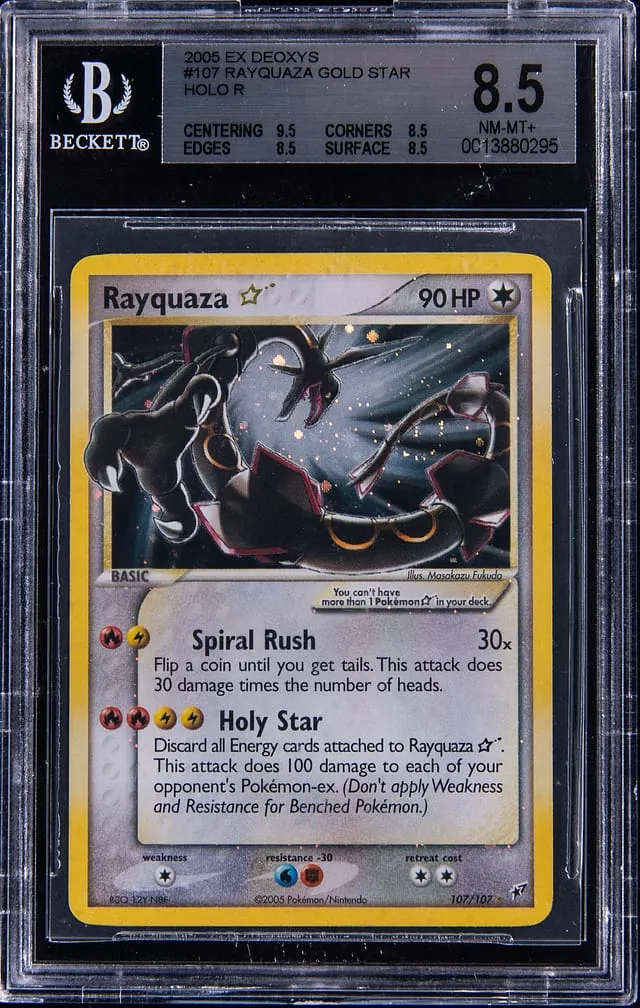
2005 Gold Star Rayquaza BGS 8.5 sells for $22,265
A 2005 Pokémon EX Deoxys Gold Star Rayquaza #107 BGS 8.5 sold for $22,265 at Goldin on March 9, 2026. Here’s what the result means for collectors.
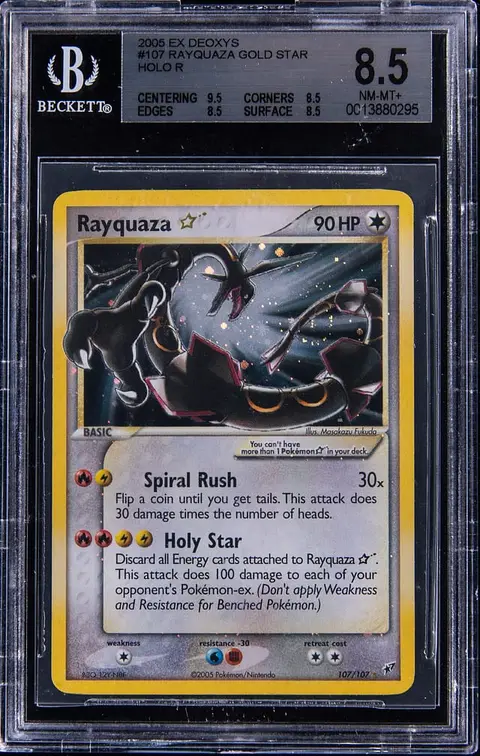
Sold Card
2005 Pokemon EX Deoxys Holo #107 Gold Star Rayquaza - BGS NM-MT+ 8.5
Sale Price
Platform
Goldin2005 Pokémon EX Deoxys Gold Star Rayquaza #107 BGS 8.5 Sells for $22,265 at Goldin
On March 9, 2026, Goldin closed a copy of one of the most important 2000s Pokémon cards: a 2005 Pokémon EX Deoxys Gold Star Rayquaza #107, graded BGS NM-MT+ 8.5, at a final price of $22,265.
For collectors who track key vintage‑adjacent Pokémon issues, this sale is another data point in the evolving market for Gold Star era grails.
The card at a glance
- Character: Rayquaza
- Year & set: 2005 Pokémon TCG, EX Deoxys
- Card: Gold Star Rayquaza, card #107/107
- Variant: Gold Star (shiny Rayquaza, alternate color, set‑defining chase card)
- Grading company: Beckett Grading Services (BGS)
- Grade: NM-MT+ 8.5 (subgrades typically matter for BGS, though not provided here)
- Category: Key issue / chase card of the EX era, not a rookie in the sports sense but often treated as a “pillar” card for 2000s Pokémon
Gold Star cards are known for featuring shiny (alternate‑color) Pokémon with a small gold star next to the name. Within EX Deoxys, Rayquaza is widely regarded as one of the top chase cards of the entire Gold Star run thanks to its artwork, difficulty of pulling it from packs, and its central place in many collectors’ memories of the Game Boy Advance / Nintendo DS era.
Why Gold Star Rayquaza matters
For context, Pokémon collectors often divide eras into:
- Wizards of the Coast (WotC) era (1999–2003) – Base Set through Skyridge.
- EX era (roughly 2003–2007) – E‑Reader transition and EX sets from Ruby & Sapphire through Power Keepers.
- DP / Platinum / HGSS onward – Later generations leading to the modern and ultra‑modern eras.
Gold Star Rayquaza sits squarely in the EX era—after the earliest nostalgic WotC years but before the massive modern print runs. Pull rates for Gold Stars were notoriously low, and sealed EX Deoxys product is now both scarce and expensive. That combination has made high‑grade examples of this card one of the anchors of any serious EX‑era Pokémon collection.
Collectors care about this card for several reasons:
Iconic artwork and shiny form
The card shows Rayquaza in its black shiny coloration with dynamic, full‑card artwork that stands out even among other Gold Stars.Set‑defining chase card
In EX Deoxys, Rayquaza is arguably the headline pull. Many people who opened packs in the mid‑2000s remember hearing stories of someone “actually pulling the Gold Star Rayquaza,” which gives it strong nostalgia and story value.EX era scarcity
Compared with modern sets, EX era products were printed in much smaller quantities. Surviving copies that were pulled, kept clean, and then graded are relatively limited.Status alongside other top Gold Stars
In conversations about the most important Gold Stars, Rayquaza is consistently mentioned along with Charizard, Torchic, and a handful of others. For many collectors focused on 2000s Pokémon, this is a “core piece” rather than a fringe card.
Understanding the $22,265 sale
This card sold for $22,265 (price converted from the reported 2,226,500 cents) via Goldin on March 9, 2026 (UTC).
To put that number in context, let’s look at how similar copies have been trading recently. When collectors talk about “comps” (comparable sales), they usually mean recent sales of the same card in the same or nearby grade, which helps frame today’s prices without promising future performance.
Recent market context and nearby grades
Public auction data over the past few years shows:
Top‑grade PSA 10 copies of 2005 EX Deoxys Gold Star Rayquaza have historically commanded very strong premiums, sometimes well into the high five‑figure or better territory when population (the number of graded copies) is low. These are the blue‑chip versions of the card.
PSA 9 and BGS 9 examples tend to sit in the middle tier: still expensive, but meaningfully below the rare gem‑mint population. They often trade at a noticeable premium over 8.5s because many collectors treat 9s as the cutoff for “high grade” on older, tough‑to‑gem EX cards.
BGS 8.5 is a border grade—stronger than a straight 8 but still short of a 9. Values often depend heavily on the subgrades (for example, an 8.5 with 9.5 centering and strong surface can track closer to 9 prices than to 8 prices, while a more balanced 8.5 might sit in the middle).
In that landscape, a $22k+ result for a BGS 8.5 fits the pattern of:
- Recognizing this card as a flagship EX era chase, not just a niche collectible.
- Sitting below the premium tier commanded by the best PSA 10 / BGS 9.5 copies, while still reflecting strong demand from collectors who prioritize owning the card itself over chasing the absolute top grade.
Because individual auction results can swing based on timing, bidder competition, and subgrade details, it’s best to see this Goldin sale as one more data point rather than a hard benchmark. Still, it reinforces that mid‑to‑high graded Gold Star Rayquaza copies command a serious price tier compared with most EX era cards.
EX era, condition, and grading
The EX era is old enough now that truly pack‑fresh, gem‑mint Gold Stars are rare:
- Many copies were played with, traded at school, or stored in less‑than‑ideal conditions.
- Surface scratching, edge wear, and print issues are common on this generation of holo foils.
That’s why condition and grading matter so much:
- BGS 8.5 (NM-MT+) indicates a clean card with some minor flaws visible under close inspection—still attractive in hand and firmly in the “collector grade” range.
- Compared to PSA, BGS offers subgrades (centering, corners, edges, surface), which can influence how collectors value a specific 8.5. An 8.5 with a standout subgrade profile often trades more like a weak 9.
For collectors who want this card but don’t want to pay top‑tier PSA 10 prices, BGS 8.5 and PSA 8–9 cards often become the practical target.
What this sale means for collectors
A single auction won’t define the entire market, but this Goldin result gives collectors a few takeaways:
Stability among key EX era grails
Despite ups and downs in broader hobby sentiment, high‑profile EX era chase cards like Gold Star Rayquaza continue to attract meaningful bids.Ongoing separation between iconic and average EX cards
Not all EX era cards behave the same. This sale reinforces the gap between a true set‑defining Gold Star and more common EX holo or regular‑rare cards from the same period.Grade ladders remain active
There’s still a clear ladder of demand from PSA 10 / BGS 9.5 down through BGS 8.5 and lower, allowing different types of collectors to participate at different price points.Auction houses as a venue for key cards
High‑end copies of cards like this often go through major auction houses such as Goldin, where the marketing reach and bidder pool can help find market‑clearing prices. For sellers, that’s useful context when deciding between fixed‑price marketplaces and auctions. For buyers, it’s a reminder to track both.
How newcomers can read a result like this
If you are newer or returning to the hobby, a five‑figure sale can look intimidating. Here are a few practical ways to use this kind of information without treating it as financial advice:
Learn the hierarchy:
Use headline sales to identify which cards are considered “pillar” pieces for each era—like Gold Star Rayquaza for the EX era—then explore more affordable relatives (different grades, languages, or thematically similar cards).Study comps over time:
Instead of focusing on one sale, look at a series of recent results. This helps you understand a card’s general range rather than anchoring on a single number.Separate nostalgia from noise:
Ask why a card is important—pull difficulty, era scarcity, fan popularity, or iconic art—so you can decide whether that story resonates with you as a collector.Use data, but collect what you like:
Price context is useful, but the most sustainable collections are built around cards you actually enjoy owning, whether that’s a BGS 8.5 Gold Star or a less expensive Rayquaza from a later set.
Summary
The 2005 Pokémon EX Deoxys Gold Star Rayquaza #107 BGS NM-MT+ 8.5 that sold at Goldin on March 9, 2026 for $22,265 is another strong example of how cornerstone EX era cards continue to be treated in the market.
For data‑minded collectors, it’s a helpful comp: a mid‑high BGS grade landing solidly in five figures. For Rayquaza and EX era fans, it’s another reminder that the cards many of us chased as kids in the mid‑2000s have grown into some of the most studied and sought‑after pieces in the Pokémon hobby.
At figoca, we track these results so you can make more informed collecting decisions—whether you’re watching the next Gold Star Rayquaza come to auction or just picking up your first EX era holo.