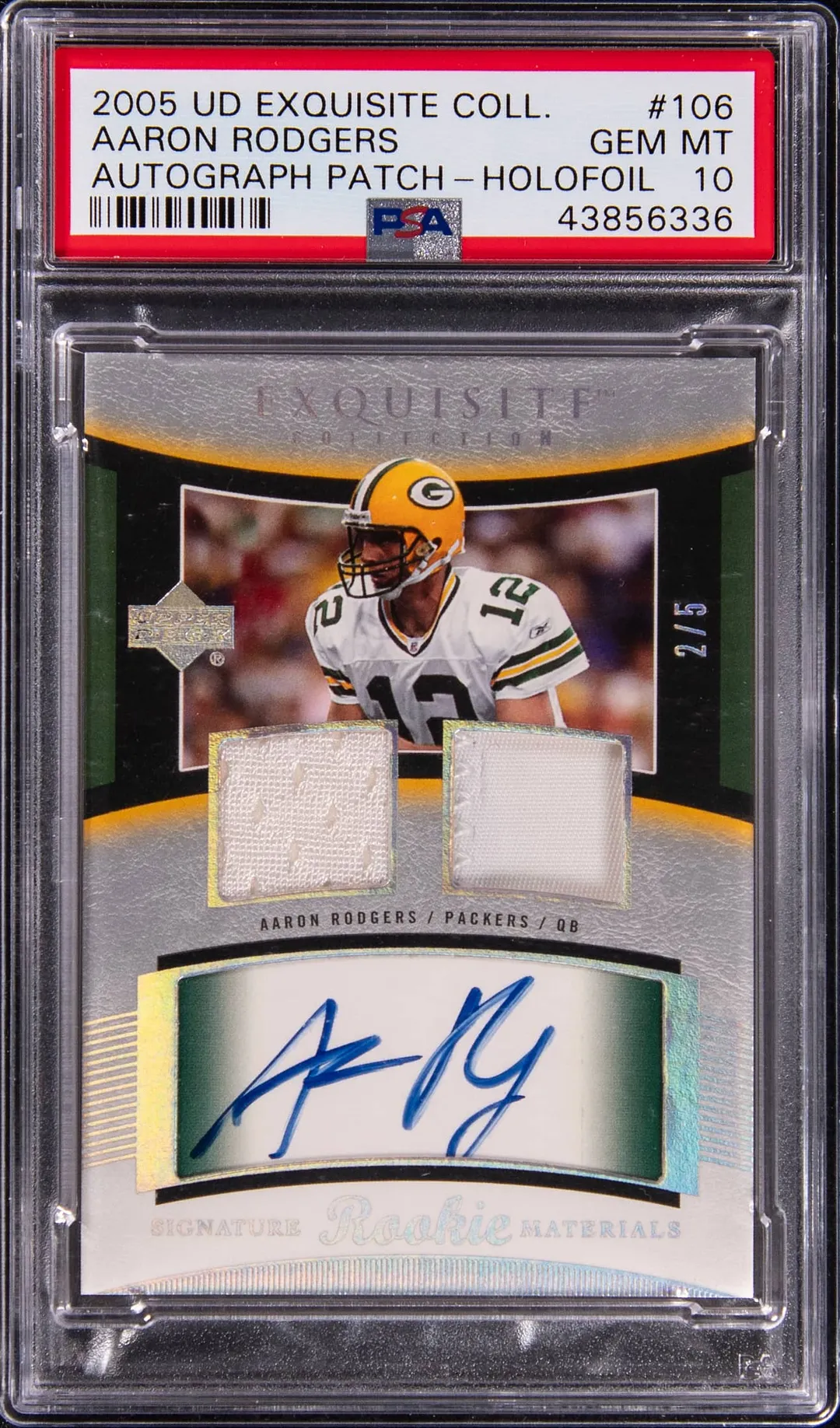
2005 Exquisite Aaron Rodgers Holofoil RPA Sale
Goldin sold a 2005 Exquisite Aaron Rodgers Holofoil RPA /5, PSA 10 (pop 2) for $14,640 on Feb 8, 2026. See why this rookie card matters to collectors.
Sold Card
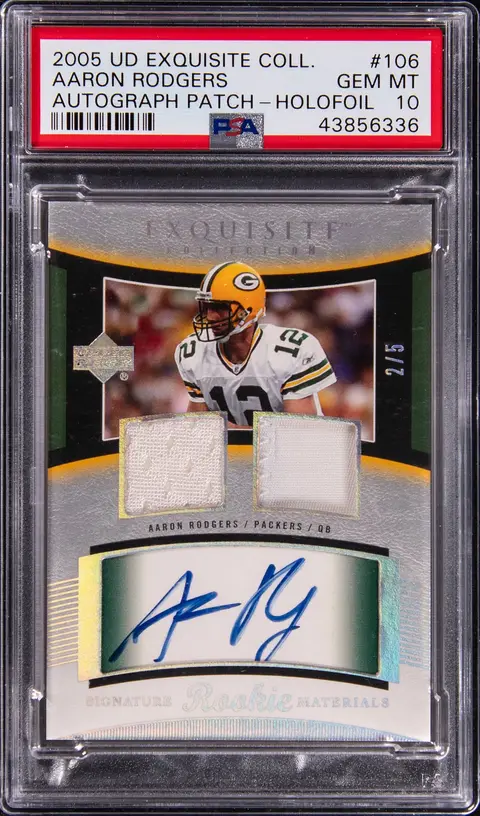
2005 Upper Deck Exquisite Collection Autograph Patch Holofoil #106 Aaron Rodgers Signed Game-Used Jersey Relic Rookie Card (#2/5) - PSA GEM MT 10 - Pop 2
Sale Price
Platform
GoldinAaron Rodgers’ best cardboard has always lived in the high‑end 2005 Exquisite and SP Authentic lanes, but every so often a sale cuts through the noise and reminds collectors just how important those early premium issues have become.
In early February 2026, Goldin sold a cornerstone piece:
2005 Upper Deck Exquisite Collection Autograph Patch Holofoil #106 Aaron Rodgers Signed Game‑Used Jersey Relic Rookie Card (#2/5) – PSA GEM MT 10 (Pop 2)
- Final price: $14,640
- Auction house: Goldin
- Sale date (UTC): 2026‑02‑08
Below, we’ll break down what this card is, why collectors care, and how this sale fits into the broader Aaron Rodgers and Exquisite rookie market.
What exactly is this card?
Let’s unpack the title piece by piece so newer and returning collectors can see why this card matters.
Core identity
- Player: Aaron Rodgers
- Team: Green Bay Packers
- Year: 2005
- Set: Upper Deck Exquisite Collection
- Card number: #106
- Card type: Rookie card (from his true rookie year)
Exquisite was Upper Deck’s ultra‑premium football line in the mid‑2000s. Boxes were extremely expensive relative to the era, with very low print runs and on‑card autographs paired with game‑used patches. For many collectors, Exquisite sits in the same mental tier as National Treasures or Flawless does in modern releases.
Holofoil parallel and print run
This specific card is the Holofoil parallel of Rodgers’ Exquisite Rookie Patch Auto (often called an RPA). It is:
- Serial numbered to just 5 copies
- This copy is #2/5
A serial number tells you how many copies exist; “/5” means only five were made. That puts it in true “ultra‑short print” territory.
Autograph and patch details
- Autograph: On‑card signature (Rodgers signed the card itself, not a sticker)
- Memorabilia: Game‑used jersey relic patch
The combination of an on‑card auto with a game‑used (not player‑worn) patch is a major driver of collector interest. Game‑used confirms the jersey saw actual NFL action, which matters a lot for serious high‑end buyers.
Grading and population
- Grading company: PSA (Professional Sports Authenticator)
- Grade: GEM MT 10 (PSA’s highest standard grade for non‑premium labels)
- Population: Pop 2 at PSA
“Pop” (population) refers to how many copies of a specific card have received a specific grade from a grading company. A pop 2 in PSA 10 means only two examples of this exact card/parallel have ever earned a GEM MT 10 grade.
Because the card itself is already limited to five copies, having only two in PSA 10 makes this a very tight supply situation at the top.
Why collectors care about 2005 Exquisite Rodgers RPAs
Key rookie from a critical set
Among Rodgers’ rookie cards, collectors usually focus on a small group of “tier one” issues:
- 2005 SP Authentic Rookie Patch Auto
- 2005 Exquisite Collection Rookie Patch Auto and its premium parallels
Exquisite sits at the luxury end of that spectrum. Within Exquisite, the Holofoil /5 is one of the most premium, low‑print versions of his rookie patch auto. It checks multiple boxes that matter to long‑term hobbyists:
- True rookie card from his debut year
- High‑end brand with strong historical reputation
- On‑card auto
- Multi‑color game‑used patch
- Extremely low serial numbering (/5)
Era and scarcity
2005 falls outside the true “vintage” era and well before the “ultra‑modern” explosion. Print runs were significantly lower than current flagship releases, especially for a boutique product like Exquisite.
That combination—limited print runs and a player who went on to become a multi‑time MVP and Super Bowl champion—has kept 2005 high‑end Rodgers rookies in demand even as the hobby’s attention cycle rotates among newer QBs.
Player legacy
Without needing to forecast the future, Rodgers’ résumé already includes:
- Multiple NFL MVP awards
- A Super Bowl title and MVP
- Long‑term production with the Packers
That foundation alone makes his best rookie cards permanent fixtures in most serious football PC (personal collection) conversations.
Any time one of the very top examples of a top card (like a PSA 10 of an Exquisite /5) comes to market, it naturally draws attention.
Market and price context
To understand the $14,640 sale at Goldin on 2026‑02‑08, it helps to look at how collectors generally think about “comps” and price ranges.
“Comps” (comparable sales) are simply recent sales of the same card or very similar versions. They give a rough sense of where the market has been, without guaranteeing where it will go.
Because this card is:
- Limited to just five copies
- Graded PSA 10 with a pop of only two
reliable, frequent comps are hard to come by. Ultra‑short print cards like this do not trade often. When they do, factors such as patch quality, autograph strength, eye appeal, and timing can produce a wide range of prices.
Comparing to closely related cards
In situations where exact comps are scarce, collectors often look at:
- Other premium 2005 Rodgers Exquisite RPAs (base /199 and other low‑numbered parallels)
- Different grades of the same Holofoil /5
- Rodgers’ other top‑tier rookies (e.g., SP Authentic RPA) in similar grades
Across auction houses and major marketplaces, the pattern has been fairly consistent:
- Base Exquisite RPAs (higher print runs, like /199) in strong grades command meaningful four‑figure prices, with elite patches and top grades pushing past that.
- Low‑numbered parallels (like /25, /10, /5) typically see a sharp premium over the base, especially when paired with high grades and standout patches.
Within that framework, a $14,640 result for a PSA 10 Holofoil /5 fits the profile of a top‑end, event‑style sale rather than a routine transaction.
Rather than calling it high or low relative to a tight set of rarely seen comps, it’s more accurate to say:
- It reflects the scarcity of both the card (/5) and the grade (pop 2)
- It’s consistent with the broader pattern in which the very best copies of Rodgers’ premier rookie issues trade well above more common versions
Auction context: Goldin, 2026‑02‑08
This copy sold through Goldin, a major auction house known for handling a large share of high‑end sports cards and memorabilia.
The sale date—February 8, 2026 (UTC)—places this result in a period where:
- The NFL postseason still tends to keep football in the headlines
- Rodgers remains a constant part of hobby and media discussions, whether for on‑field performance or broader career narrative
High‑end buyers often time their purchases strategically around the NFL calendar, but in the case of a /5 Exquisite PSA 10, availability can matter even more than timing. When a pop 2 grail‑type rookie appears, collectors who have been waiting may not want to assume another copy will surface soon.
How this sale fits the broader Rodgers rookie landscape
If you zoom out beyond a single card, a few themes stand out:
1. Emphasis on true RPAs
Collectors continue to place a premium on:
- True rookie year issues
- On‑card autos
- Game‑used multi‑color patches
The 2005 Exquisite Rodgers RPA portfolio lines up perfectly with those preferences. The Holofoil /5 PSA 10 sits at the very top of that pyramid.
2. Grade scarcity is compounding card scarcity
With only five copies made, you might expect grading pops to stay low. But in practice, it’s not just that there are few copies—it’s that only two have ever been confirmed at PSA 10.
This creates an additional layer of scarcity:
- Even if you can locate one of the five raw or in another grade, you might never get back to this exact combination of card + grade.
3. Market views on established stars
As more modern QBs enter the league and cycles of hype move quickly, established players like Rodgers anchor the “proven production” segment of the market.
Without predicting future prices, this sale reinforces the idea that:
- The best, most condition‑sensitive rookie cards of established stars can still command strong attention when they do surface.
What this means for collectors and small sellers
Whether you’re a longtime Rodgers collector, a newer hobbyist, or a small seller learning the landscape, here are a few takeaways from this sale:
For collectors
- Understand tiers within a player’s rookies. Not all Rodgers rookies are created equal. Exquisite RPAs and their parallels sit at the top tier.
- Factor in both serial number and grade. A /5 card is rare on its own; pairing that with a PSA 10 pop 2 makes it significantly more special.
- Expect irregular comps. When a card is this scarce, you may not see clean price history. Each sale can function as its own event.
For small sellers
- Know what you have. If you handle any Exquisite‑era rookies, especially with on‑card autos and patches, it’s worth researching serial numbers, patch quality, and grading potential.
- Use population reports. PSA and other grading companies publish population data. Checking “pop reports” helps you understand how supply looks at each grade level.
- Choose venues carefully. Ultra‑high‑end pieces like this Rodgers Holofoil /5 often perform best at established auction houses (like Goldin in this case), where the right bidder base is already active.
Final thoughts
The 2005 Upper Deck Exquisite Collection Autograph Patch Holofoil #106 Aaron Rodgers Rookie Card (#2/5) – PSA GEM MT 10 (Pop 2) that closed for $14,640 at Goldin on 2026‑02‑08 is a clear reminder of how the hobby treats the very best versions of a star’s most important rookies.
In a market that sees thousands of new parallels and inserts every year, the combination of:
- True rookie status
- Exquisite branding
- On‑card auto + game‑used patch
- Ultra‑low serial numbering (/5)
- PSA 10 grade with pop 2
still stands out. For serious Rodgers collectors and high‑end football buyers, this sale will likely be a reference point the next time one of these extremely limited Holofoil copies surfaces.
At figoca, we track these kinds of sales not as predictions, but as markers—data points that help collectors understand how rarity, condition, and legacy interact in today’s trading card market.