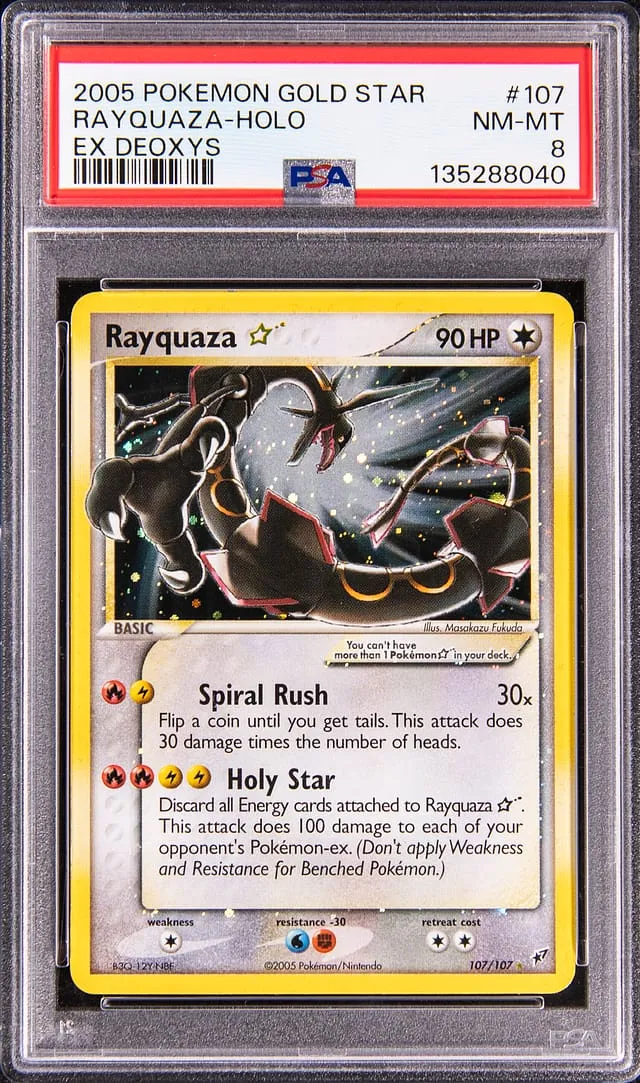
2005 EX Deoxys Rayquaza Gold Star PSA 8 Sale
Figoca looks at the $19,530 Goldin sale of a 2005 Pokémon EX Deoxys Rayquaza Gold Star Holo #107 graded PSA 8 and what it means for collectors.
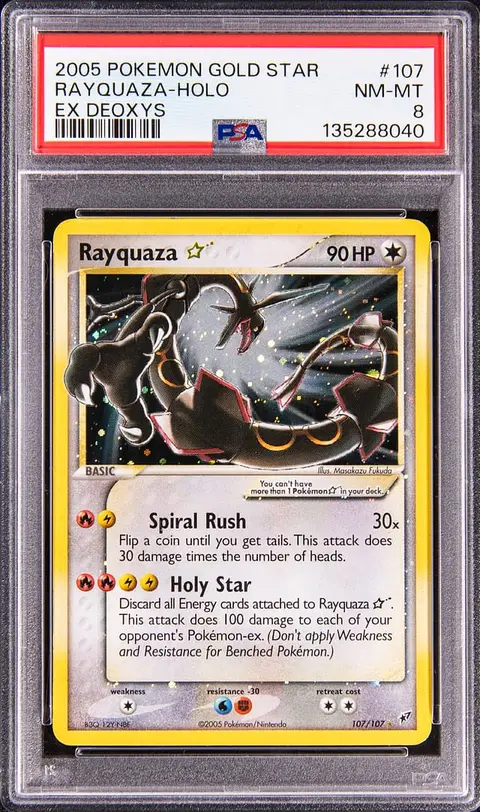
Sold Card
2005 Pokemon EX Deoxys Gold Star Holo #107 Rayquaza - PSA NM-MT 8
Sale Price
Platform
Goldin2005 Pokémon EX Deoxys Rayquaza Gold Star Holo #107 in a PSA 8 just changed hands for $19,530 at Goldin on February 16, 2026. For many collectors, this is one of the defining chase cards of the 2000s era, so it’s worth unpacking what this sale actually tells us about the current market.
The card at a glance
- Card: 2005 Pokémon EX Deoxys Gold Star Holo Rayquaza #107
- Character: Rayquaza
- Set: EX Deoxys (Nintendo e-Reader / EX era)
- Rarity / variant: Gold Star (shiny Pokémon, ultra-short print)
- Grading company: PSA (Professional Sports Authenticator)
- Grade: PSA NM-MT 8 (Near Mint–Mint)
- Attributes: Non-serial-numbered, no autograph, but an iconic key issue from the EX era
This is not a rookie card in the sports sense, but it is widely viewed as Rayquaza’s flagship premium card and one of the most important Gold Stars ever printed.
Why Gold Star Rayquaza matters
The Gold Star subset in the EX era introduced shiny versions of popular Pokémon with a distinct gold foil “★” next to the name. Pull rates were extremely low by modern standards, and EX-era sealed product was never opened at today’s volume. As a result, these cards are difficult to find clean even before grading.
Gold Star Rayquaza from EX Deoxys sits near the top of that food chain for a few reasons:
- Character popularity: Rayquaza is a headliner Legendary from the Ruby/Sapphire/Emerald generation, central to the Game Boy Advance era and Pokémon Emerald’s cover.
- Art and design: The dynamic Holo artwork and dark background make edge and surface flaws very visible. That drives a real separation in value between mid, high, and gem-mint grades.
- Set scarcity: EX Deoxys is one of the tougher EX sets to find sealed. Many surviving copies show print lines, edge whitening, or scratching.
In short, this card is a key EX-era grail for both character collectors and people building high-end Gold Star runs.
Understanding the PSA 8 grade
PSA’s NM-MT 8 grade means the card is in strong condition but shows light wear: often minor whitening on edges or corners and/or a light surface scratch. For a 2005 holo from a notoriously condition-sensitive set, PSA 8 is still considered a solid, collectible grade.
The population report (“pop report”) from PSA—essentially a census of how many copies exist in each grade—has historically shown a steep drop-off as you move up the ladder from PSA 8 to PSA 9 and especially PSA 10. That scarcity at the top is a major driver of the price spread between grades.
Market context and price positioning
The hammer price here was $19,530 at Goldin on February 16, 2026. To understand what that means, it helps to frame it against the broader market for this card and nearby grades.
When collectors talk about “comps” (comparables), they mean recent sales of the same card or very similar versions, used to get a sense of current market ranges.
Based on recent public auction and marketplace data leading into early 2026, the typical picture for EX Deoxys Gold Star Rayquaza looks roughly like this:
- PSA 10 copies have historically commanded very strong five-figure prices, and in some cases have reached into six-figure territory at market peaks. Exact numbers move with broader Pokémon sentiment, but top-grade copies sit in their own tier.
- PSA 9 copies have usually traded at a significant discount to 10s but still well above lower grades, reflecting the difficulty of landing a near-flawless copy.
- PSA 8 copies have tended to sit in the mid five-figure range during stronger Pokémon cycles and somewhat lower in softer markets, with noticeable volatility as collectors move between high and mid grades.
At $19,530, this particular PSA 8 result sits in the upper band of what has often been seen for an 8 in a stable-to-firm market, but below the territory reserved for 9s and 10s. That suggests:
- There is still healthy demand for mid-high grade copies of this card, not just the top of the pop.
- The card’s long-term status as a flagship Gold Star appears intact, even as broader Pokémon prices have cooled off from earlier spikes.
Because individual results can be influenced by eye appeal (centering, print quality) and auction-specific factors (timing, competing lots, marketing), it’s better to view this number as a data point within a range, not a hard benchmark.
Where this sale fits historically
Historically, record headlines for this card have come from gem-mint examples, particularly PSA 10 and, for some time, high-grade BGS copies. Those top-grade results helped cement Gold Star Rayquaza as a reference point for high-end Pokémon.
This PSA 8 sale at $19,530 is not a record for the card overall, but it does underline a few important themes:
- Grade ladder is still steep: Even as the market matures, there remains a clear, meaningful tiering between PSA 8, 9, and 10.
- Mid-grade liquidity: The fact that an 8 can still draw strong bidding at a major auction house like Goldin indicates continued depth of demand among serious collectors who are priced out of 10s but still want a trophy-level card.
- EX-era resilience: EX sets occupy a middle ground between vintage (early WotC) and modern/ultra-modern. Supply is limited, nostalgia is strong, and print runs are far lower than most modern sets. That combination has helped these key cards hold attention even as tastes cycle.
Factors that can influence interest
Several dynamics can affect interest in a card like this over time:
- Nostalgia waves: Collectors who grew up with the Game Boy Advance and Nintendo DS era tend to hit peak purchasing power over the next decade, often targeting exactly these EX-era chase cards.
- Set-level collecting: Some hobbyists are building full Gold Star runs or EX Deoxys master sets. That structural demand can support prices even when general Pokémon interest cools.
- Condition awareness: As more collectors learn how hard true mint copies are to find, they may become more comfortable with PSA 8–9 as long-term collection grades, which can support mid-grade pricing.
None of this guarantees any future outcome, but it does give context for why an eight from 2005 can still command almost twenty thousand dollars in 2026.
What this means for different types of collectors
For newcomers:
This sale is a reminder that Pokémon has a spectrum. At the very top are cards like Gold Star Rayquaza that behave more like fine collectibles than like casual trading cards. Watching high-end sales can help you understand which sets and eras have deep, persistent demand.
For returning collectors from the EX era:
If you opened EX Deoxys as a kid, seeing a PSA 8 copy of Gold Star Rayquaza reach $19,530 at Goldin on February 16, 2026, is a clear signal that your childhood chase card has become a long-term hobby centerpiece. Even if you’re not buying at this level, it can be motivating to dig out old binders and learn about grading and condition.
For active hobbyists and small sellers:
This result is useful as a data point, not a price guarantee:
- It shows that well-presented, authenticated copies consigned to a major auction house can still draw strong attention.
- It highlights how important it is to understand grade gaps: the difference in market value as you move from PSA 7 to 8 to 9 to 10.
- It underscores the value of checking multiple comps (recent comparable sales) before making any buy or sell decision.
Takeaways
The 2005 Pokémon EX Deoxys Gold Star Holo Rayquaza #107 PSA 8 sale at $19,530 via Goldin on February 16, 2026 reinforces this card’s place as one of the defining EX-era grails. It may not be a headline record, but it’s a clear, recent example of how the market continues to respect iconic Gold Stars across the grade ladder.
As always, it’s best to treat results like this as context, not certainty. For collectors, the core value of a card like this often lies as much in its history and personal connection as in any single sale price.