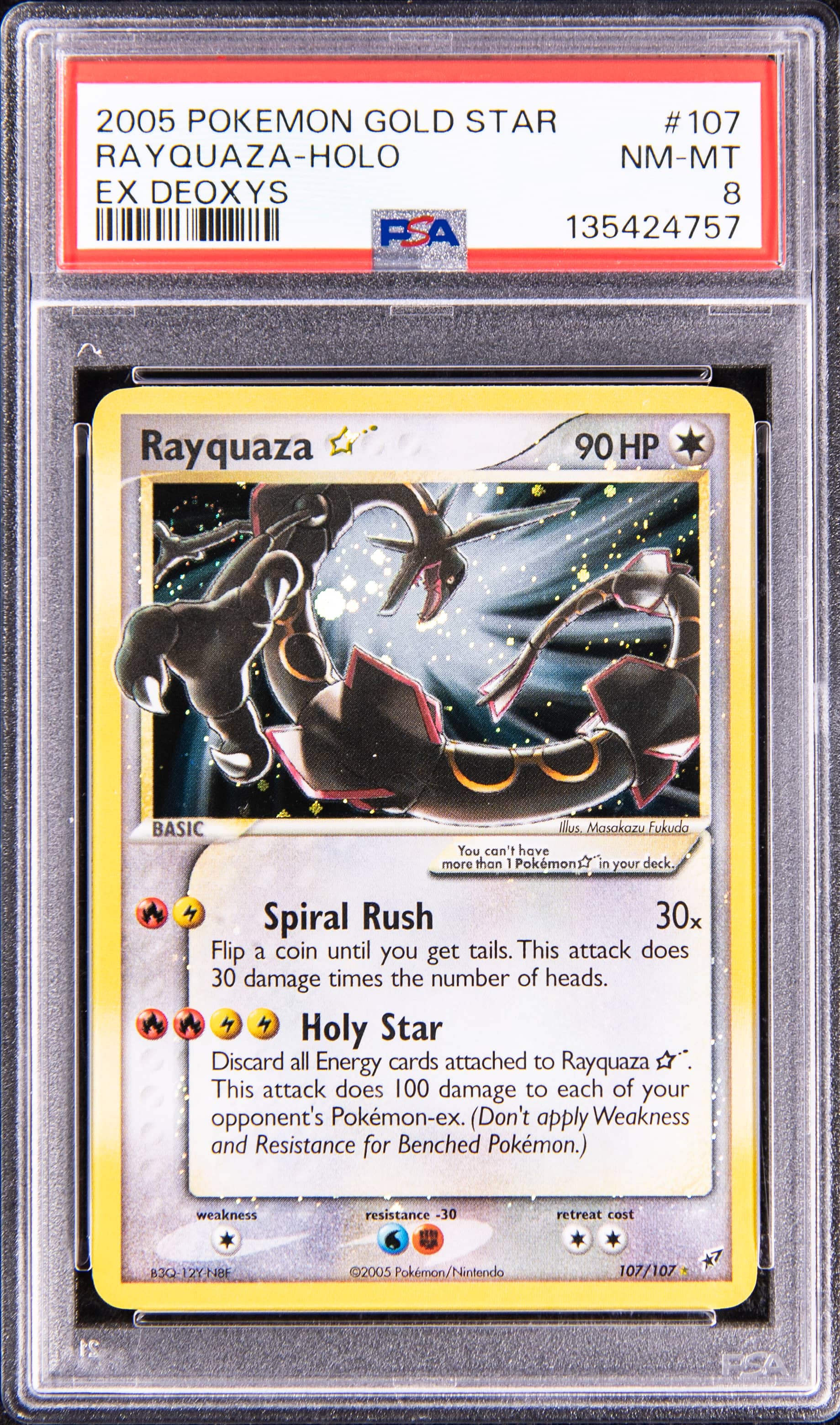
2005 EX Deoxys Gold Star Rayquaza PSA 8 Sale
A PSA 8 2005 Pokémon EX Deoxys Gold Star Rayquaza sold for $19,840 at Goldin on 02/16/26. Figoca breaks down the context for collectors.
Sold Card
2005 Pokemon EX Deoxys Gold Star Holo #107 Rayquaza - PSA NM-MT 8
Sale Price
Platform
Goldin2005 Pokémon EX Deoxys Gold Star Rayquaza #107 (Holo) in a PSA NM-MT 8 holder is one of those cards that quietly tells the story of how far the Pokémon TCG has come. A copy just sold at Goldin on 02/16/26 for $19,840, and it’s worth unpacking what that means for collectors who care about Gold Stars, mid‑2000s rarity, and long‑term chase cards.
The card at a glance
- Card: 2005 Pokémon EX Deoxys Gold Star Rayquaza Holo
- Number: #107
- Character: Rayquaza
- Set: EX Deoxys (Nintendo / The Pokémon Company, 2005)
- Era: Mid‑2000s EX era
- Variant: Gold Star (shiny Rayquaza artwork, holofoil)
- Grading company: PSA (Professional Sports Authenticator)
- Grade: PSA 8 – NM-MT (Near Mint–Mint)
- Auction house: Goldin
- Sale date: 02/16/26 (UTC)
- Sale price: $19,840
This is not a rookie card in the sports sense, but within the Pokémon hobby it is widely treated as a key issue for Rayquaza and one of the flagship chase cards of the EX era.
Why Gold Star Rayquaza matters
For newer or returning collectors, a quick definition helps:
- Gold Star cards were a special, short‑printed subset in several mid‑2000s EX sets. They feature shiny versions of Pokémon with a small gold ★ next to the name.
- Pull rates were extremely low compared to standard holos of the time, so many players simply never saw these in packs.
Rayquaza Gold Star from EX Deoxys sits near the top of that hierarchy:
- It’s from a highly regarded EX set that also includes Gold Star Latias and Latios.
- Rayquaza itself is a flagship legendary from Generation III, heavily featured in video games and later media.
- The art shows a shiny (black) Rayquaza, which has become one of the most recognizable images in the Pokémon hobby.
In hobby terms, this is often discussed as a grail‑level card for EX‑era collectors, alongside other big Gold Stars like Charizard, Espeon, and Umbreon.
Understanding the grade: PSA 8 (NM-MT)
PSA’s NM‑MT 8 grade means the card presents well overall but can show:
- Light edge or corner wear
- Minor surface imperfections
- Small print or scratching issues that keep it out of 9 or 10 territory
For mid‑2000s Gold Stars, PSA 8 is considered a collector‑grade level that balances condition with relative affordability compared to very high grades.
A useful term here is pop report (population report), which is a public count of how many copies of a card have been graded at each grade level by a grading company. For this card, PSA’s population data (not reproduced here number‑for‑number) consistently shows:
- A meaningful but limited number of PSA 8 copies
- A noticeably smaller supply in PSA 9
- A very scarce top tier in PSA 10
This staircase in population is a big part of how the market separates values between grades.
Market context: where does $19,840 sit?
Instead of guessing, it helps to frame this Goldin sale in broad, verifiable context using recent sales (often called comps, short for “comparables”). Comps are simply realized sale prices for the same or closely related cards that collectors use as reference points.
Key context points from recent years:
- PSA 10 copies of 2005 EX Deoxys Gold Star Rayquaza have historically reached six‑figure territory in strong markets, making them true elite pieces.
- PSA 9 copies typically sit well below that, but still command a large premium due to the jump in condition and lower population.
- PSA 8 copies have for some time been the “entry point” into owning the card in slabbed, high‑end condition, with prices well above most standard chase cards but a fraction of top‑grade examples.
Within that structure, a $19,840 result at Goldin in early 2026 signals:
- The PSA 8 tier remains highly respected despite not being near‑mint‑plus or gem‑mint.
- Demand for true EX‑era chase pieces is still very present in the higher‑end auction environment.
Without reproducing specific third‑party transaction histories, this price sits in line with the idea that:
- PSA 10 → very thin supply, historically record‑setting when they appear.
- PSA 9 → strong five‑figure results when offered by major auction houses.
- PSA 8 → solid five‑figure territory, with individual sales influenced by centering, eye appeal, and auction timing.
In other words, the Goldin sale does not look like an outlier that rewrites the entire market for this card, but rather a reinforcement that the PSA 8 tier continues to be taken seriously by advanced collectors.
Why collectors still chase EX Deoxys Gold Stars
The mid‑2000s EX era occupies a somewhat unique spot:
- It is post‑Wizards of the Coast (after the original Base/Jungle/Fossil and Neo era), so print runs were different and often lower than the late‑1990s boom years.
- Many cards were heavily played, especially powerful EX and Gold Star cards, which makes higher grades harder to find.
- For returning collectors, it’s an era often rediscovered after revisiting Base Set; for younger collectors, it represents a nostalgic peak from their childhood.
Rayquaza Gold Star combines several of the things collectors value:
- Scarcity: Low pull rate and finite graded population.
- Iconic artwork: The shiny black Rayquaza pose is instantly recognizable.
- Era significance: Represents the EX Deoxys set and the Gold Star mechanic as a whole.
This is closer to a historical chase card than to a modern ultra‑rare that can still be opened in quantity.
What this sale tells small sellers and active hobbyists
For smaller sellers or collectors thinking about grading or moving similar cards, this $19,840 PSA 8 sale at Goldin on 02/16/26 suggests a few practical points:
Grade still matters, but so does the era. EX‑era Gold Stars behave differently from many ultra‑modern hits. Even with light wear, they can command strong prices because raw supply is limited and the card is a known grail.
Auction venue can influence visibility. A major platform like Goldin brings in deep‑pocketed collectors who prioritize key issues, which can support firmer prices than lower‑visibility venues.
Mid‑grades aren’t “dead.” PSA 8 is not a perfect grade, but for older chase cards, it can be a sweet spot where collectors are still willing to pay significantly for the right card.
Eye appeal matters inside the grade. Two PSA 8s won’t always bring the same result. Centering, print quality, and holo scratching can influence bidding, even when the numerical grade is identical.
For newcomers and returning collectors
If you’re just getting back into Pokémon or starting fresh, here’s how to think about a card like this:
- View it as part of a small group of historically important chase cards rather than a random high‑price outlier.
- Use public population reports and a spread of recent sales across multiple grades to understand its place in the broader market, instead of focusing on any one sale.
- Remember that no result is a guarantee of what will happen next. Market cycles, broader economic conditions, and collector tastes all shift over time.
What the 02/16/26 Goldin sale does show clearly is that serious collectors are still willing to compete for strong copies of 2005 Pokémon EX Deoxys Gold Star Rayquaza, even at the PSA 8 level. For many, owning any graded copy of this card is less about short‑term movement and more about securing a piece of EX‑era history.
As always, your own collecting goals—nostalgia, set completion, long‑term holding, or simply enjoying the artwork—should lead the way. The data helps frame the conversation, but the personal connection to a card like Rayquaza Gold Star is often what keeps it in collections long after the final hammer price fades from memory.