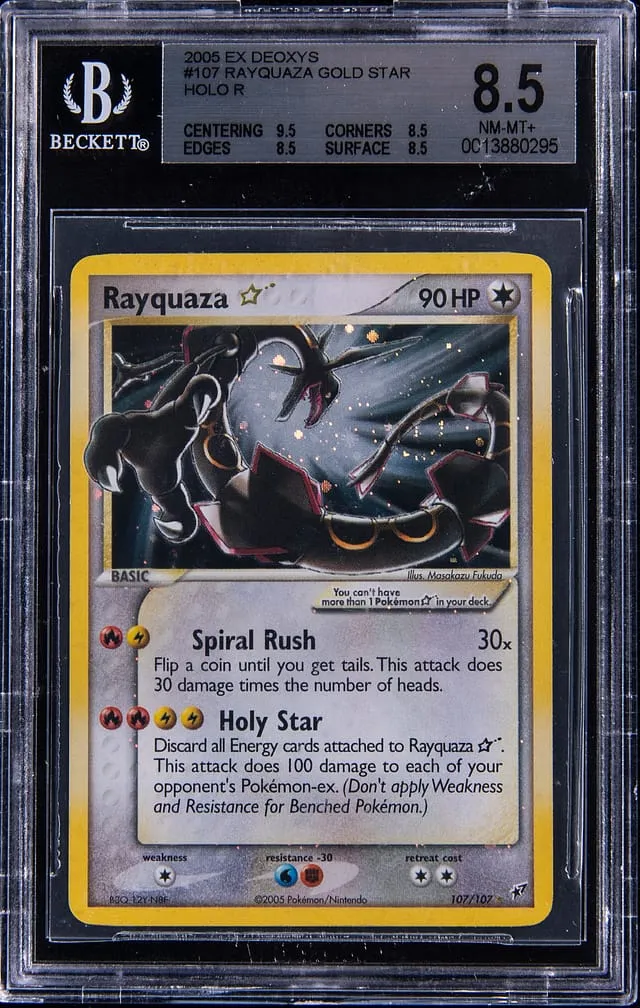
2005 EX Deoxys Gold Star Rayquaza BGS 8.5 Sale
Breakdown of the 2005 Pokémon EX Deoxys Gold Star Rayquaza BGS 8.5 sale for $22,265 at Goldin on March 9, 2026, with market and collector context.
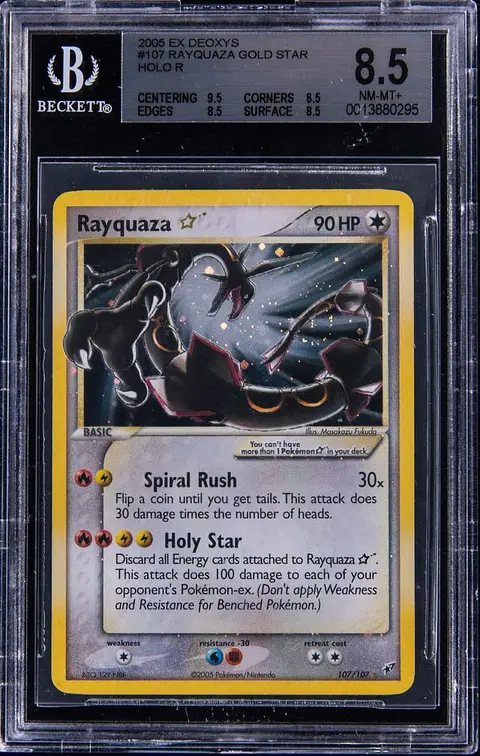
Sold Card
2005 Pokemon EX Deoxys Holo #107 Gold Star Rayquaza - BGS NM-MT+ 8.5
Sale Price
Platform
Goldin2005 Pokémon EX Deoxys Gold Star Rayquaza BGS 8.5 Sells for $22,265
On March 9, 2026, a copy of one of the most chased Pokémon cards of the 2000s crossed the block at Goldin: a 2005 Pokémon EX Deoxys Holo #107 Gold Star Rayquaza, graded BGS NM-MT+ 8.5, closing at $22,265.
For collectors who track the high-end Pokémon market, Gold Star Rayquaza is a familiar name. This sale adds another data point to a card that has quietly become a benchmark for mid‑2000s Pokémon rarity and demand.
The card at a glance
- Card: 2005 Pokémon EX Deoxys Holo Rayquaza ★ (Gold Star)
- Card number: #107
- Character: Rayquaza
- Set: EX Deoxys (Nintendo / Pokémon, 2005)
- Era: EX-era (mid‑2000s, often treated as “early modern” Pokémon)
- Variant: Gold Star (shiny Rayquaza variant with the gold ★ next to the name)
- Rarity: Ultra-rare, low pull rate
- Grading company: Beckett Grading Services (BGS)
- Grade: NM-MT+ 8.5
- Attributes: Holofoil, non-promo, pack‑pulled chase card
- Auction house: Goldin
- Sale date (UTC): 2026-03-09
- Sale price: $22,265
This is not a rookie card in the sports sense, but within Pokémon it is considered a key issue: a central, high‑importance card for the character and the era.
Why Gold Star Rayquaza matters
Gold Stars and the EX-era
The EX-era sets (roughly 2003–2007) are known for:
- Lower print runs compared with many later Pokémon releases
- Tough holo and ultra‑rare pulls
- Cards that were frequently played, handled, and stored in less-than-ideal ways
Within these sets, Gold Star cards are a special ultra‑rare tier. They feature shiny versions of Pokémon, marked by a gold ★ next to the name and unique artwork. Pull rates were notoriously low, which means surviving high-grade copies are heavily contested.
Rayquaza is one of the standout Gold Stars. The EX Deoxys #107 Rayquaza ★ is widely viewed as:
- One of the top chase cards of the EX era
- A centerpiece for collectors focusing on Rayquaza, Gold Stars, or 2000s Pokémon
- A flagship example when people talk about how demanding EX-era grading can be
Character significance: Rayquaza
Introduced in Generation III (Ruby, Sapphire, Emerald), Rayquaza quickly became a fan favorite. As the cover legend for Pokémon Emerald and an anchor of the Hoenn legendary trio, Rayquaza sits in the same tier of hobby recognition as Lugia or Ho‑Oh for many collectors.
The Gold Star version captures Rayquaza in its shiny black form, which adds another layer of appeal. For a lot of collectors, this is the Rayquaza card to own.
Grading context: BGS 8.5 for an EX-era Gold Star
This copy received a BGS 8.5 (NM-MT+). In Beckett’s scale, that’s a high-end raw equivalent with only modest flaws: slight edge or corner wear, minor surface or centering issues.
EX-era Gold Stars are hard to grade, because:
- Dark borders make whitening and edge dings more visible
- Printing and cutting from the era weren’t always precise
- Many copies were pulled and kept by younger collectors, not immediately sleeved or graded
While exact population data (often called the pop report, a count of how many copies exist at each grade) changes over time, the pattern for Gold Star Rayquaza across grading companies is consistent:
- Very few GEM MINT 10s
- A small but meaningful cluster in the 8.5–9 range
- A long tail of lower-grade, heavily handled copies
In short, 8.5 is a respectable mid‑high grade for this card, particularly in BGS, where subgrades and stricter centering standards can make top marks harder to achieve.
Market context and comps
Collectors often refer to “comps” (comparable sales) to understand where a new sale sits relative to recent history. While exact prices fluctuate with time and platform, a few broad patterns around Gold Star Rayquaza have been clear:
- Top grades (BGS/PSA 9–10): These have historically commanded a substantial premium, often reaching well into the mid‑five‑figure range or beyond for the very best examples during peak periods.
- Mid grades (around 7–8): Prices tend to step down noticeably from 9s, reflecting visible wear and the strong preference some collectors have for near-mint or better copies.
- Crossover zone (8–8.5): This is where price sensitivity shows up. Slight changes in centering, eye appeal, or subgrades can create a meaningful spread between sales that, on paper, share the same numeric grade.
Placed within that framework, the $22,265 result for this BGS 8.5 at Goldin sits in what has recently been a strong but not extreme range for high-end, non‑gem examples of this card:
- It reflects ongoing demand for Gold Star Rayquaza even outside the absolute top grades.
- It confirms that the card continues to behave like a key EX-era benchmark, with mid‑high grades still attracting serious bidders.
Because the Pokémon market has cycled through growth and consolidation phases over the last few years, individual sales can land slightly above or below nearby comps depending on timing, venue, and card presentation. This Goldin result fits neatly into that evolving picture rather than standing out as an outlier.
Why collectors care about this specific copy
Several factors made this particular card worth tracking:
- Established key card: Gold Star Rayquaza is a known quantity in the hobby, not a new or speculative chase.
- Respected grading standard: A BGS 8.5 carries clear expectations for condition, and many advanced collectors are comfortable evaluating eye appeal from scans.
- Auction venue: Goldin tends to gather serious bidders for high-end Pokémon, which often produces data points that collectors use as reference for private deals and other auctions.
- Mid-high grade sweet spot: For some buyers, 8.5 offers a balance between condition and price. It’s significantly cleaner than heavily played copies, but far less expensive than the small population of gem‑level cards.
What this sale suggests about the EX-era market
EX-era Pokémon continues to settle into its role between vintage (Wizards of the Coast) and modern sets:
- Scarcity: Print runs were lower than many modern releases, and survival rates in top condition are modest.
- Condition sensitivity: Darker borders and older storage habits mean a lot of copies show whitening, creases, or scratches.
- Collector maturity: Many people who grew up with these sets are now returning as adult collectors, focusing on the exact cards they once pulled or chased.
Seeing a Gold Star Rayquaza BGS 8.5 confirm a five‑figure sale price in 2026 adds weight to the idea that EX-era anchors like this card have graduated from “emerging” to “established” key pieces.
Takeaways for different types of collectors
New or returning collectors
- Gold Star Rayquaza is a helpful reference point for understanding how rarity, condition, and character popularity come together in Pokémon.
- You don’t need this exact card to participate. Watching how it performs can inform how you think about other EX-era Gold Stars or key chase cards from your own favorite sets.
Active hobbyists
- This sale reinforces the importance of grades in the 8–9 band for EX-era chase cards. The jump from played copies to clean, mid‑high examples remains significant.
- Tracking venue (Goldin vs. fixed-price marketplaces) continues to matter when interpreting comps.
Small sellers and flippers
- When looking at raw EX Deoxys or other EX-era cards, this result is a reminder of how strongly condition drives outcomes.
- High-end buyers are clearly willing to compete for well‑presented, authenticated copies of established key issues, even outside gem mint territory.
Final thoughts
The 2005 Pokémon EX Deoxys Holo #107 Gold Star Rayquaza has long been one of the defining cards of the EX era. The $22,265 BGS 8.5 sale at Goldin on March 9, 2026 doesn’t rewrite the record books, but it does something just as important for long‑term collectors: it provides another clear, public marker of where this card stands in the current market.
As more data points accumulate across grades and auction houses, Gold Star Rayquaza continues to serve as a useful barometer for how the hobby values mid‑2000s Pokémon rarity, condition, and nostalgia all at once.