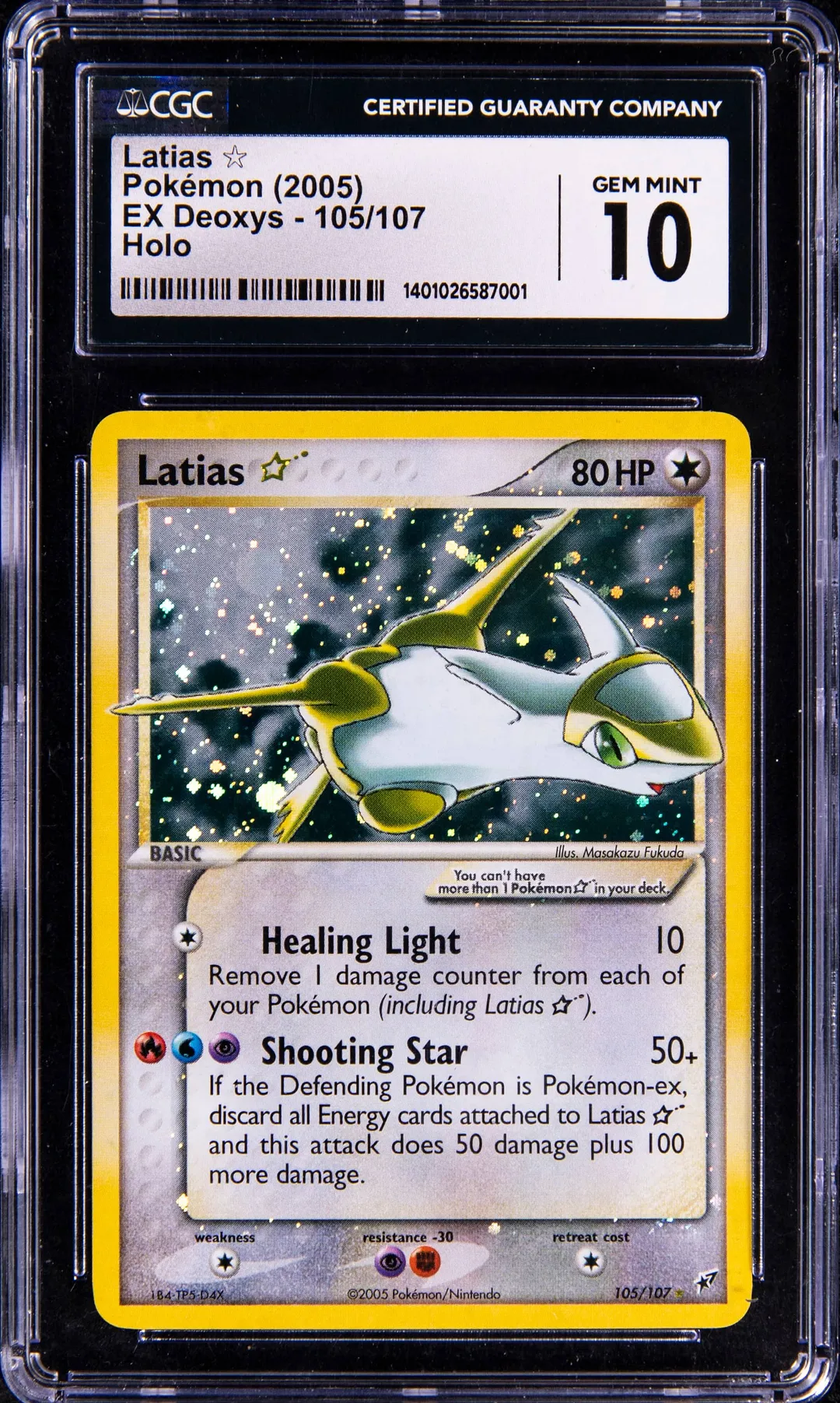
2005 EX Deoxys Gold Star Latias CGC 10 sells for $31K
Goldin sold a 2005 Pokémon EX Deoxys Gold Star Latias CGC Gem Mint 10 for $31,000 on Feb 16, 2026. See the card’s context and market significance.
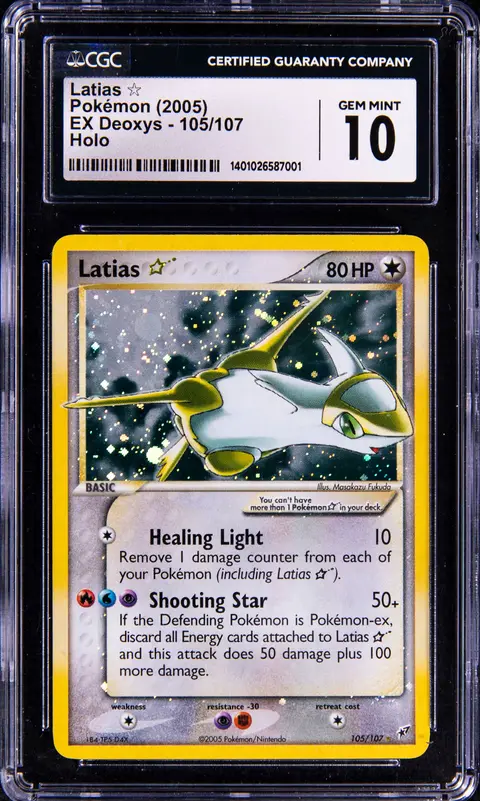
Sold Card
2005 Pokemon EX Deoxys Holo #105 Gold Star Latias - CGC GEM MINT 10
Sale Price
Platform
Goldin2005 Pokémon EX Deoxys Gold Star Latias CGC 10 Sells for $31,000
On February 16, 2026, Goldin auctioned a major mid‑2000s Pokémon chase card: a 2005 Pokémon EX Deoxys Holo #105 Gold Star Latias, graded CGC Gem Mint 10, which closed at $31,000.
For collectors who track Gold Stars and the EX era closely, this is a meaningful data point. Below we break down what the card is, why it matters, and how this result fits into the broader market.
The Card at a Glance
- Character: Latias
- Year & Era: 2005, EX era (often grouped as early “vintage‑adjacent” for Pokémon)
- Set: EX Deoxys
- Card Number: #105
- Variant: Gold Star (shiny variant, marked by a gold ★ next to the name)
- Rarity: Secret rare within the set
- Grading Company: CGC (Certified Guaranty Company)
- Grade: Gem Mint 10
- Attributes: Holofoil, Gold Star chase card, no autograph or patch (Pokémon doesn’t use those in the sports‑card sense)
- Rookie/Key Issue?: Not a “rookie card” in the sports sense, but a key Gold Star issue and one of the headliners of EX Deoxys.
Gold Star cards are a short‑printed tier of chase cards from mid‑2000s Pokémon sets. They depict shiny versions of the Pokémon and were intentionally difficult to pull at release. EX Deoxys contains several of the most recognizable Gold Stars, and Latias is among the more coveted non‑box‑legendary characters of the run.
Why EX Deoxys Gold Star Latias Matters
Gold Star Era Importance
Gold Stars (2004–2007) are widely seen as a bridge between true WotC vintage (Base–Neo) and the modern era. For many collectors who started in the early to mid‑2000s, these were the ultimate pack‑hit cards.
Key reasons collectors care about Gold Star Latias:
- Low Pull Rates: Gold Stars from this era are believed to have extremely low pack odds. While exact print numbers aren’t publicly confirmed, the accepted hobby view is that they were among the hardest pulls of the time.
- Shiny Artwork: Latias appears in its shiny form, which adds to the chase. Shiny legendaries combine rarity in‑game with rarity on cardboard.
- Set Reputation: EX Deoxys is a high‑profile EX‑era set, also containing cards like Gold Star Rayquaza. That association helps pull attention to Latias within the broader Gold Star conversation.
- Mid‑2000s Nostalgia: For collectors who grew up with the Game Boy Advance and early DS era, EX Deoxys sits right in a nostalgia sweet spot.
Put simply, this card is a cornerstone target for anyone building a Gold Star run or a focused EX Deoxys collection.
The CGC Gem Mint 10 Factor
CGC has become a prominent grading company in Pokémon, known for relatively strict grading standards, particularly on centering and surface.
- Gem Mint 10 on a mid‑2000s holo like this signals strong condition across corners, edges, centering, and surface.
- EX‑era cards are prone to print lines, chipping, and edge wear, so top grades are genuinely tough.
While population reports (or “pop reports” — census data showing how many copies exist in each grade) periodically change, the consistent pattern across grading companies is that high‑grade Gold Star Latias is scarce relative to demand.
A CGC 10 does not always map 1:1 to a PSA 10 or BGS 9.5/10 in price, but it increasingly stands on its own as collectors have gotten more familiar with CGC’s scale and consistency.
Market Context and Recent Sales
This Goldin sale closed at $31,000. To put that into context, we look at how this card has behaved across grades and grading companies. Specific numbers move over time, but a general pattern has emerged:
- PSA 10 Gold Star Latias has historically been one of the stronger Gold Stars price‑wise among the non‑Rayquaza tier, with past results in the high four‑figure to notable five‑figure range depending on timing and venue.
- BGS and CGC 9.5/10 examples have typically formed a tier below PSA’s strongest results, but the gap has narrowed as CGC has built a track record in the Pokémon space.
- Lower grades (PSA/CGC 8–9) trade at materially lower levels, often used by collectors who want the card but are willing to compromise on condition.
Within that structure, a $31,000 closing for a CGC Gem Mint 10:
- Sits in the upper range of what has been seen historically for top‑grade Gold Star Latias.
- Reflects the ongoing premium for high‑grade, low‑supply Gold Star examples from strong EX‑era sets.
- Confirms that the card is still firmly in the conversation as a major mid‑2000s chase, rather than a fringe collectible.
Because private sales and off‑platform deals are common, we can’t say with precision whether this is an absolute record, but it clearly belongs in the top tier of publicly visible Latias Gold Star results.
How This Fits Into the Broader Gold Star Market
Gold Stars as a group have shown a few consistent themes in recent years:
- Strong separation by grade: The gap between mid‑grade and gem mint examples is wide. Condition rarity matters a lot for EX era.
- Set‑driven demand: Cards from headlining sets (like EX Deoxys, EX Dragon Frontiers, and EX Power Keepers) tend to track together directionally. When one marquee card in a set sees strength, related Gold Stars often benefit from renewed attention.
- Collector‑led demand: Many buyers of Gold Stars are long‑term collectors rather than short‑term flippers. That can make the market less reactive to short news cycles and more tied to nostalgia and long‑term views on scarcity.
In that context, the Goldin sale reinforces a few points:
- EX Deoxys remains a priority set, with its Gold Stars continuing to command meaningful premiums.
- Top‑grade copies are still thinly supplied. When a CGC 10, PSA 10, or BGS 9.5/10 surfaces at a major auction house, it can draw competitive bidding simply because another may not appear for some time.
What This Means for Different Types of Collectors
New or Returning Collectors
If you are just getting back into Pokémon and you see a $31,000 sale, it can feel distant from everyday collecting. A few practical takeaways:
- This sale does not mean every EX Deoxys card is worth five figures. The result is specific to a top‑tier rarity in a top‑tier grade.
- You can still participate in the EX era through lower grades or less scarce holos from the set.
- Use high‑end results like this as a reference point, not as a price anchor for every version of Latias or every Gold Star.
Active Hobbyists and Small Sellers
For those already operating in the space, the Goldin result is a useful comp — a comparable sale used to gauge relative value.
- If you own a Gold Star Latias in a lower grade, this sale suggests that condition premiums remain strong. The gap between, say, an 8 and a 10 is not just incremental — it’s exponential.
- If you handle other EX Deoxys Gold Stars, this is another signal that the set remains a serious focus for high‑end collectors.
- If you’re debating which cards to grade, it reinforces the idea that clean EX‑era Gold Stars, even if raw, can justify grading costs if they truly have gem‑mint potential.
No Predictions, Just Context
It’s important not to read any single auction as a promise for the future. Prices are shaped by:
- Who showed up to bid that day
- How the card was presented and timed
- Broader market confidence at that moment
This Goldin sale tells us that as of February 16, 2026, serious buyers were prepared to pay $31,000 for a CGC Gem Mint 10 EX Deoxys Gold Star Latias. It doesn’t guarantee what the next one will do, but it adds a clear marker to the card’s price history.
Final Thoughts
The 2005 Pokémon EX Deoxys Holo #105 Gold Star Latias in CGC Gem Mint 10 closing at $31,000 at Goldin is another reminder of how much attention mid‑2000s Pokémon continues to command.
For collectors, it underscores a few core principles:
- Scarcity plus nostalgia plus condition still drive the top of the market.
- Gold Stars from headline EX sets remain central targets for advanced collections.
- Careful grading and preservation can meaningfully change how a card participates in the market.
As more data points like this emerge across auction houses, they help refine our understanding of where the EX‑era Gold Stars sit in the larger Pokémon landscape — both as nostalgic artifacts and as some of the most sought‑after cards of their time.