2005-06 SP Authentic Jordan Auto Patch PSA 9 Sale
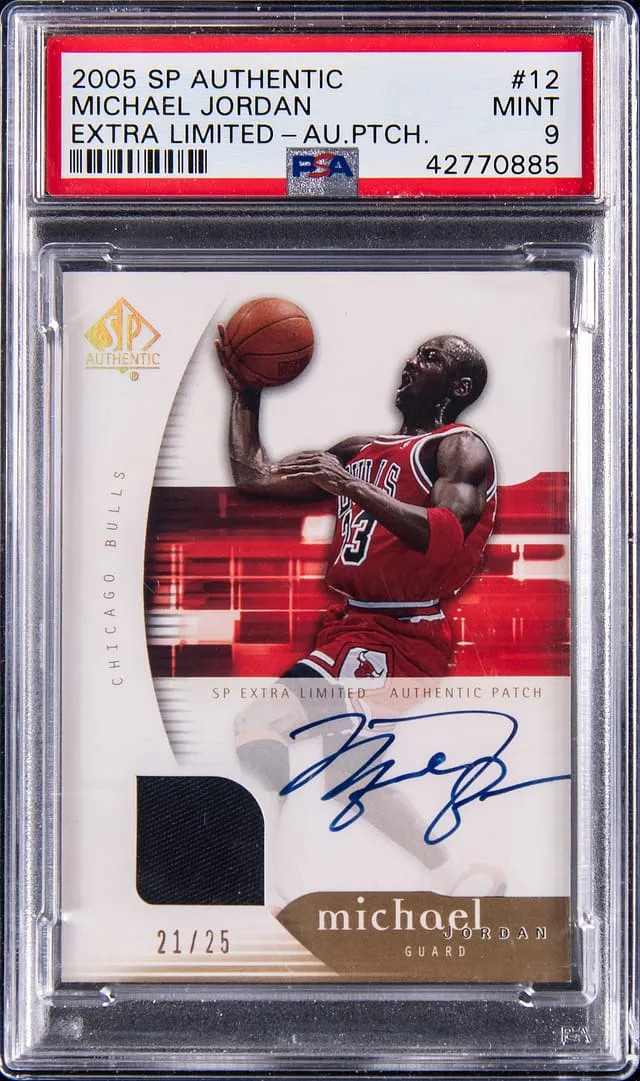
Goldin sold a 2005-06 SP Authentic Extra Limited Michael Jordan auto patch PSA 9 /25 for $26,842. See what this pop 1 result means for the market.
Sold Card
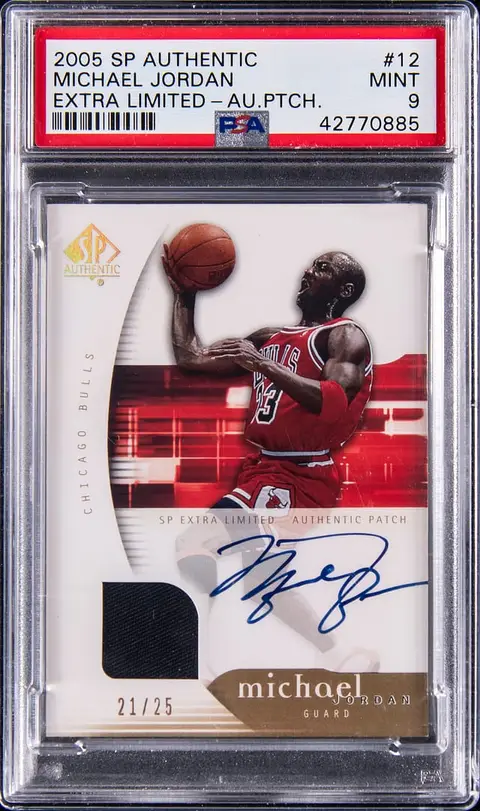
2005-06 Upper Deck SP Authentic Extra Limited Autograph Patch #12 Michael Jordan Signed Game-Used Patch Card (#21/25) - PSA MINT 9 - Pop 1
Sale Price
Platform
GoldinA Michael Jordan game-used patch autograph from the mid-2000s just quietly reminded the hobby how strong high-end Jordan material remains.
On March 15, 2026, Goldin sold a 2005-06 Upper Deck SP Authentic Extra Limited Autograph Patch #12 Michael Jordan, serial numbered 21/25, for $26,842. The card is graded PSA MINT 9 and is a true one-of-one in that grade in PSA’s population report (often shortened to “pop report”), meaning it’s the only copy to receive a 9 and there are none higher.
The card at a glance
- Player: Michael Jordan
- Team: Chicago Bulls (pictured in Bulls uniform)
- Year: 2005-06
- Set: Upper Deck SP Authentic
- Subset/Parallel: Extra Limited Autograph Patch
- Card number: #12
- Serial numbering: 21/25 (only 25 copies made)
- Autograph: On-card autograph (signed directly on the card)
- Memorabilia: Game-used patch
- Grading company: PSA
- Grade: MINT 9
- Population: Pop 1, none graded higher at PSA (at time of sale)
This is not a rookie card—Jordan’s rookie issues are from 1984-85 Star and 1986-87 Fleer—but it is a key premium issue from his post-playing-era autograph and memorabilia catalog. The “Extra Limited” tier within SP Authentic is known for very low serial numbers, on-card signatures, and multi-color game-used patches.
Why this SP Authentic Jordan matters
For Jordan collectors, the hierarchy of modern-era cards often centers around a few pillars:
- True rookie cards (Star and Fleer)
- Key 1990s inserts and parallels
- Low-numbered, on-card autograph patch cards from premium brands
This 2005-06 SP Authentic Extra Limited Autograph Patch sits squarely in the third category. It combines:
- On-card autograph – Collectors usually value signatures placed directly on the card more highly than sticker autos.
- Game-used patch – The swatch comes from a jersey used in an actual game, a detail that still carries weight even as “player-worn” memorabilia has become more common in modern products.
- Tight print run (25 copies) – A serial number like 21/25 means only 25 examples exist. That is a very small supply for a globally collected player like Jordan.
- High grade and population scarcity – PSA MINT 9 is a strong grade for a thick patch autograph card from the mid-2000s, and the fact that this is a pop 1 with none higher adds another layer of scarcity on top of the /25 print run.
The 2005-06 season falls into what many collectors consider the early ultra-modern autograph patch era: manufacturers were refining premium designs, patch windows were getting larger, and hard-signed autos were still prevalent on top-tier issues. SP Authentic as a brand has long been respected for clean card designs and disciplined print runs.
Market context and recent sales
When collectors talk about “comps,” they’re referring to comparable recent sales that help frame where a card typically trades. For a card this specific and scarce—Jordan, Extra Limited, /25, PSA-graded with a pop 1 in MINT 9—direct comps are naturally thin.
Looking at the broader market over the past couple of years, a few patterns stand out:
- Jordan SP Authentic auto patch cards from the mid-2000s across PSA 8–10 and BGS holders have typically clustered in the mid five-figure range, with stronger prices for multi-color patches and on-card autos from respected brands.
- Sales of similar Jordan auto patch /25 cards (from comparable sets and years) in high grade have often landed somewhere in the low- to mid-$20,000s, with occasional outliers above or below depending on patch quality, eye appeal, autograph strength, and timing.
- Population scarcity tends to matter more the higher up the price ladder you go. A pop 1, none-higher PSA grade gives this specific copy a premium narrative relative to raw or lower-graded examples.
Against that backdrop, the $26,842 result at Goldin on March 15, 2026 sits in what looks like the upper but still reasonable band of recent results for similar Jordan autograph patch pieces. It is not an outlier on the level of record-breaking 1986 Fleer rookies or 1990s grail inserts, but it does reinforce that well-centered, well-preserved Jordan auto patch cards continue to command solid attention.
As with any rare card, it is also important to remember that a single auction result doesn’t define an exact “market price.” With only 25 copies in existence—and only one currently sitting in a PSA 9 slab—prices can shift based on which collectors are actively looking when a card surfaces.
Set and era significance
The mid-2000s SP Authentic line occupies an interesting point in hobby history:
- Transition from playing days to legacy era: By 2005-06, Jordan was long retired, and his autograph content had clearly shifted into “legend” territory.
- Established premium brands: Upper Deck had already built a strong reputation for high-end Jordan content across Exquisite, SP Authentic, and other lines.
- Growing focus on patch autos: Collectors were increasingly drawn to the combination of autograph plus a meaningful patch from a game-used jersey, especially for all-time greats.
Within that context, the Extra Limited Autograph Patch subset stands out for particularly tough print runs and strong design. The card’s vertical layout, on-card signature area, and patch window give it a clean, high-end look without being overly busy—something that appeals to both set builders and player collectors.
Pop report and grading nuances
Population reports (or “pop reports”) are datasets from grading companies showing how many copies of a card have received each grade. They don’t tell the whole story—many cards remain ungraded or are in other holders—but they give a useful snapshot of graded supply.
For this Jordan:
- PSA currently shows only one copy graded MINT 9.
- There are no copies graded GEM MINT 10, which is not surprising for a thick, foil-heavy patch autograph card that is prone to chipping and edge wear.
- Other copies in lower grades or in other grading company slabs may exist, but they do not change the fact that this specific combination—PSA 9, pop 1—is unusually scarce.
Collectors often pay extra attention to “pop 1, none higher” labels because they signal the best-graded example available in that population set. For cards with inherently low print runs, that extra layer of scarcity can matter to advanced collectors who focus on both card and grade.
What this sale suggests to collectors
A few hobby takeaways from the Goldin sale on March 15, 2026:
- High-end Jordan remains resilient. Despite market cycles and ups and downs in broader sports cards, clean, low-numbered Jordan autograph patches continue to show stable demand.
- Quality plus scarcity is still a strong combo. A /25 print run, on-card auto, game-used patch, and PSA MINT 9 grade—plus pop 1 status—line up several factors that seasoned collectors track when they evaluate a card.
- Specific card stories matter. Not all Jordan autos are treated equally. Set reputation, patch quality, autograph placement, and grading history all contribute to how a card is perceived, beyond just the player’s name.
For returning collectors, this card is a useful reference point: it illustrates how a non-rookie Jordan can still command a five-figure price when it sits at the intersection of scarce print run, desirable brand, and top-tier grade. For newer hobbyists, it’s an example of how to read an auction listing carefully—looking past the headline name to understand set, numbering, autograph type, memorabilia description, grade, and population.
How small sellers and active hobbyists might use this data
If you’re a small seller or active hobbyist, this sale doesn’t mean every Jordan autograph card is suddenly worth more. Instead, it can help you:
- Benchmark similar pieces. If you own or are considering a Jordan auto patch from a comparable era, you can use this result as a rough data point, adjusting for differences in set, numbering, grade, and eye appeal.
- Learn to evaluate premium cards. Pay attention to serial numbering (/25 vs /50 vs /100), type of memorabilia (game-used vs player-worn), autograph format (on-card vs sticker), and grading company and grade.
- Understand how scarcity layers stack. There are only 25 copies of this card to begin with, and among the PSA-graded examples, there is currently just one at a 9 and none higher. That stack of scarcity helps explain why the card found strong interest.
As always, any single comp is simply a snapshot in time, not a guarantee of future value. But the Goldin result from March 15, 2026 does underscore a consistent theme in the modern hobby: when it comes to all-time greats like Michael Jordan, well-chosen, low-numbered autograph patch cards from reputable brands remain central to many advanced collections.
For figoca users tracking the market, this sale is one more data point showing how the hobby continues to differentiate between mass-printed autographs and carefully constructed, truly limited premium pieces.