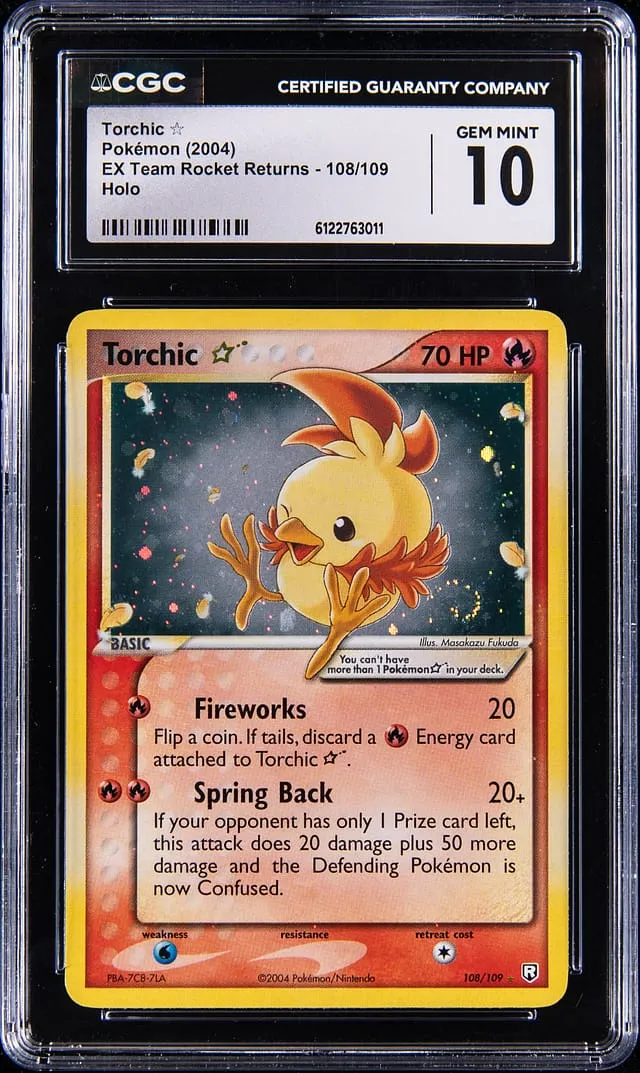
2004 Torchic Gold Star CGC 10 sells for $53k
Goldin sold a 2004 EX Team Rocket Returns Torchic Gold Star CGC 10 for $53,070. See how this key EX-era Pokémon card fits into today’s market.
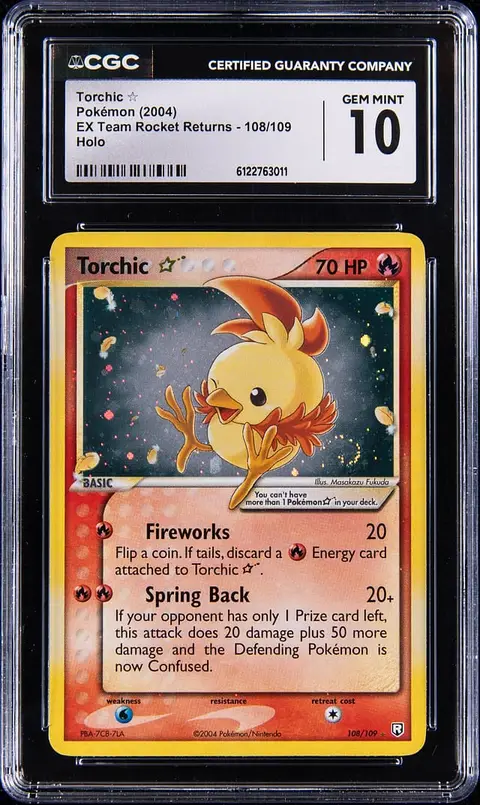
Sold Card
2004 Pokemon EX Team Rocket Returns Gold Star Holo #108 Torchic - CGC GEM MINT 10
Sale Price
Platform
GoldinThe 2004 Pokémon EX Team Rocket Returns Torchic Gold Star has quietly become one of the most studied cards in the hobby, and a recent sale has added another data point to that story.
On March 9, 2026, Goldin sold a 2004 Pokémon EX Team Rocket Returns Gold Star Holo #108 Torchic – CGC GEM MINT 10 for $53,070.
In this post we’ll walk through what this card is, why collectors care, how this sale fits into recent price history, and what it might mean for people who collect or track high‑end Pokémon.
The card at a glance
- Character: Torchic (Gold Star)
- Year: 2004
- Set: EX Team Rocket Returns
- Card number: #108
- Parallel/variant: Gold Star Holo (shiny Torchic)
- Rarity: Key chase card of the set; widely treated as a “grail” (top‑tier goal) for Torchic and Gold Star collectors
- Era: Mid‑2000s EX era (low print relative to modern sets)
- Grading company: CGC
- Grade: GEM MINT 10
Gold Star cards feature shiny (alternate‑color) Pokémon and were intentionally very hard to pull back in the EX era. The Torchic from EX Team Rocket Returns is part of the iconic Torchic / Mudkip / Treecko Gold Star trio that anchors the set for many collectors.
This card is not a “rookie card” in the sports sense, but for many Pokémon collectors it functions similarly to a flagship rookie: an early, premium, and very low‑supply appearance of Torchic in a highly respected chase rarity.
Why EX Team Rocket Returns Gold Stars matter
EX Team Rocket Returns (2004) sits in an interesting hobby window:
- Print runs were much smaller than modern Pokémon releases.
- The Gold Star mechanic was still relatively new and extremely hard to pull.
- Sealed product from this era is scarce and expensive, so new pack‑fresh copies entering the market are limited.
Within that context, Gold Star Torchic checks several collector boxes:
- Gold Star status – Gold Stars are widely recognized as a pinnacle rarity for early‑ to mid‑2000s Pokémon.
- Starter Pokémon appeal – Torchic is part of the Hoenn starter trio. Starters tend to have broader demand than many non‑legendary species.
- Set importance – EX Team Rocket Returns is often cited as one of the stronger EX‑era sets from a collector perspective, with a darker theme and a meaningful chase structure.
- Condition sensitivity – Like many EX‑era holos, copies are prone to surface and edge wear, making top grades genuinely difficult.
All of this makes high‑grade copies, especially in GEM MINT 10, a focus point for both character collectors and people building Gold Star runs.
Grading and population context
This card was graded CGC GEM MINT 10.
In simple terms, GEM MINT 10 is the top standard grade: essentially no visible flaws under normal viewing, with very tight centering and clean surfaces. CGC’s standards, especially on early submissions, have a reputation for being strict on surface and centering, which matters for this era.
Population reports (often called “pop reports”, a count of how many copies exist at each grade) for Gold Star Torchic across grading companies show:
- Very few total graded copies relative to modern chase cards
- A small number of true 10s, whether labeled by CGC, PSA, or BGS
Even without citing exact population numbers, the pattern is clear: GEM MINT copies are meaningfully scarce, and most existing copies sit a grade or two lower.
Price context: how does $53,070 fit in?
This Goldin result at $53,070 is best understood by comparing it to recent sales (“comps”). In the hobby, “comps” simply means comparable recent sales of the same or very similar items, usually used to understand a rough market range.
Looking across major marketplaces and auction houses, the recent history for Torchic Gold Star and closely related versions shows a few consistent themes:
- GEM MINT 10s (across grading companies) tend to sit near the top of the price ladder for this card, often selling at a very large premium over 9s and 8.5s.
- High‑grade 9s (PSA 9 / CGC 9 / BGS 9) have traded in a much lower band, typically well below the 10‑grade ceiling.
- Earlier high‑profile sales of this card in a top grade have been referenced as anchor points for private negotiations and auction expectations.
Against that backdrop, a $53k sale in March 2026 is consistent with the card’s role as a premier EX‑era Gold Star. It reflects:
- Ongoing demand for early‑generation Gold Stars
- The scarcity of true GEM MINT 10 examples
- The broader strength of 2000s Pokémon compared with most modern‑era chase cards
Because market conditions change, it’s wise to see this Goldin sale as a data point, not a guarantee of future prices. But it does provide a clear, public marker for where at least one high‑end buyer and seller met in early 2026.
Why collectors track this specific card
For many collectors, this card is appealing for reasons that go beyond the dollar figure:
- It’s a centerpiece card for anyone building an EX Team Rocket Returns master set.
- It’s often on the shortlist for people chasing a complete Gold Star run.
- It carries strong nostalgia for collectors who grew up with the Game Boy Advance / Hoenn era.
- The artwork and shiny Torchic colorway give it a distinct visual identity within binder pages and display cases.
From a market‑watching standpoint, Torchic offers a useful case study in how:
- Low‑print, early‑2000s chase cards behave over time
- Condition sensitivity and grading populations can influence high‑end pricing
- Different grading companies’ top grades (CGC 10 vs PSA 10 vs BGS 9.5/10) can create separate but related price tracks
Takeaways for collectors and small sellers
If you’re a new or returning collector:
- This sale shows how much attention still flows to EX‑era Gold Stars, well beyond the modern‑set hype cycles.
- You don’t need a GEM MINT 10 to enjoy the card; lower‑grade copies follow the same general demand story at more accessible price points.
If you’re an active hobbyist or small seller:
- Tracking public auction results like this Goldin sale can help you understand the upper end of the market for a card.
- When reviewing comps, it’s helpful to sort by grade, grading company, and date—the more similar the card and the more recent the sale, the more useful the comparison.
This $53,070 CGC GEM MINT 10 sale doesn’t rewrite the narrative on Gold Star Torchic, but it does reinforce what the hobby has been signaling for years: high‑grade EX‑era Gold Stars remain a core, and relatively scarce, segment of the Pokémon market.
For collectors building long‑term EX‑era projects or simply tracking key sales, the March 9, 2026 Goldin auction now stands as a clean reference point for what one of the best‑condition Torchic copies can achieve in the open market.