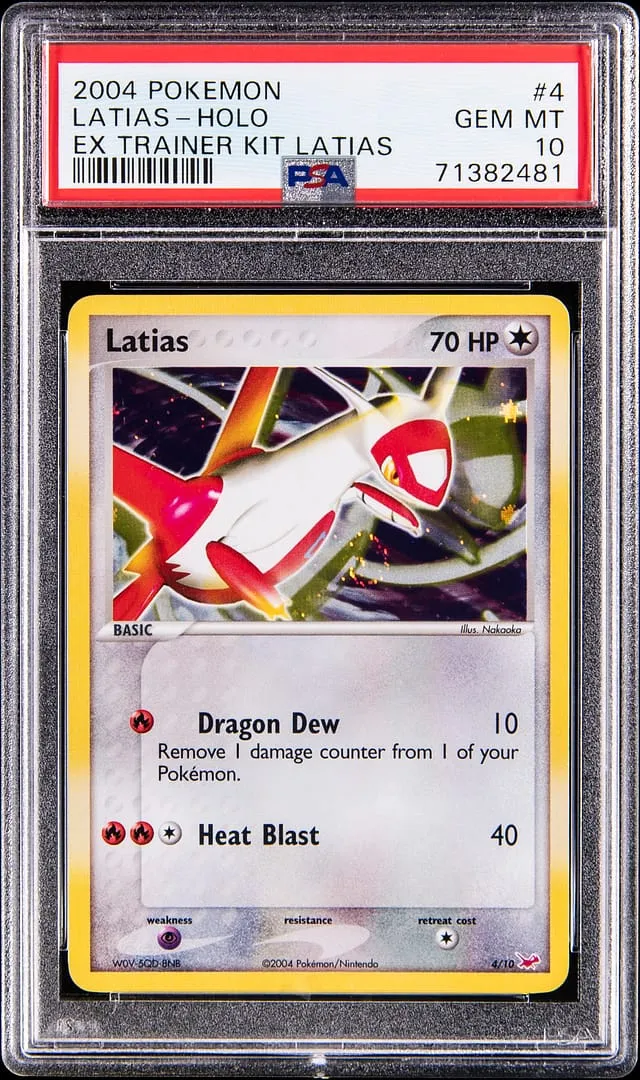
2004 Latias ex Trainer Kit PSA 10 Sells for $12,200
Deep dive on the 2004 Pokémon ex Trainer Kit Latias Holo #4 PSA 10 that sold for $12,200 at Goldin on May 18, 2026, and what it means for collectors.
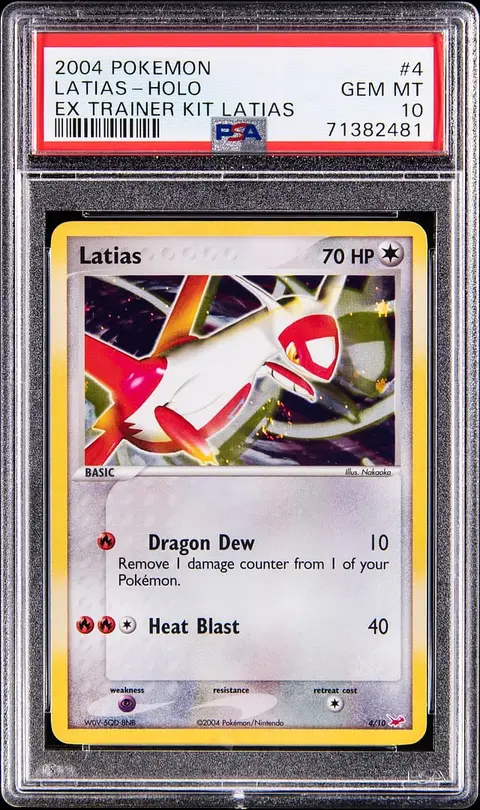
Sold Card
2004 Pokemon ex Trainer Kit Latias Holo #4 Latias - PSA GEM MT 10
Sale Price
Platform
Goldin2004 Pokémon ex Trainer Kit Latias Holo #4 in a PSA GEM MT 10 just quietly registered a notable result at Goldin. On May 18, 2026 (UTC), a copy sold for $12,200, drawing fresh attention to one of the more interesting early-EX era Latias cards.
In this breakdown, we’ll look at what this card is, why collectors care, and how this sale fits into recent price context.
Card overview
Card: 2004 Pokémon ex Trainer Kit Latias Holo #4 – Latias
Set: Pokémon ex Trainer Kit (Latias Half Deck), released in 2004
Era: Early EX / mid‑2000s
Character: Latias (Legendary Pokémon from Gen III)
Card type: Holofoil (non‑EX, non‑Gold Star)
Grading company: PSA (Professional Sports Authenticator)
Grade: GEM MT 10 (PSA’s highest standard grade)
This Latias comes from the ex Trainer Kit Latias & Latios product, which was a special two-player trainer kit rather than a standard booster set. The Latias Holo is the featured card in the Latias half deck, giving it a bit of “mini‑anchor card” status for that product. It is not a rookie card in the traditional sports sense, but it is an important early‑generation Latias holo from the EX era.
The copy sold at Goldin is a straight holo (no serial number, no autograph, no patch), so the value is driven primarily by:
- Condition (PSA 10)
- Set and era
- Character appeal (Latias and the Latias/Latios duo have a dedicated fan base)
Market context and recent sales
When collectors talk about “comps,” they mean comparable recent sales—other copies of the same or very similar card that help frame current prices.
For this Latias Trainer Kit holo, publicly visible comps are relatively thin compared to more mainstream chase cards from the same era (like Gold Stars or EXs). A few patterns do show up when looking across recent major marketplaces and auctions:
- Lower grades (PSA 8–9): These tend to sell in a much more modest range, reflecting the card’s non-chase status in raw form and the usual condition distribution for mid‑2000s holos.
- Ungraded/raw copies: Often available at accessible prices, but with common mid‑level wear—surface scratches, edge wear, and clouding on the holo—making true gem copies less common.
- PSA 10 copies: The population of PSA 10s is small compared with mass‑printed modern era cards, and sales outside of fixed listings are infrequent enough that each auction result can move perceptions.
The $12,200 Goldin sale lands well above what many collectors might associate with a non‑EX Latias holo on instinct alone. That underscores two realities:
- Condition scarcity matters. Even if a card doesn’t have an ultra‑rare stamp or a serial number, a small PSA 10 population in a niche but beloved lane (EX‑era Latias) can command a meaningful premium.
- Auction‑driven price discovery can spike. When two or more collectors with specific wants meet in a well‑publicized auction, the realized price can set a new short‑term benchmark for thinly traded cards.
Because public sales data for PSA 10 examples of this exact card are limited, it’s better to see this Goldin result as a recent reference point rather than a stable long‑term “value.” One strong result does not guarantee a permanent level, but it does highlight that there is real competition for top copies.
Why collectors care about this Latias
This card sits at the intersection of a few collecting focuses:
1. EX‑era and mid‑2000s nostalgia
The EX era (early‑ to mid‑2000s) occupies an interesting spot between vintage (Wizards of the Coast) and ultra‑modern. Print runs were generally smaller than contemporary booster products, distribution was more fragmented, and many children who played during this period did not keep their cards in gem condition.
Trainer kits, theme decks, and half decks often flew under the radar for years, but they’re now being revisited by collectors who grew up with them. As that generation returns to the hobby with more resources, clean graded copies of their childhood cards have attracted renewed attention.
2. Latias / Latios character collecting
Latias (often paired with Latios) has a strong, character‑driven collector base. Key reasons:
- Prominent roles in Pokémon Ruby/Sapphire/Emerald and related media.
- Starring appearance in Pokémon Heroes (the fifth Pokémon movie).
- Consistent representation in TCG art, especially during the e‑Reader and EX eras.
For focused Latias collectors, the 2004 Trainer Kit holo is one of the more memorable non‑EX, non‑Gold Star appearances. In high grade, it can function as a keystone card in a Latias character run.
3. Set and product uniqueness
The ex Trainer Kit Latias & Latios product was designed as a learning tool for two players, not a standard booster‑driven set. That gives its key holos a slightly different flavor:
- They’re guaranteed in the product, but 20+ years on, sealed kits are less common and often not preserved in mint condition.
- Many copies were played with as intended, leading to typical wear patterns that cap the number of true gem candidates.
This combination—non‑booster product origin plus character focus—makes the card a slightly off‑beat but appealing target for collectors who prefer niche, narrative‑rich pieces over obvious chase cards.
Understanding the PSA 10 premium
A PSA GEM MT 10 grade indicates that PSA considers the card essentially flawless to the naked eye, with only extremely minor manufacturing issues allowed. For older holos, this usually means:
- Centering within PSA’s tightest tolerance.
- Clean surfaces with minimal or no print lines under normal viewing.
- Sharp corners and edges with no whitening visible on inspection.
From a market perspective:
- Condition tiers matter. The gap between PSA 9 and PSA 10 can be substantial for condition‑sensitive cards, especially when the PSA 10 population is low.
- Population reports (“pop reports”)—the census of how many copies exist in each grade—are useful context. They don’t tell you demand, but they do show how scarce top grades are relative to submissions.
The $12,200 Goldin sale reflects what happens when a low‑pop, high‑condition example of a character favorite crosses a well‑attended auction block.
What this Goldin sale may signal
Without making any predictions or financial recommendations, a few grounded observations are reasonable:
- Niche EX‑era holos are being taken seriously. Collectors are not limiting their attention to Gold Stars and EXs. Key character holos from special products—like this Trainer Kit Latias—are being recognized as important pieces of the 2000s TCG timeline.
- Thin markets can move quickly. In categories where only a handful of PSA 10 copies appear publicly over several years, one strong auction can reset short‑term expectations. Buyers and sellers should treat each sale as a data point, not a guarantee.
- Character collectors shape the top end. When people are building deep Latias / Latios runs or EX‑era showcases, they often prioritize quality over price, especially for cards that rarely show up in their desired grade.
Takeaways for collectors and small sellers
If you’re a collector considering this card:
- Decide whether you’re collecting Latias specifically, EX‑era holos, or Trainer Kit products. This card fits snugly into all three lanes.
- Condition is everything. If PSA 10 is out of reach or feels aggressive relative to your budget, PSA 8–9 or very clean raw copies can still anchor a character or era collection visually.
If you’re a small seller or someone sorting old boxes:
- Check any 2004 Trainer Kit Latias holos carefully for surface scratches, edge whitening, and creases before assuming they are gem‑worthy.
- Compare your copy to high‑resolution images of PSA 9 and PSA 10 examples to set realistic grading expectations.
- Use this $12,200 Goldin sale (May 18, 2026, UTC) as context, not a shortcut to pricing. Condition, timing, and venue all matter.
Final thoughts
The 2004 Pokémon ex Trainer Kit Latias Holo #4 in PSA GEM MT 10 is a good reminder that not every significant card needs a stamp, a serial number, or a chase‑card label. Sometimes, a well‑preserved holo from a niche mid‑2000s product, centering on a beloved Legendary, is enough.
Goldin’s May 18, 2026 sale at $12,200 won’t single‑handedly define this card’s long‑term market. It does, however, spotlight how much attention—and competition—exists for top‑tier examples of character‑driven EX‑era holos. For Latias collectors and EX‑era fans, this result is another data point that their corner of the hobby is both active and evolving.