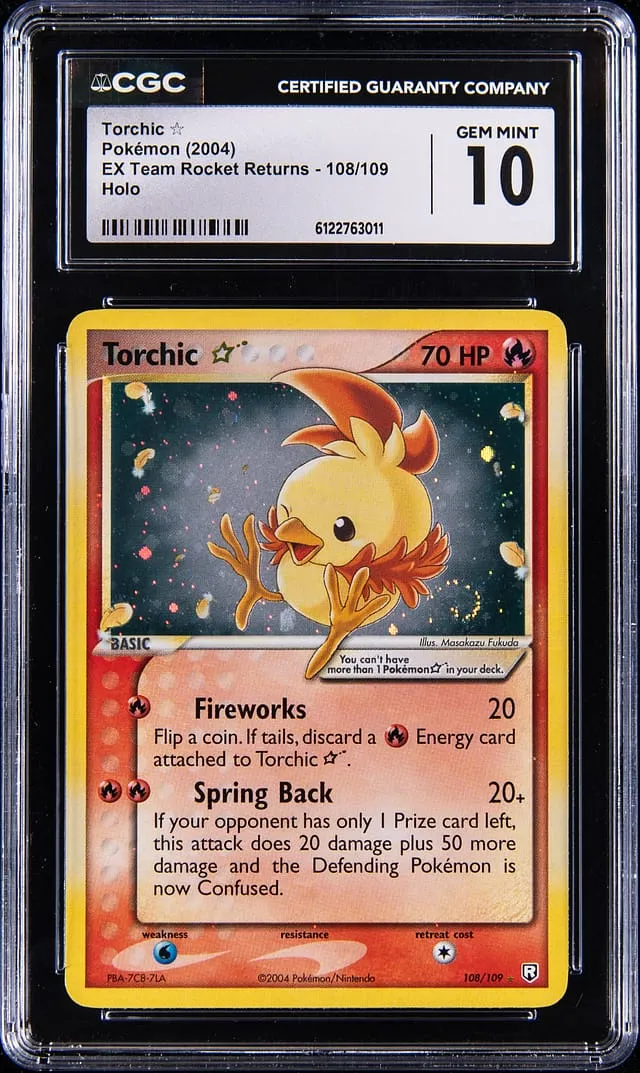
2004 Gold Star Torchic CGC 10 Sells for $53,070
Goldin sold a 2004 EX Team Rocket Returns Gold Star Torchic CGC 10 for $53,070. See why this EX-era Pokémon card still commands strong demand.
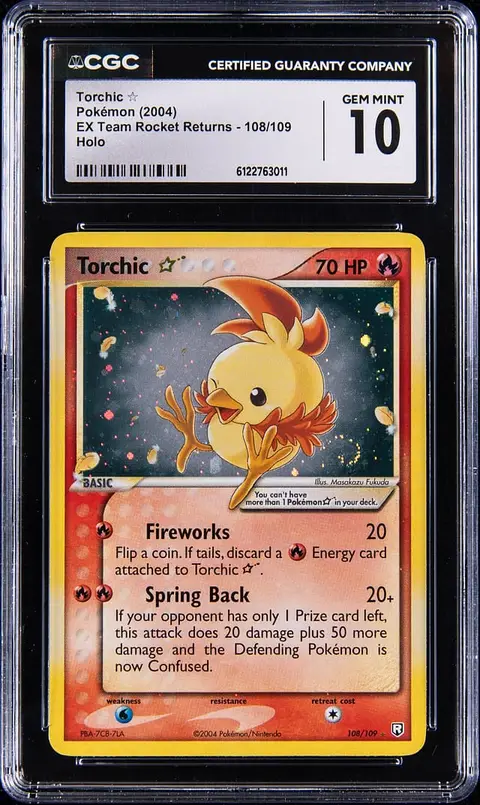
Sold Card
2004 Pokemon EX Team Rocket Returns Gold Star Holo #108 Torchic - CGC GEM MINT 10
Sale Price
Platform
Goldin2004 Pokémon EX Team Rocket Returns Gold Star Torchic in CGC 10 Sells for $53,070
On March 9, 2026, Goldin sold a 2004 Pokémon EX Team Rocket Returns Gold Star Holo #108 Torchic in a CGC Gem Mint 10 slab for $53,070. For collectors who follow early-2000s EX-era Pokémon, this is one of the key Gold Star cards and an important data point for the high-end market.
Card overview
Let’s break down exactly what this card is:
- Character: Torchic (Hoenn starter Pokémon)
- Year: 2004
- Set: EX Team Rocket Returns
- Card: Gold Star Holo #108 Torchic
- Variant: Gold Star (★ symbol next to the name, special shiny version)
- Rarity context: Ultra-short print chase card in the set
- Era: EX era / mid-2000s (often grouped with early “modern” Pokémon)
- Grading company: CGC
- Grade: CGC Gem Mint 10
This is not a “rookie card” in the sports sense, but within the Pokémon TCG, Gold Stars are widely regarded as premier chase cards of the EX era. Torchic is part of a trio with Mudkip and Treecko, and the Gold Star Torchic is one of the most recognized cards from EX Team Rocket Returns.
Why the EX Team Rocket Returns Gold Stars matter
EX Team Rocket Returns (2004) is often considered one of the toughest EX-era sets to complete in high grade. The Gold Star cards from this era are:
- Very low pull-rate chase cards
- Subject to heavy play and handling when they were released
- Printed well before grading became mainstream in the hobby
As a result, high-grade examples — especially in the top grades — are notably scarce. Collectors often group Torchic with other early Gold Stars such as the Eeveelutions and key Hoenn starters as a core part of any advanced EX-era collection.
CGC Gem Mint 10 vs other grading scales
CGC’s Gem Mint 10 grade is one of the highest designations on its scale and is generally seen as a very strict standard. While grading scales between companies are not perfectly interchangeable, many collectors view a CGC 10 as representing:
- Extremely clean surfaces
- Centering within a very tight tolerance
- Sharply cut corners and edges
- No obvious print lines, dents, or whitening
Because of that, top CGC grades can create strong separation from near-mint or even mint copies when it comes to auction results.
Market context: how does $53,070 fit in?
When collectors talk about “comps” (short for comparables), they mean recent sales of the same or very similar cards used as reference points. For a card like this, useful comps include:
- The same Gold Star Torchic in other CGC grades
- PSA 10 and BGS 9.5/10 copies of the same card
- Other EX-era Gold Stars with similar population and demand
Looking at public sales over the last couple of years, high-grade Gold Star Torchic prices have generally:
- Tracked closely with broader sentiment toward EX-era Gold Stars as a group
- Shown a premium for top grades due to very low population counts
- Oscillated based on where and when they sell (major auction houses vs fixed-price marketplaces)
This $53,070 sale at Goldin sits toward the upper end of what has been seen for this card in top grade in recent cycles, especially for non-PSA slabs. That suggests a few things:
- There is still meaningful demand for early Gold Stars at the very top of the grading scale.
- Strong, well-promoted auctions at major houses like Goldin can draw multiple determined bidders.
- The market continues to differentiate between true top-tier examples and lower-grade or raw copies.
Population and scarcity
Population reports (often called “pop reports”) are the grading companies’ public counts of how many copies have been graded at each grade. For Gold Star Torchic, key themes from pop data include:
- Very few Gem Mint copies overall relative to more recent ultra-modern chase cards.
- A steep drop-off from the mid/high grades (8–9) to the top grade tier (9.5–10 depending on the company).
- Evidence that many surviving copies show the typical EX-era wear: edge chipping, surface scratches, and centering issues.
While raw numbers vary by grading company, the main takeaway is consistent: CGC Gem Mint 10 Torchic is a true top-end example of an already tough card.
Collector significance
A card like this sits at the intersection of several collector priorities:
- Era appeal: The EX era has matured from being “modern” to a sort of middle generation between WotC (1999–2003) and current sets. Many collectors who grew up with Ruby & Sapphire now have the means to chase their childhood grails.
- Set reputation: EX Team Rocket Returns is widely respected for its art, difficulty, and overall challenge as a master set.
- Character relevance: Torchic is the Fire-type starter of the Hoenn region, with strong nostalgic pull for players who began with Pokémon Ruby and Sapphire.
- Gold Star status: Gold Stars, in general, are seen as the premier chase cards of their time, roughly analogous to key short-print parallels in sports cards.
Recent hobby trends
A few broad trends help frame this sale:
- EX era stabilization: After the strong run-up of 2020–2021 and subsequent corrections, EX-era key cards have been finding more stable trading ranges. High-end examples continue to perform differently from lower grade or over-graded copies.
- Grading diversification: While PSA remains the dominant grader in Pokémon, CGC has carved out a strong niche, especially among collectors who value strict grading and subgrades (when present). High-end CGC 10 results like this help add clarity around how the market is valuing CGC’s top labels.
- Focus on quality over quantity: Many advanced collectors have shifted from chasing volume to targeting a smaller number of top-tier pieces. That dynamic tends to support strong prices for scarce, high-grade examples like a CGC 10 Gold Star Torchic.
What this sale might mean for collectors
For active collectors and small sellers, this Goldin sale on March 9, 2026 offers a few practical takeaways:
- Top-end separation: The gap between Gem Mint examples and everything else remains wide for tough EX-era chase cards.
- Auction house impact: Major auction houses can still draw notable premiums on rare, high-grade pieces, especially when timed and marketed well.
- Data point, not a promise: This $53,070 result is one sale in a specific context. It’s useful as a reference, but not a guarantee of future pricing.
If you’re holding a lower-grade Torchic or other EX-era Gold Stars, this sale mainly highlights the strength at the very top of the grading ladder. For buyers, it underscores how steep the premium can be when you move from a strong near-mint card to one that meets a Gem Mint 10 standard.
As always, it’s worth using multiple recent sales, pop reports, and your own collecting goals when deciding how to approach cards like this. But as a snapshot of where high-end EX-era Pokémon stands, the 2004 EX Team Rocket Returns Gold Star Torchic CGC Gem Mint 10 crossing $53,000 at Goldin is a clear signal that the top of this segment remains firmly in demand.