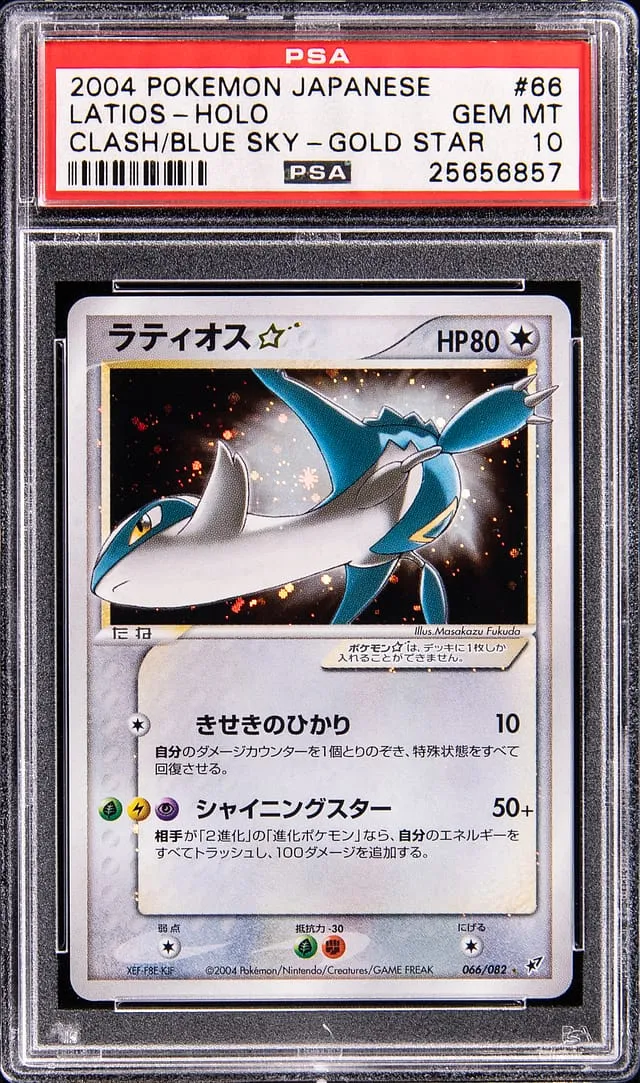
2004 Gold Star Latios PSA 10 sells for $13,427
Figoca reviews the $13,427 Goldin sale of a 2004 Japanese Clash of Blue Sky Gold Star Latios PSA 10 and what it means for EX-era collectors.
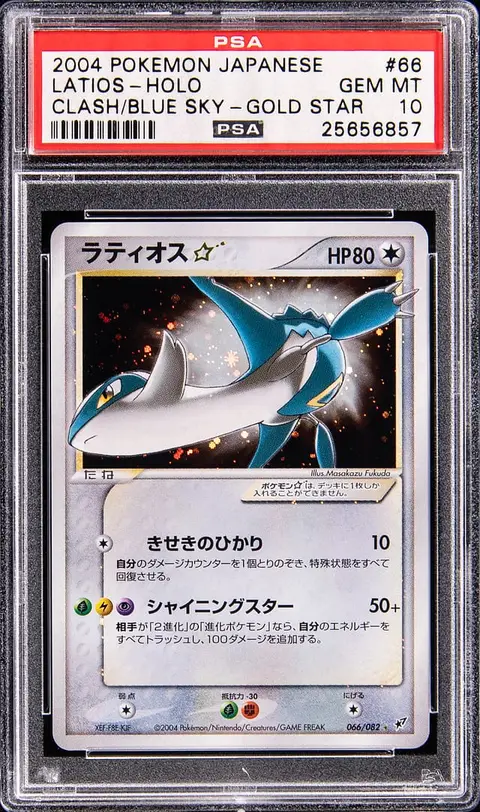
Sold Card
2004 Pokemon Japanese Clash of Blue Sky Gold Star Holo #66 Latios - PSA GEM MT 10
Sale Price
Platform
Goldin2004 Pokemon Japanese Clash of Blue Sky Gold Star Holo #66 Latios - PSA GEM MT 10: Market Notes on a $13,427 Sale
On May 18, 2026, Goldin sold a 2004 Pokemon Japanese Clash of Blue Sky Gold Star Holo #66 Latios in a PSA GEM MT 10 for $13,427. For collectors who track Gold Stars and mid‑2000s Japanese sets, this is a useful data point in a niche but important segment of the Pokemon market.
Card overview
- Character: Latios (Legendary Dragon/Psychic-type)
- Year: 2004
- Set: Clash of Blue Sky (Japanese set; corresponds to EX Deoxys era)
- Card: Gold Star Holo #66
- Language: Japanese
- Key attributes:
- Gold Star (☆) rare: alternate‑color “shiny” Latios artwork
- Holofoil treatment
- No autograph or serial numbering (standard for this issue)
- Grading: PSA GEM MT 10 (highest standard grade on PSA’s 10‑point scale)
Gold Star cards feature shiny versions of popular Pokemon with a small gold star next to the name. They are widely viewed as some of the most important chase cards from the EX era.
Why this card matters to collectors
Gold Star era significance
Clash of Blue Sky is part of the mid‑2000s EX era, often seen as a bridge between early WotC (Wizard of the Coast) sets and the explosion of modern full‑art and alternate‑art cards. Within that era, Gold Stars are:
- Difficult pulls: Very low pull rates compared to regular holos, which keeps raw (ungraded) supply relatively tight.
- Artistically distinct: The shiny Latios art, with the characteristic Gold Star layout, is both nostalgic for long‑time collectors and visually striking for newer ones.
- Historically important: Gold Stars helped define the idea of ultra‑chase cards in Pokemon long before modern “secret rares” became common.
Latios and its counterpart Latias are particularly popular among collectors who focus on Legendary and pseudo‑Legendary Pokemon, giving this card collector relevance beyond set completion.
Japanese vs. English versions
For many EX‑era cards, English versions in high grade tend to get more attention from newer collectors, while Japanese versions often appeal to set purists and those who prioritize print quality and original releases. Japanese print runs, especially for chase cards like Gold Stars, are generally more controlled than some later English releases.
This Latios comes from the Japanese Clash of Blue Sky set, which can carry:
- Appeal to niche collectors: Those who specifically seek Japanese Gold Stars and prefer original card text.
- Perceived quality advantage: Japanese cards from this era are often well‑centered and clean, but that does not mean PSA 10s are common.
Grading and population context
A PSA GEM MT 10 indicates virtually no visible flaws under typical viewing conditions: clean surfaces, sharp corners, strong centering, and minimal print defects.
For EX‑era Gold Stars in general, PSA population reports (the grading company’s public count of how many cards exist in each grade, often called a “pop report”) usually show:
- A meaningful number of copies in PSA 8–9
- A smaller, more restricted population in PSA 10 because of:
- Easily scratched holofoil surfaces
- Edge wear and chipping from glossy EX‑era stock
Even without quoting exact population numbers, it’s reasonable to treat PSA 10 Gold Star Latios as a high‑end, low‑availability version of an already tough card.
Recent sales and price context
This Goldin sale closed at $13,427 on May 18, 2026.
When collectors talk about “comps” (short for comparables), they mean recent sales of the same card or very similar cards, used as reference points rather than price guarantees. For a card like this, relevant comps include:
- The same 2004 Japanese Clash of Blue Sky Latios Gold Star in PSA 10
- The same card in PSA 9
- Closely related Gold Stars from Latios/Latias in similar grades
Across marketplaces and auction houses, EX‑era Gold Stars in PSA 10 have shown:
- A wide range of realized prices depending on character, language, and timing
- Occasional spikes when very clean, low‑pop examples appear after long gaps
Within that broader pattern, a five‑figure result for a PSA 10 Gold Star Latios lines up with how collectors have come to value premium EX‑era chase cards, particularly Legendaries. The exact positioning of this $13,427 sale—whether at the low, middle, or upper end of recent results—will depend on:
- How frequently PSA 10 copies appear at public auction
- Differences between auction venues (Goldin vs. other houses and fixed‑price platforms)
- Short‑term hobby cycles and attention on Gold Stars at the time of sale
From a market‑tracking perspective, this sale looks like a notable but believable data point for a high‑grade Gold Star Legendary rather than an outlier that completely resets expectations.
How this sale fits the broader EX‑era trend
Over the past several years, collectors have:
- Revisited mid‑2000s EX sets as an alternative to increasingly expensive early WotC grails
- Focused on key chase tiers within each era instead of trying to own everything
For the EX era, those chase tiers often include:
- Gold Stars
- Select EX and holo cards with standout art or low print runs
- High‑grade, well‑centered examples verified by major grading companies
This Latios sale at Goldin adds another concrete point to that narrative. It supports the idea that:
- There is steady, committed demand for top‑grade Gold Stars
- Legendary and fan‑favorite characters in these premium slots continue to command strong interest
Takeaways for different types of collectors
New or returning collectors
- Gold Stars are a core concept for understanding EX‑era chase cards.
- You do not need a PSA 10 to participate; lower‑grade copies or even clean raw examples can be enjoyable targets.
- Use sales like this as reference, not as a must‑hit target. It’s a benchmark for the top end of the condition scale.
Active hobbyists
- A $13,427 result at Goldin suggests that high‑end buyers remain comfortable allocating real capital to scarce, graded EX‑era cards.
- Tracking the spread between PSA 9 and PSA 10 for this card can be informative: a widening gap can signal increasing premium for top condition.
Small sellers and traders
- This sale helps anchor expectations when you field offers or price similar Gold Stars.
- It’s useful when talking with buyers to explain why Gold Stars and PSA 10s carry a premium: low pull rates, age, condition sensitivity, and limited high‑grade supply.
Final thoughts
The 2004 Pokemon Japanese Clash of Blue Sky Gold Star Holo #66 Latios in PSA GEM MT 10 that sold for $13,427 at Goldin on May 18, 2026, is more than just another high‑end auction result. It’s a clear, traceable marker of how collectors currently value:
- Mid‑2000s EX‑era chase cards
- Gold Star Legendaries
- Top‑grade, third‑party authenticated examples
For anyone mapping the long‑term story of Pokemon’s middle years, this Latios sale is a data point worth bookmarking, not as a forecast, but as a well‑documented snapshot of where the market stood on that particular day.