2004-05 SPx Jordan–LeBron Dual Auto Relic Sells
Deep dive on the 2004-05 SPx Jordan–LeBron dual autograph relic /10 that sold for $34,160 at Goldin on February 8, 2026, and what it means for collectors.
Sold Card
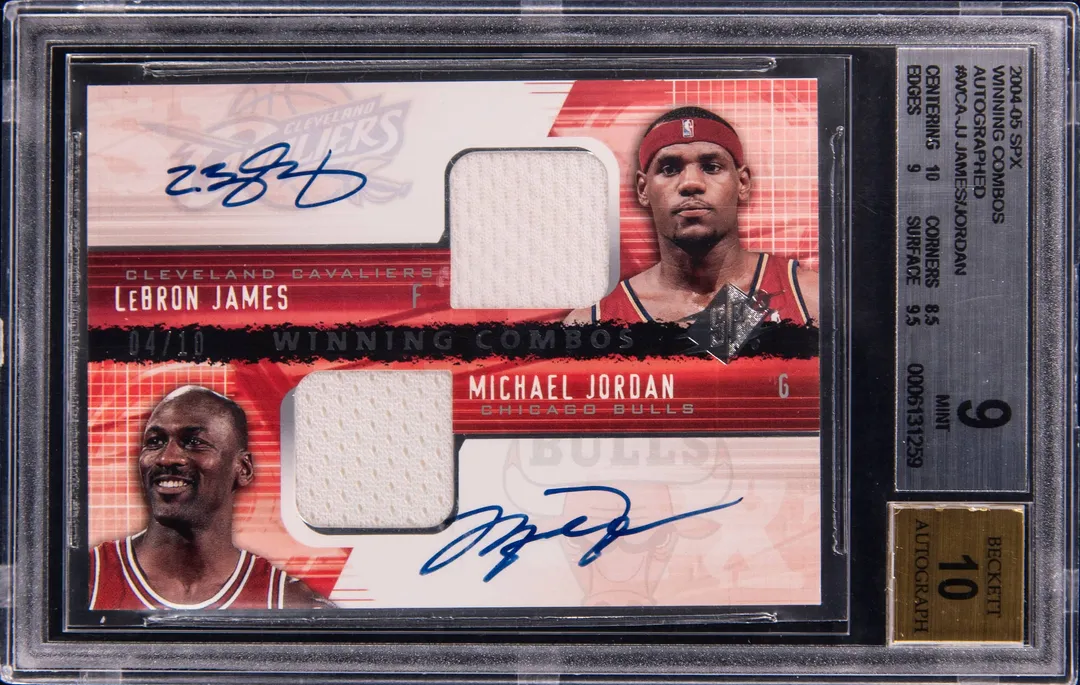
2004-05 Upper Deck SPx Winning Combos Autograph #WCA-JJ LeBron James/Michael Jordan Dual-Signed Relic Card (#04/10) - BGS MINT 9, Beckett 10
Sale Price
Platform
Goldin2004-05 SPx LeBron James / Michael Jordan Dual Auto Relic Sells for $34,160
When a single trading card features both Michael Jordan and LeBron James – with on-card autographs and game-used relics – collectors tend to pay attention. That’s exactly what happened when a 2004-05 Upper Deck SPx Winning Combos Autograph #WCA-JJ LeBron James / Michael Jordan Dual-Signed Relic, serial-numbered 04/10 and graded BGS MINT 9 with a Beckett 10 autograph, sold for $34,160 at Goldin on February 8, 2026 (UTC).
Below, we’ll break down what this card is, why it matters in the hobby, and how this sale fits into the broader market for dual Jordan–LeBron cards.
The Card at a Glance
Card basics
- Year: 2004-05
- Brand / Set: Upper Deck SPx
- Insert: Winning Combos Autograph
- Card number: #WCA-JJ
- Players: Michael Jordan / LeBron James
- Teams pictured: Chicago Bulls (Jordan) and Cleveland Cavaliers (LeBron)
- Serial numbering: Hand-numbered 04/10 (only 10 copies produced)
- Autographs: Dual on-card autographs (each player signed directly on the card)
- Relics: Dual game-used memorabilia swatches (relic pieces embedded in the card)
- Era: Early modern, post-1990s premium insert era
Grading details
- Grading company: Beckett Grading Services (BGS)
- Card grade: BGS MINT 9
- Autograph grade: Beckett 10 (a top grade for the signature quality)
For many collectors, 2004-05 SPx sits in an important window: LeBron’s early career, while Jordan was already a fully established legend and global icon. Dual cards featuring both players from this period are widely seen as hobby landmarks.
Why This Card Matters to Collectors
A dual-icon, dual-autograph combination
Jordan and LeBron are often discussed together in any “greatest of all time” conversation. Cards that literally place them side-by-side – each with an on-card autograph – are considered hobby centerpieces rather than simple inserts.
Key points collectors tend to focus on:
- Both autographs are on-card, meaning each athlete signed directly on the card’s surface, which many collectors prefer over sticker autographs.
- Game-used relics from both players are embedded, making this a multi-attribute premium piece: auto + relic + serial numbered.
- Print run of 10: With only ten copies, this is a true low-serial card, and genuine supply in the market is thin.
This isn’t a rookie card for either player, but it is what many collectors would call a “key issue” – a card that’s especially important or desirable within a player’s broader card catalog because of its design, scarcity, and star power.
SPx and early-2000s premium inserts
Upper Deck’s SPx line in the early 2000s helped define what “premium” meant in that era: layered foiling, serial numbering, relics, and autographs packed into relatively higher-end products.
Within that context, Winning Combos Autograph inserts stood out for pairing two stars on one card with dual signatures. Getting that treatment for Jordan and LeBron together is about as high-profile as it gets for this concept.
Era context: between vintage and ultra-modern
This card comes from a period that sits in between vintage (pre-1980s) and ultra-modern (the last decade of parallel-heavy, case-hit-driven products). For modern NBA legends like Jordan and LeBron, early-2000s premium autos and duals occupy a relatively stable niche:
- Production was limited compared with mass-market 1990s base cards.
- On-card dual autos of two all-time greats remain relatively scarce, even as today’s products offer more parallels and variations.
In short, collectors often see these early dual autos as foundational Jordan–LeBron pieces rather than speculative modern parallels.
The Goldin Sale: $34,160 on February 8, 2026
Goldin reported a final price of $34,160 for this copy of the 2004-05 SPx Winning Combos Autograph #WCA-JJ LeBron James / Michael Jordan Dual-Signed Relic (BGS 9, auto 10), sold on February 8, 2026 (UTC).
The card’s features that likely contributed to this result:
- Low print run (04/10): Only ten exist, making direct comparisons difficult because they rarely surface.
- High card grade (BGS 9): Near the top of the condition range for a tough, foil-heavy SPx design.
- Perfect autograph grade (10): Clean signatures with strong eye appeal.
Whenever population is this low, even a single strong auction can reset expectations. Rather than viewing this sale as an outlier, most collectors will treat it as one of the key reference points for this card going forward.
Market Context and Comps
“Comps” (short for comparables) are recent sales that collectors use to understand the current price landscape for a card. For a card numbered to 10, true like-for-like comps can be sparse.
Direct comps: same card, different copies
Because there are only ten copies of #WCA-JJ, they don’t show up at auction very often. In general hobby data for high-end dual Jordan–LeBron autos from this era, patterns look something like this:
- Stronger grades and autos (BGS 9/10 and above) command a clear premium over ungraded or lower-graded copies.
- Serial numbering can matter on ultra-low-run cards. Some collectors like jersey-number matches or the first or last number in the run. In this case, 04/10 is a clean mid-run number without a special multiplier factor.
Publicly archived results show that comparable Jordan–LeBron dual autos from early Upper Deck and SPx releases often sell in a wide range, depending on:
- Whether there is a relic component.
- How many copies were printed (for example, /10 vs /25 vs /50).
- The grading outcome and autograph grade.
Within that broader landscape, $34,160 for a BGS 9 / Auto 10 copy of a dual auto + relic numbered to 10 slots in as a strong but not unreasonable realization, especially considering current interest in premium Jordan and LeBron pieces.
Related cards and reference points
When exact comps are scarce, collectors look at “proximate” cards – related issues that provide context. For this card, proximate references include:
- Other Jordan / LeBron dual autographs from early- to mid-2000s Upper Deck products, both with and without relics.
- High-end, low-serial dual autos of each player with other top-tier stars, to gauge overall appetite for multi-signature pieces.
Across these categories, the pattern has been relatively consistent in recent years:
- Top-condition, early-era dual autos of Jordan and LeBron have generally maintained a meaningful premium over single-player autos of comparable scarcity.
- Cards that combine on-card autos and game-used relics show stronger demand than similar dual autos without memorabilia, all else equal.
This sale continues that trend without obviously breaking from it.
Collector Significance: How Hobbyists Might View This Sale
For Jordan and LeBron collectors
For player-focused collectors, this SPx Winning Combos card sits among the more desirable duals because it checks several boxes:
- Early LeBron years (second NBA season) paired with a fully established Jordan.
- On-card ink from both players.
- Very low print run.
- Recognizable, legacy brand (Upper Deck SPx).
Many serious Jordan or LeBron collectors build what they consider a “representative run” of key cards rather than trying to own everything. For a dual-theme focus, this card is an obvious candidate for that shortlist.
For set and insert collectors
Collectors who focus on inserts and autographed subsets from the 2000s often rank Winning Combos Autograph cards as cornerstone pieces:
- They represent a time when dual autos were still relatively novel.
- The designs are emblematic of early-2000s hobby aesthetics: bold foiling, layered textures, and memorabilia windows.
Landing a Jordan–LeBron combo from this run is, for many set-focused collectors, the high end of what is realistically achievable.
For the broader high-end market
From a broader market perspective, this sale reinforces a few ongoing themes:
- Dual autos of all-time greats continue to command attention even as newer ultra-modern chase cards proliferate.
- Early-2000s premium inserts have carved out a stable niche between 1990s grails and ultra-modern serial-parallel explosions.
- Strong grades from established graders like BGS, especially with a 10 autograph grade, still matter in realized prices.
While each sale is unique, this result suggests continued healthy demand for well-preserved, low-serial Jordan–LeBron dual autos from the 2000s.
What This Means If You Collect or Sell Similar Cards
This sale doesn’t guarantee anything about future values, but it does offer a few practical takeaways for collectors and small sellers:
Condition and autograph quality remain critical.
- On cards where the signatures are the main draw, the auto grade can be as important as the card grade.
- Clean, bold ink with no smudging or streaking tends to attract stronger bidding.
Low-serial dual autos trade differently than mass-printed inserts.
- With only ten copies, each auction can look a bit different because specific bidders may or may not be active at that moment.
- It’s more useful to look at several years of results for similar cards than to rely on a single comp.
Story and context help collectors understand a card.
- Explaining that this is an early LeBron-era dual with Jordan, on-card, with dual relics, from SPx, helps justify why it sits above many other autos in the same era.
Auction house choice can influence visibility.
- Selling a card like this through a major auction house such as Goldin ensures it’s seen by the target audience for high-end Jordan–LeBron pieces.
Final Thoughts
The February 8, 2026 Goldin sale of the 2004-05 Upper Deck SPx Winning Combos Autograph #WCA-JJ LeBron James / Michael Jordan Dual-Signed Relic – numbered 04/10 and graded BGS MINT 9 with a Beckett 10 autograph – at $34,160 adds another data point to the evolving story of premium dual autos in the hobby.
For collectors, the card represents a rare convergence: two of basketball’s greatest players, early-2000s Upper Deck design, on-card signatures, game-used relics, and a genuinely scarce print run. In a market full of new parallels and short prints each season, pieces like this stand out as enduring reference points for what high-end basketball cards can be.
At figoca, we track landmark sales like this to help collectors understand how key issues fit into the broader hobby landscape – not as guarantees of future prices, but as real-world context for the cards that define modern basketball collecting.