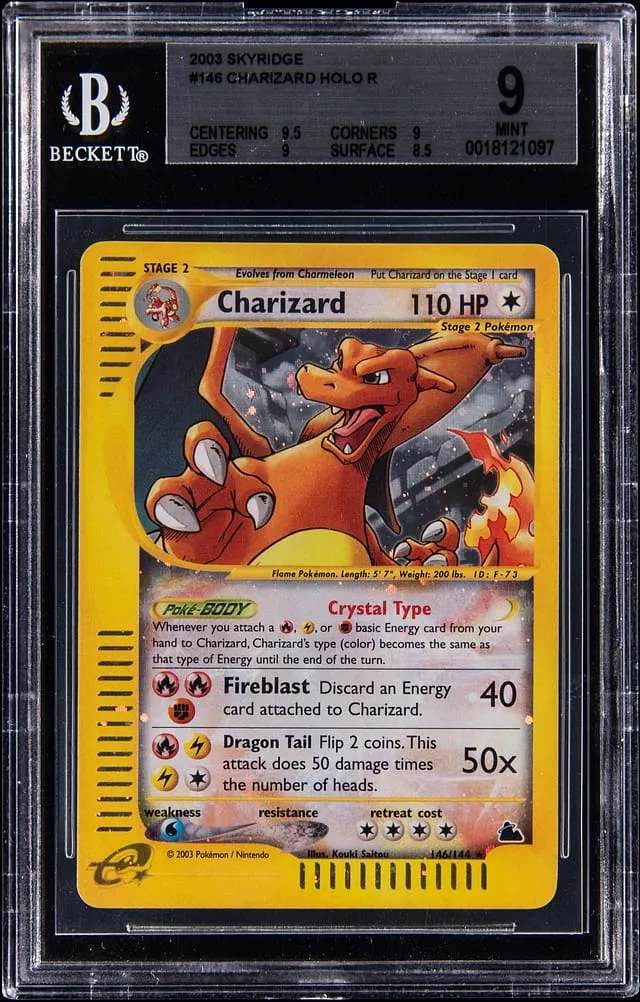
2003 Skyridge Crystal Charizard BGS 9 Sells for $18K
Figoca breaks down the $18,686 Goldin sale of a 2003 Pokémon Skyridge Crystal Charizard #146 BGS Mint 9 and what it means for collectors.
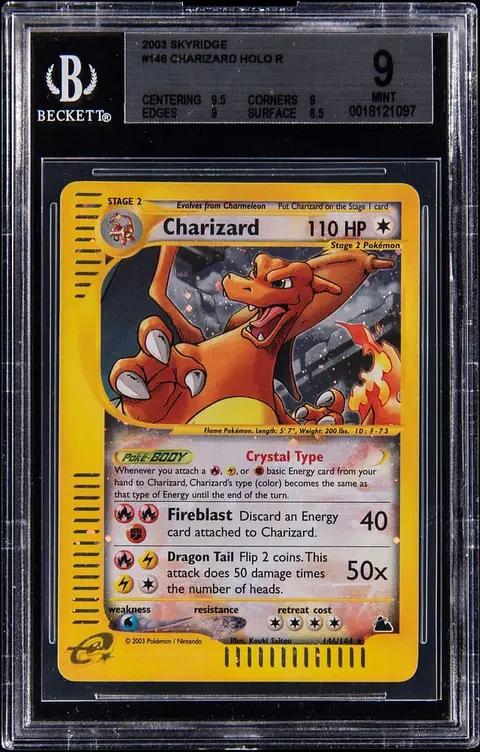
Sold Card
2003 Pokemon Skyridge Holo #146 Crystal Charizard - BGS MINT 9
Sale Price
Platform
Goldin2003 Pokémon Skyridge Holo #146 Crystal Charizard in a BGS Mint 9 holder quietly changed hands at Goldin on 2026-05-25 for $18,686. For a lot of collectors, this is more than just a big number – it’s a useful data point for one of the most important Charizard cards of the 2000s.
The card: 2003 Skyridge Crystal Charizard #146 BGS 9
Let’s start with what actually sold:
- Character: Charizard (Crystal type variant)
- Year: 2003
- Set: Pokémon Skyridge
- Card number: #146
- Card type: Holographic, Crystal Pokémon (a special mechanic from the e-Reader era)
- Rarity / status: Considered a key issue for Charizard collectors, and a chase card of the Skyridge era
- Grading company: Beckett Grading Services (BGS)
- Grade: MINT 9
- Attributes: Non-auto, non-serial, but naturally scarce due to the set’s low print run and age
This is not a rookie card in the sports sense, but in the Pokémon hobby it functions as a pillar card: one of the core Charizard chase cards outside of Base Set.
Why Skyridge Crystal Charizard matters
To understand the sale, it helps to understand the set.
Skyridge and the e-Reader era
Skyridge (released in 2003) was the final English set produced by Wizards of the Coast and part of the short-lived e-Reader era, where cards were printed with dot codes along the side. These sets – Expedition, Aquapolis, and Skyridge – are known for:
- Lower print runs than the early Base/Jungle/Fossil era
- Complex, higher-level artwork
- Crystal Pokémon, a special rarity tier above standard holos
Within Skyridge, Charizard appears as a Crystal Pokémon – an alternate type mechanic with standout foil treatment and a distinct card frame. For many Charizard and WotC-era collectors, this is one of the top non-Base Set Charizard cards you can own.
Collector significance
Collectors care about this card because it sits at the intersection of several key themes:
- End of an era: Final WotC English set, closing out a foundational period of the TCG.
- High-difficulty pull: Crystal cards were significantly harder to pull than regular holos.
- Condition challenges: Dark borders, heavy holo foil, and age make true Mint copies less common.
- Charizard focus: Many collections are built around Charizard “pillars” – Base, Neo, e-Series Crystals, Gold Stars, and key modern chase cards. Skyridge Crystal Charizard is firmly on that list.
In hobby terms, this is a key issue: a card that anchors a character’s collecting run across eras.
Market context: recent sales and price levels
Note: Public sales data for this specific configuration – Skyridge Crystal Charizard #146 in BGS 9 – is more limited than for PSA slabs, because PSA tends to dominate population reports and auction volume. Where necessary, looking at PSA 9 and BGS 9.5 results helps frame the range, as long as we keep grading differences in mind.
How this $18,686 sale fits in
The Goldin sale at $18,686 on 2026-05-25 sits in what has become a mid- to upper-tier range for high-grade copies of this card.
Across recent years, public auction results for PSA 9 copies have generally landed in the low- to mid-five-figure range, with stronger examples and well-timed listings occasionally pushing higher. BGS 9 sales often trail PSA 9 slightly, depending on subgrades and eye appeal.
Against that backdrop, a BGS Mint 9 changing hands for just under $19,000 looks competitive but not out of line. It suggests:
- There is still steady demand for high-grade Skyridge Crystal Charizard.
- The market is willing to pay strong, but not extreme, premiums for nicely presented Mint copies.
Comparing to higher and lower grades
When collectors talk about comps (short for comparable sales), they often look across grades for the same card to get a sense of relative value.
While exact numbers fluctuate with each auction, the general structure for Skyridge Crystal Charizard tends to look like:
- High-grade (PSA 10 / BGS 9.5+): Historically much higher, reflecting a substantial premium for Gem Mint population scarcity.
- Mint (PSA 9 / BGS 9): A more “reachable” tier for serious collectors who want a top-end copy without the Gem Mint multiplier.
- Near Mint / lower (PSA 7–8 and below): Still meaningful, but the price curve usually softens as condition issues become more obvious.
This Goldin result reinforces the idea that Mint is a key breakpoint: buyers are willing to pay a clear premium over Near Mint for a clean, graded example, but the jump to Gem Mint is still another tier entirely.
Scarcity, condition, and grading
Two elements help frame why this card holds its value across cycles:
- Natural scarcity of Skyridge: The set had a more limited print run than earlier WotC sets, and sealed product is now both expensive and scarce.
- Condition difficulty: Surface scratching, edge chipping, and print issues are common. Achieving a BGS 9 means the card has avoided many of the major eye-level flaws.
BGS adds another layer via subgrades (centering, corners, edges, surface). Even when two cards share a 9 overall, subgrades can influence how collectors perceive value, especially for crossover potential to PSA or for long-term holding.
What this sale might signal for the market
A single auction never tells the whole story, but this result offers a few practical takeaways for collectors:
- Stability over spectacle: The realized price looks aligned with recent ranges rather than a dramatic spike or collapse. For a mature chase card, that kind of stability is often more informative than a record.
- Continued focus on key WotC Charizards: Even with new sets and chase cards arriving every quarter, core WotC-era Charizards continue to attract strong bidding.
- Grade still matters: The Mint 9 label clearly separates this card from mid-grade copies, while still leaving space for Gem Mint to command a higher tier.
None of this should be read as financial advice or a prediction. Instead, it’s another data point for how the market is currently valuing a flagship e-Series Charizard.
For different types of collectors
How you might look at this sale depends on where you are in the hobby:
- New or returning collectors: This sale shows why some cards are talked about so often. Skyridge Crystal Charizard is a textbook example of how rarity, set history, and character popularity come together.
- Active hobbyists: If you track pop reports (the grading company’s count of how many copies exist in each grade) and auctions, this result helps you refine your personal range for what a BGS 9 should roughly cost versus PSA 9 or BGS 9.5.
- Small sellers: If you handle raw Skyridge or other e-Series holos, this sale underlines the gap between raw and graded Mint copies. It can be a reminder to look carefully at centering, surface, and edge wear before deciding whether to grade.
Final thoughts
The 2003 Pokémon Skyridge Holo #146 Crystal Charizard in BGS Mint 9 selling for $18,686 at Goldin on 2026-05-25 adds one more clear mark on the pricing map for this card.
It doesn’t rewrite the story of Skyridge Charizard, but it does something more useful for most collectors: it reinforces where the market currently sits for a key WotC-era Charizard in a strong, but not Gem Mint, grade.
For anyone building a Charizard run, studying e-Series cards, or simply trying to understand how iconic non-Base Set cards behave at auction, this is a sale worth bookmarking and comparing against the next round of results.