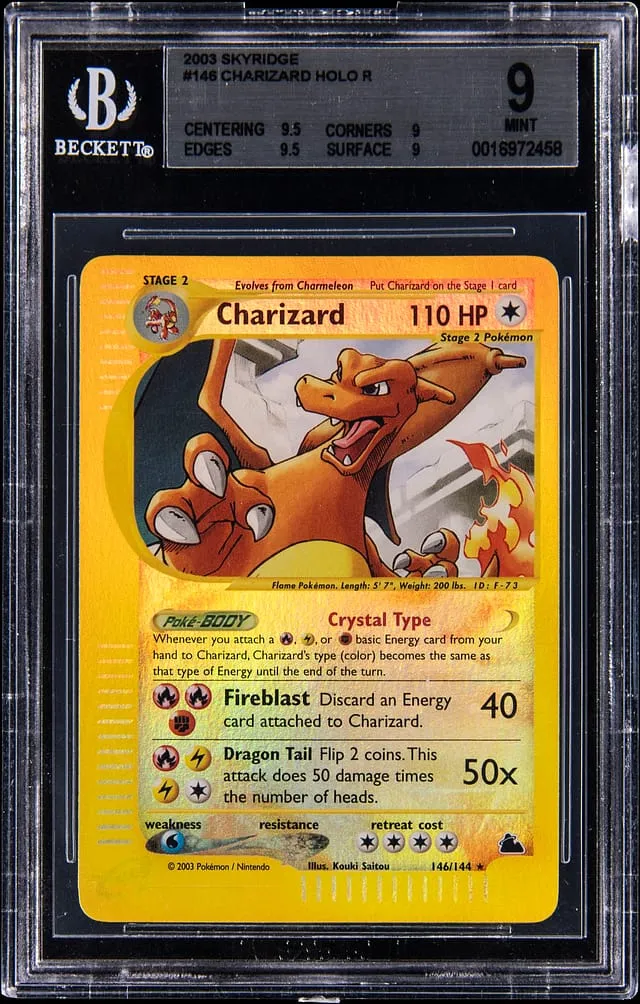
2003 Skyridge Crystal Charizard BGS 9 Goldin Sale
Deep dive on the 2003 Pokémon Skyridge Reverse Holo Crystal Charizard BGS 9 that sold for $12,200 at Goldin on June 1, 2026.
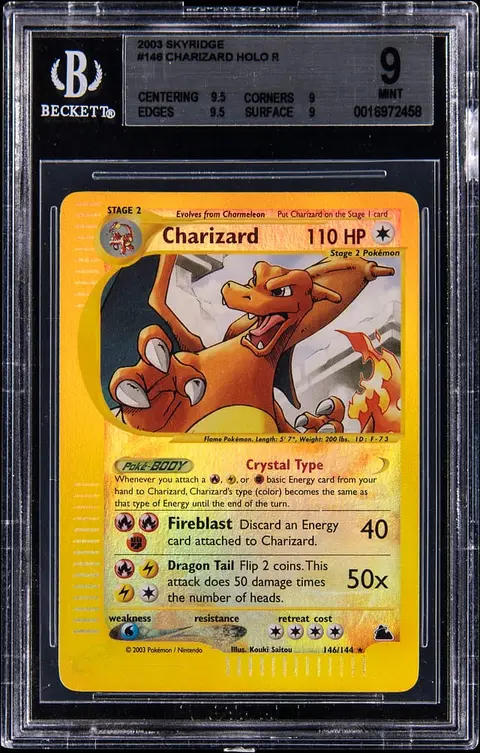
Sold Card
2003 Pokemon Skyridge Reverse Holo #146 Crystal Charizard - BGS MINT 9
Sale Price
Platform
Goldin2003 Pokémon Skyridge Reverse Holo #146 Crystal Charizard – BGS 9 Goldin Sale Breakdown
A copy of the 2003 Pokémon Skyridge Reverse Holo #146 Crystal Charizard graded BGS MINT 9 just sold at Goldin on June 1, 2026 for $12,200. For a card that already sits near the top of many collectors’ “grail” lists, this is a useful data point for understanding how the Skyridge era and the Crystal Charizard specifically are behaving in today’s market.
In this post, we’ll unpack what this card is, why Skyridge matters, how this sale lines up with recent comps (comparable sales), and what collectors can realistically take away from the result.
- Card ID: What Exactly Sold?
Let’s start by identifying the card clearly.
- Character: Charizard
- Year: 2003
- Set: Pokémon Skyridge (the final WotC-era English Pokémon set)
- Card number: #146
- Variant: Reverse Holo Crystal Charizard (not the regular holo)
- Rarity/key status: Key chase card of Skyridge and a major Charizard key issue
- Era: Late WotC / early 2000s
- Grading company: Beckett Grading Services (BGS)
- Grade: MINT 9
This card is not a rookie card (that concept is looser in Pokémon than in sports), but it is widely treated as a blue-chip Charizard card because:
- It comes from Skyridge, a historically important and relatively low-printed set.
- It features the “Crystal” mechanic, which is a marquee subset within Skyridge.
- It’s a reverse holo, which in Skyridge means the whole card background is holofoil while the main art window is non-holo, with the special set pattern in the foil.
Within Charizard’s long checklist of cards, Skyridge Crystal Charizard (in both holo and reverse holo) is typically grouped in the top tier alongside Base Set, Neo, and certain high-end EX/Gold Star appearances.
- Why Skyridge and Crystal Charizard Matter to Collectors
To understand the sale, it helps to understand the set.
- Skyridge was the last English-language Pokémon set printed by Wizards of the Coast (WotC).
- The print run is generally believed to be lower than earlier WotC sets, due to timing and the transition away from WotC. That tends to mean fewer sealed boxes, fewer singles, and fewer high-grade copies today.
- The set introduced Crystal Pokémon, a special group of cards with a distinct template, typing, and rarity that effectively function like a high-end insert.
Crystal Charizard is one of the central cards in that subset. For many collectors:
- It anchors Skyridge the way Base Set Charizard anchors Base Set.
- It occupies a cross-over space: WotC-era nostalgia, Charizard fandom, and high-end set collecting.
- Reverse holos in Skyridge can be tougher in high grade because the holofoil area is large and prone to scratches, print lines, and edge wear.
As a result, a BGS 9 reverse holo copy is not just “another Charizard,” but a relatively scarce, era-defining card in a tough grade from a low-availability set.
- Grading: What a BGS MINT 9 Means Here
BGS (Beckett Grading Services) uses a 1–10 scale with subgrades (centering, corners, edges, surface) when provided. While the specific subgrades for this card aren’t included in the sale summary, a BGS 9 generally indicates:
- Sharp corners with only very minor issues
- Strong centering within BGS tolerance for a 9
- Clean surface with limited print lines or minor flaws
Collectors often compare BGS and PSA populations (the “pop report” is the count of graded copies in each grade). For Skyridge Crystal Charizard, both:
- PSA 10 / BGS 9.5+ copies tend to be particularly thin on the ground.
- BGS 9 and PSA 9 represent a more accessible, but still meaningfully premium, grade level.
The reverse holo version can also be trickier than the regular holo in some respects, because the holofoil covers more of the card and captures more flaws.
- Market Context: Where Does $12,200 Fit?
Price: The Goldin sale closed at $12,200 on June 1, 2026.
Because this is a niche, high-end card, sales data can be irregular. Instead of daily liquidity, you tend to see a handful of meaningful public auction results spread out over time. For context, when looking across major auction houses and marketplaces:
- Higher grades (PSA 10 / BGS 9.5 and above) for Skyridge Crystal Charizard, particularly the holo version, have historically pulled significantly higher numbers when they appear, reflecting much lower supply.
- PSA 9 and BGS 9 copies, especially in the reverse holo format, have repeatedly settled in a mid–five-figure to low–five-figure band depending on timing, auction venue, eye appeal, and general market tone.
- Lower grades (PSA/BGS 8 and below) sit meaningfully below this level, with more frequent appearances and a wider range of realized prices.
Taken together, the $12,200 result for a BGS 9 reverse holo aligns with a pattern where:
- The few public sales we see for this grade and variant tend to cluster around the low five figures.
- The card shows resilience relative to many modern and ultra-modern releases, reflecting its WotC-era origin and Charizard/Skyridge status.
The sample size of recent, directly comparable sales (same card, same grade, same variant) is not large, so any one auction should be read as a data point rather than a definitive price anchor. Still, this result is directionally consistent with how the market has treated Skyridge Crystal Charizard in strong, but not gem mint, grades.
- Record Sales and Historical Context
Over the last several years, premium Charizard cards have produced some of the hobby’s headline numbers. Within that landscape, Skyridge Crystal Charizard has not usually been the single most expensive Charizard card, but it has consistently sat in the upper tier.
Historically:
- Top-grade examples of Skyridge Crystal Charizard (particularly PSA 10 holo) have drawn attention at major auction houses.
- Reverse holo examples in high grade have followed a similar trajectory, though generally at a discount to the regular holo in the same grade.
The $12,200 result at Goldin is therefore best viewed as:
- A solid, data-rich comp for a high-end, non-gem copy.
- Evidence that the market continues to recognize Skyridge Crystal Charizard as a stable, important Charizard card.
It doesn’t appear, based on broader high-end Charizard data, to be a record-breaking number for the species as a whole, but it contributes to the ongoing historical record for this specific variant and grade.
- Collector Significance: Why People Chase This Card
Collectors care about this card for several overlapping reasons:
Charizard factor
- Charizard has been one of the most collected Pokémon since the late 1990s.
- Almost every era’s standout Charizard ends up on long-term want lists.
WotC era nostalgia
- WotC sets (Base through Skyridge) are where many current adult collectors got their start.
- Skyridge, being the last WotC set, carries a sense of “end of an era” finality.
Crystal mechanic and design
- Crystal Pokémon are mechanically distinct and visually recognizable.
- The Skyridge crystal template and artwork stand out even among Charizard’s crowded catalog.
Reverse holo challenge
- Skyridge reverse holos are prone to surface wear.
- High-grade reverse holo Charizards have both set-collector and Charizard-collector demand.
Set-building pressure
- Full Skyridge reverse holo sets are an ambitious project.
- Key cards like Crystal Charizard tend to see demand from both set builders and character-focused collectors, keeping available supply low.
How This Sale Fits the 2020s Hobby Landscape
The broader Pokémon market has cooled and stabilized relative to the peak frenzy of 2020–2021. Many modern and ultra-modern issues have seen noticeable retraces from their highs. Against that backdrop:
- Late WotC era keys like Skyridge Crystal Charizard have generally shown better stability.
- Prices are still well above pre-2020 levels in many cases, but have moved into a range where long-term collectors and hobbyists are more active again.
The $12,200 BGS 9 sale on June 1, 2026 suggests that buyer and seller expectations for this card are converging around the idea that:
- It remains a premium, long-term relevant piece.
- It may not be in the same speculative spotlight as during peak years, but demand is sufficiently deep that high-grade copies continue to clear at strong levels.
- Takeaways for Collectors and Small Sellers
If you’re a collector or small seller looking at this sale as a data point, here are some practical takeaways:
Use it as a comp, but not the only one
- A comp is a comparable sale you use as a rough reference.
- For a card as thinly traded as this, you’ll want to look at:
- Same card, same grade (best match)
- Same card, adjacent grades (BGS/PSA 8.5, 9.5)
- Regular holo versions to understand the relationship between holo and reverse holo.
Pay attention to grading crosses and differences
- BGS and PSA can grade slightly differently.
- A BGS 9 with strong subgrades might be viewed differently from a PSA 9.
Condition still matters a lot within the same grade
- Centering, print quality, and overall eye appeal can shift realized prices, especially at the high end.
Expect irregular supply
- This is not a card you’ll see every week in public auctions.
- When examples do appear at major houses like Goldin, they can re-anchor expectations for similar copies.
Separate card quality from market forecasts
- This sale reinforces that Skyridge Crystal Charizard remains a meaningful card.
- It does not guarantee future price direction. Treat it as a snapshot of what one well-exposed auction achieved at a specific moment in time.
Closing Thoughts
The June 1, 2026 Goldin sale of a 2003 Pokémon Skyridge Reverse Holo #146 Crystal Charizard in BGS MINT 9 for $12,200 is another marker in the evolving history of high-end Charizard cards.
For collectors, it confirms a few themes:
- WotC-era keystones, especially Charizards from low-printed sets like Skyridge, continue to command serious attention.
- The reverse holo Crystal Charizard is firmly established as a chase card rather than a secondary variant.
- High-grade copies remain scarce enough that each public auction matters when you’re trying to understand the market.
As always, the best use of this data is to combine it with your own collecting goals, condition standards, and budget. The story this sale tells is less about speculation and more about how a historically important, difficult card is finding its level in a more mature Pokémon market.