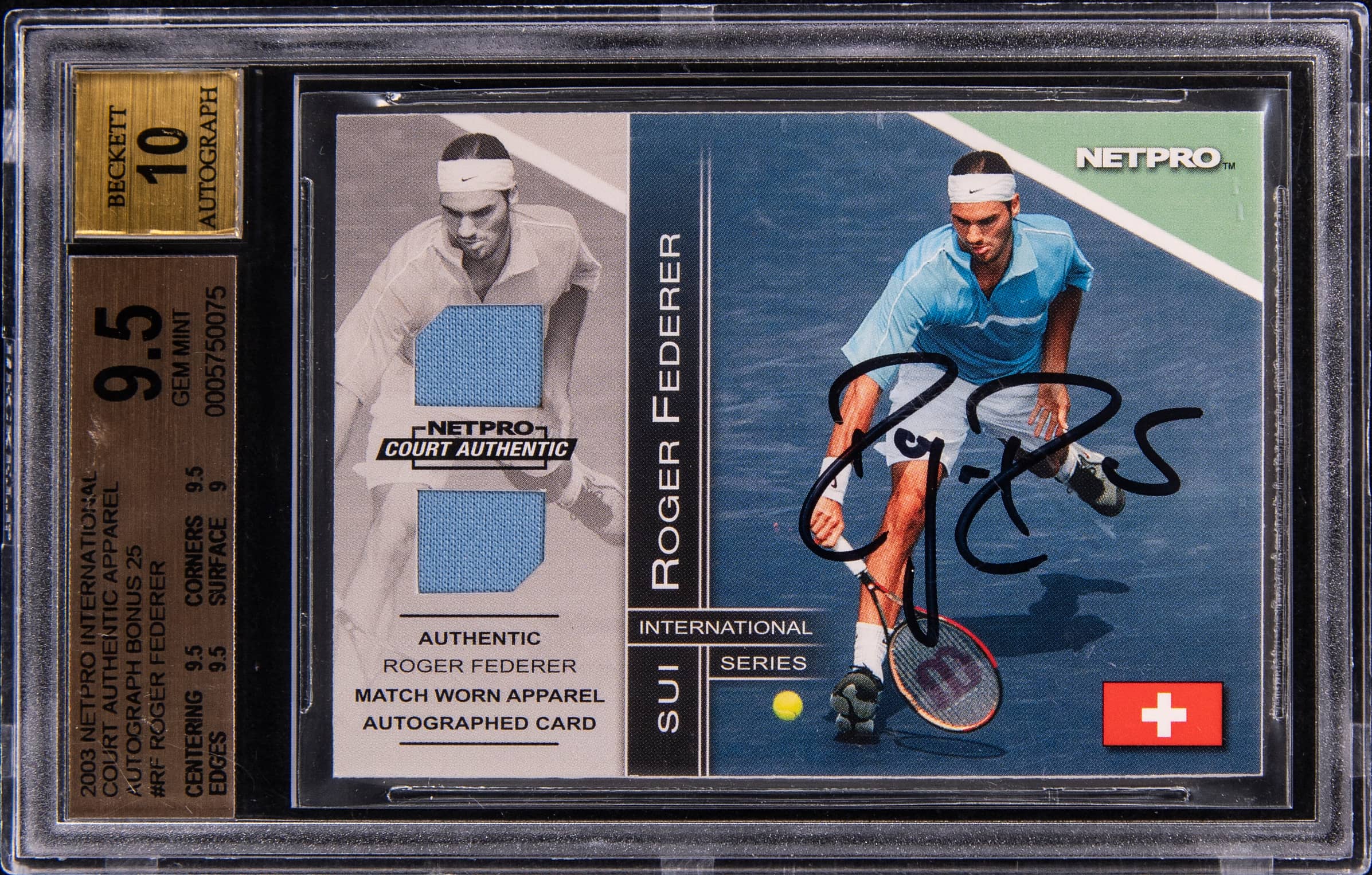
2003 NetPro Roger Federer Auto Relic Sells for $95K
Goldin’s Feb 8, 2026 sale of a 2003 NetPro Roger Federer /25 BGS 9.5/10 rookie auto relic at $95,770 shows how high-end tennis cards are evolving.
Sold Card
2003 NetPro International Series Court Authentic Apparel Autograph Bonus 25 #RF Roger Federer Signed Match-Worn Relic Rookie Card (#12/25) - BGS GEM MINT 9.5, Beckett 10
Sale Price
Platform
GoldinA $95,770 Federer Rookie Auto-Relic: What This 2003 NetPro Sale Tells Us
On February 8, 2026, Goldin closed a key tennis auction: a 2003 NetPro International Series Court Authentic Apparel Autograph Bonus 25 #RF Roger Federer Signed Match-Worn Relic Rookie Card (#12/25), graded BGS GEM MINT 9.5 with a Beckett 10 autograph, sold for $95,770.
For a sport that still sits on the edge of mainstream hobby attention, this is a meaningful data point. Let’s unpack why this specific Federer card matters and what the sale might tell us about the tennis card market.
The Card at a Glance
- Player: Roger Federer
- Year: 2003
- Set: NetPro International Series – Court Authentic Apparel Autograph "Bonus 25"
- Card number: #RF
- Serial numbering: Limited to 25 copies, this one is #12/25
- Attributes:
- On-card autograph (signed directly on the card)
- Match-worn apparel relic (piece of Federer-used clothing)
- Recognized as a rookie-year premium issue
- Grading: BGS GEM MINT 9.5, Beckett 10 autograph
NetPro’s 2003 release is widely considered the foundational modern tennis set, similar to what 1986 Fleer is for basketball. Within that ecosystem, the Autograph and Autograph Apparel cards are among Federer’s most chased early issues.
The "Bonus 25" variation marks an even more limited, premium tier. With just 25 copies worldwide, it occupies the same role that a low-numbered parallel or premium patch auto does in major US sports releases.
Why 2003 NetPro Matters in Tennis Collecting
For newer collectors: 2003 NetPro was the first broadly distributed, fully licensed modern tennis set that captured the sport’s future legends in real time. The checklist includes Roger Federer, Rafael Nadal (in the International Series subset), Serena Williams, and others.
Key reasons collectors care about this product:
- First mainstream Federer cards – While Federer has earlier regional and oddball issues, 2003 NetPro is his first widely recognized trading card release.
- Era-defining set – NetPro became the de facto “flagship” (the main, most recognized base set) for modern tennis in the 2000s.
- On-card autos and relics – At a time when tennis had relatively few premium products, having on-card signatures and match-worn pieces made these cards stand out.
Within that ecosystem, a low-serial, on-card autograph with a match-worn relic is near the peak of what collectors look for in early Federer.
Grading and Condition: Why BGS 9.5 / 10 Matters
Beckett Grading Services (BGS) is one of the major grading companies in the hobby. A BGS 9.5 GEM MINT grade signals that the card is extremely well-preserved across centering, corners, edges, and surface. The Beckett 10 autograph subgrade confirms the signature itself is bold, clean, and free of noticeable flaws.
For a complex card like this—thicker stock, relic window, and on-card autograph—reaching GEM MINT isn’t trivial. Chipping on edges, surface issues around the relic window, and autograph fading can all hold a card back.
In a tiny print run of just 25, any high-grade example is meaningful. Population reports (often called "pop reports"—they show how many copies of a card have achieved each grade at a grading company) for these kinds of Federer autos are usually very low at the top end. Not every card in a /25 run is submitted, and of those that are, not all reach 9.5/10 levels.
Price Context: How Does $95,770 Stack Up?
This card sold at Goldin on February 8, 2026, for $95,770. To understand that number, it helps to think in terms of "comps"—short for comparables, meaning recent sales of the same card or very similar cards.
For this exact card (2003 NetPro International Series Court Authentic Apparel Autograph Bonus 25 #RF, BGS 9.5/10), public auction data is limited simply because:
- The card is serial-numbered to just 25 copies.
- Many are likely locked away in long-term collections.
- Not every sale is public or reported.
More commonly traded Federer rookies tend to be the base 2003 NetPro and the standard 2003 NetPro Autographs, especially in PSA 9 and PSA 10. The match-worn auto relics, and especially this "Bonus 25" tier, sit a step above in scarcity and perceived prestige.
When comparing this sale to prices of:
- Standard 2003 NetPro Federer rookies (non-auto, non-relic)
- Standard auto or auto-relic versions without the /25 "Bonus" designation
- Other high-end Federer rookies in top grades
…the $95,770 result places this card clearly in the upper echelon of Federer’s rookie-year market. While exact recent comps for this precise card and grade are sparse, the closing price is consistent with how collectors have increasingly treated:
- Federer as a top-tier “GOAT” (greatest of all time) candidate in tennis.
- 2003 NetPro as his key early platform.
- Ultra-scarce autograph relics as the premium layer above base rookies.
Rather than viewing this as an outlier, the sale fits into a broader trend of serious collectors directing more capital toward true top-of-the-pyramid pieces—low-serial, on-card auto, match-worn, high grade—within already respected sets.
Why Collectors Value This Specific Federer Card
Several overlapping factors give this card its collector significance:
Rookie-year origin
2003 aligns with Federer’s breakout period, including his first Wimbledon title. Collectors often prioritize cards tied to the season when a player first emerged on the global stage.Ultra-low serial number (/25)
Serial-numbered cards limit maximum supply. Here, the entire print run is just 25, which is extremely low compared with base rookies that can number in the tens of thousands.Match-worn relic
The embedded piece of apparel is described as match-worn, connecting the card directly to on-court action. For many collectors, that physical connection to play is a big part of the appeal.On-card autograph
Federer signed directly on the card rather than on a sticker later applied by the manufacturer. In the hobby, on-card autos are generally preferred as they feel more personal and integrated with the design.High-end grade with 10 auto
A BGS 9.5 with a 10 autograph subgrade is a strong combination. For cards that are already scarce and important, grade can be a significant multiplier.Set and sport context
In more mature categories like basketball or baseball, premium rookie autos and auto-relics of all-time greats are already well established. Tennis is catching up in terms of hobby recognition, and Federer is one of the main drivers of that shift.
Market Context: Tennis and Federer in 2026
As of early 2026, Roger Federer is firmly in the retired-legend phase of his career. In sports cards, that can be a stabilizing period: active-player volatility (form, injuries, short-term narratives) calms down, and long-term historical status carries more weight.
Other factors that likely support sustained interest in this type of card:
- Ongoing debate over the "GOAT" between Federer, Nadal, and Djokovic keeps tennis in the broader sports conversation.
- The growth of global collecting—particularly in regions with strong tennis followings—has brought more attention to high-end tennis cards.
- 2000s-era sets like 2003 NetPro have the advantage of being modern enough for good printing technology but old enough to have real scarcity and less overproduction.
Rather than responding to a single short-term storyline, the market for Federer’s top-tier rookies appears to be building around his full career legacy.
For Collectors: How to Think About This Sale
If you’re a newer or returning collector, here are a few takeaways from the Goldin sale on February 8, 2026:
True scarcity matters
A print run of 25 sets a hard cap on supply. In markets where demand is global and long term, that level of scarcity is meaningful.Hierarchy within a player’s rookies
Not all rookie-year cards are equal. Base rookies, autographs, relics, and low-serial variations form a kind of ladder. This card sits near the top of Federer’s ladder.Grading amplifies already-rare cards
High grades don’t just matter for overproduced eras. For low-serial, important cards, top-tier grades can separate one copy from another in a very small pool.Look at comparable structures, not just exact comps
In ultra-scarce cards, exact recent sales might not exist. In those cases, it can be useful to compare the structure of the card (rookie-year, on-card auto, relic, low serial, high grade) to what collectors pay for similar structures in other sports and sets.Auction houses as price discovery tools
High-profile venues like Goldin often bring out serious bidders and can serve as reference points for what the market is currently willing to pay, especially on rare items.
What This Means for the Tennis Card Segment
Tennis remains a smaller corner of the hobby compared with the major US sports, but sales like this one show that there is a defined, serious market for top-tier pieces. A nearly six-figure result for a Federer rookie-year, match-worn, on-card auto relic suggests:
- High-end collectors are willing to assign substantial value to the very best tennis cards.
- 2003 NetPro continues to be treated as the central modern tennis platform.
- Scarce, high-grade Federer rookies can anchor collections in much the same way that premium Jordan, Brady, or Messi pieces do in their respective sports.
It doesn’t mean every Federer card will follow the same path, and it doesn’t guarantee future prices. But as a single, well-documented sale, it adds another clear data point to how the market currently views the top of the Federer pyramid.
Final Thoughts
The February 8, 2026 Goldin sale of the 2003 NetPro International Series Court Authentic Apparel Autograph Bonus 25 #RF Roger Federer Match-Worn Relic Rookie, BGS 9.5 with a Beckett 10 auto, at $95,770, underscores how far the tennis category has come.
For collectors, it’s a reminder that:
- Foundational sets like 2003 NetPro can become long-term reference points.
- Scarcity, eye appeal, and grading still sit at the heart of high-end card valuation.
- Even in a niche sport from a hobby perspective, the very best pieces can command serious attention.
If you’re building a tennis or Federer-focused collection, tracking results like this—alongside more common rookies and mid-tier inserts—can help you map the full spectrum of the player’s card market, from accessible entry points to true centerpiece grails.