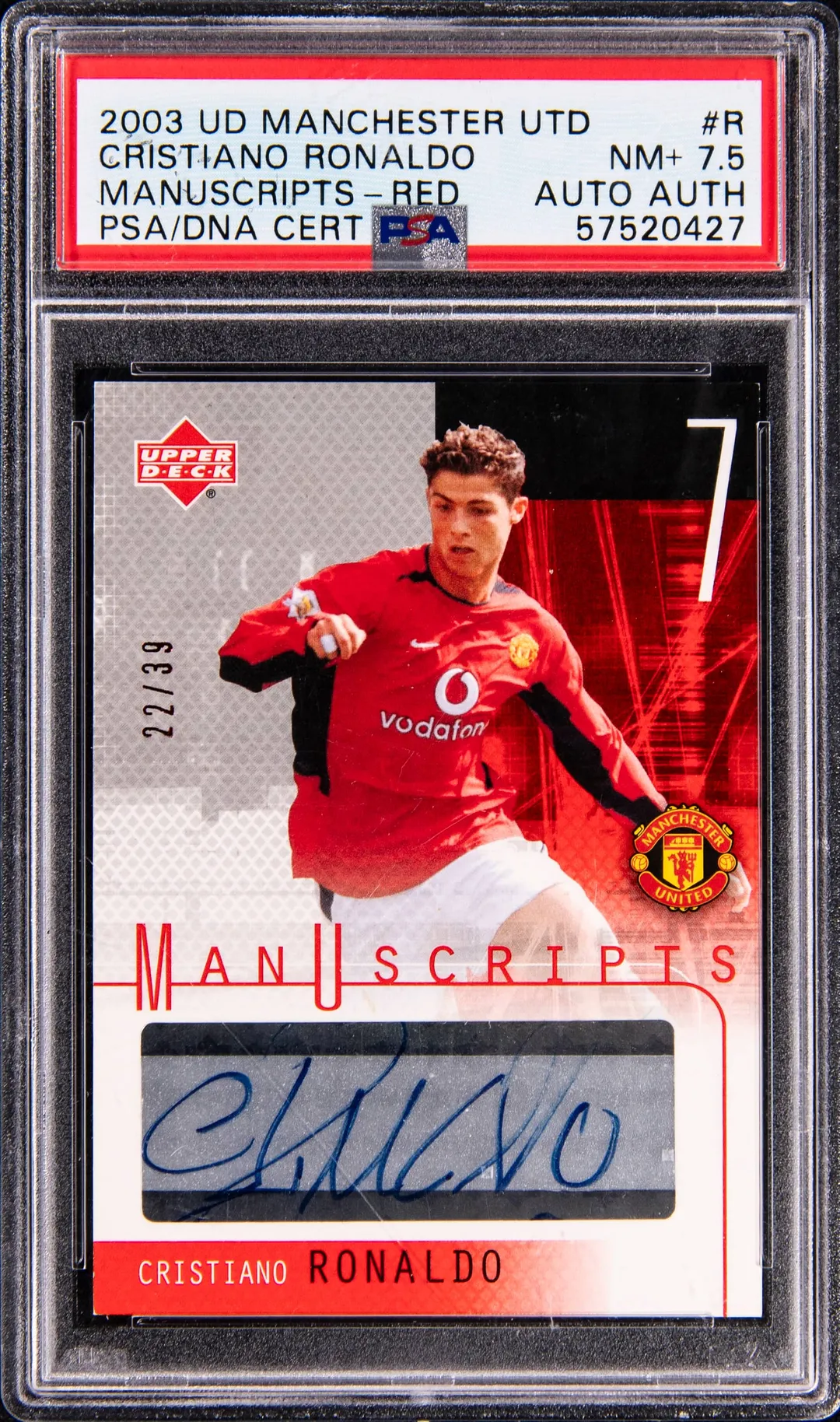
2003 ManUscripts Red Ronaldo Auto /39 Sells for $41K
Goldin sold a 2003 Upper Deck ManUscripts Red Cristiano Ronaldo auto /39 (PSA 7.5, PSA/DNA) for $41,236. A key early United-era CR7 autograph.
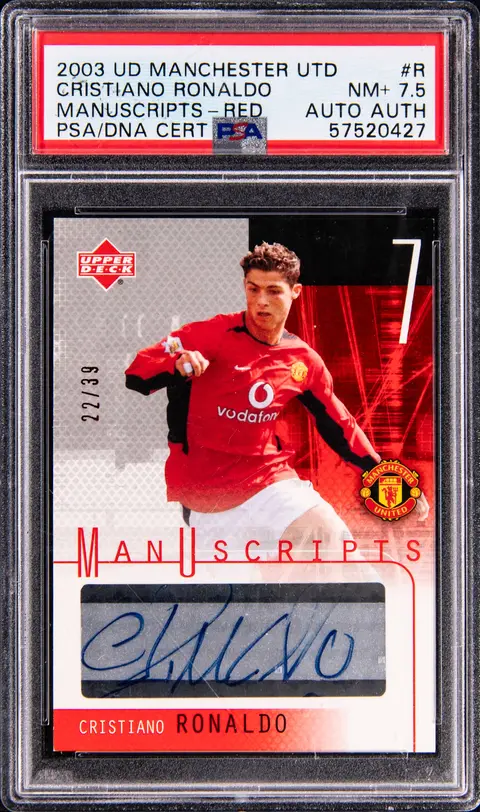
Sold Card
2003 Upper Deck Manchester United ManUscripts Red #R Cristiano Ronaldo Signed Card (#22/39) - PSA NM+ 7.5, PSA/DNA Authentic - Pop 1
Sale Price
Platform
Goldin2003 Upper Deck Manchester United ManUscripts Red #R Cristiano Ronaldo Signed Card (#22/39) - PSA NM+ 7.5, PSA/DNA Authentic - Pop 1
On February 8, 2026, Goldin sold a key early Cristiano Ronaldo autograph: a 2003 Upper Deck Manchester United ManUscripts Red #R, serial numbered 22/39, graded PSA NM+ 7.5 with a PSA/DNA authenticated on-card autograph. The final price was $41,236.
For Cristiano Ronaldo collectors and soccer card fans, this is not just another signed card. It’s an early, low-serial-number Manchester United-era auto with a population (“pop”) of just 1 in this grade according to PSA.
Card overview
Let’s break down exactly what this card is:
- Player: Cristiano Ronaldo
- Team: Manchester United
- Year: 2003
- Set: 2003 Upper Deck Manchester United – ManUscripts insert
- Card: ManUscripts Red #R
- Serial numbering: 22/39 (only 39 copies produced)
- Autograph: On-card (signed directly on the card), PSA/DNA Authentic
- Grading company: PSA
- Card grade: NM+ 7.5
- Population: Pop 1 in PSA 7.5 (no other exact 7.5 copies in PSA’s census at the time of sale)
This ManUscripts Red is widely recognized among hobbyists as one of Ronaldo’s more important early Manchester United autographs. It is not his only early auto, and it sits alongside his 2002–2003 Sporting and 2003–2004 United issues, but the combination of a recognized brand (Upper Deck), a club-specific release, and a low serial number gives it real weight in the modern soccer card market.
Is this a rookie or a key early issue?
Definitions of “rookie card” in soccer can be loose, especially for players who began their careers in Europe before mainstream licensed card products were widely tracked by today’s hobby. Ronaldo has earlier cards tied to his Sporting CP days, and some collectors chase those as his true rookies.
This card is best described as a key early Manchester United-era autograph, rather than the definitive rookie. Collectors value it because:
- It’s from the very start of his Premier League career.
- It features him in Manchester United kit, where his global superstardom really took off.
- It is hard-numbered to just 39 copies, giving it true scarcity.
- It carries an on-card signature, preferred by many collectors over sticker autos.
Why the PSA NM+ 7.5, PSA/DNA Authentic combo matters
The card’s slab reads PSA NM+ 7.5 for the card and PSA/DNA Authentic for the autograph. Here’s what that signals to collectors:
- Card grade 7.5 (Near Mint+): For an early-2000s glossy, foil-accented autograph insert, minor edge, surface, or corner issues are common, especially given how they were handled for signing. NM+ 7.5 places the card in solid condition but not at the very top of the population.
- Autograph authentication: PSA/DNA has certified the signature as authentic, which is central to the card’s value. While some slabs also carry a separate numerical grade for auto quality, an “Authentic” designation is still widely accepted and traded.
In this kind of piece, especially at this rarity level (39 copies total), collectors often prioritize card authenticity, real scarcity, and eye appeal over squeezing out one or two extra grade points.
Market context and comps
Exact comps (comparable recent sales) for this exact card in PSA 7.5 with PSA/DNA Authentic are limited because of:
- The tiny print run (only 39 copies total).
- The low graded population in any holder.
- The tendency for high-end Ronaldo collectors to hold long term rather than flip frequently.
Instead, collectors usually triangulate value using:
- Other ManUscripts Ronaldo autos in different grades or parallel colors.
- Comparable early Ronaldo autos from 2003-era Manchester United products.
- Higher-end Ronaldo rookies and early issues (non-auto and auto) to set a rough hierarchy.
Across major marketplaces and auction houses, the pattern over the past couple of years has been:
- Early Ronaldo autos from the early-to-mid 2000s have seen steady interest, driven by his cemented GOAT-tier status (multiple Champions League titles, Euro 2016, all-time men’s international goal record, etc.).
- Low-serial, on-card United autos tend to clear a strong premium to later, higher-print-run issues from his Real Madrid, Juventus, and national team periods.
Within that context, the $41,236 sale at Goldin on February 8, 2026 positions this card firmly in the high-end Ronaldo lane. For similar low-print early autos, recent public sales have generally clustered in a five-figure range, with top grades and especially iconic issues sometimes stretching higher.
Because the sample size for this exact ManUscripts Red #R is very small, it’s best to see this result as a data point in a thin market rather than a precise price guide. In other words: it tells us what a motivated buyer and seller agreed on at that moment, but not necessarily a rigid value floor or ceiling.
Population report and scarcity
“Pop report” is hobby shorthand for the population report a grading company publishes, showing how many copies of a card they have graded at each grade level.
Key points for this card:
- PSA pop 1 in 7.5: There is only one copy graded PSA 7.5 at the time of sale.
- The total PSA-graded population for this exact ManUscripts Red insert is small relative to mass-produced modern cards, consistent with its 39-copy print run.
- When supply is this limited, actual available copies on the market at any given time can be close to zero.
For collectors, that means:
- If you specifically want a ManUscripts Red Ronaldo auto from 2003, you cannot simply wait for a steady flow of listings.
- Condition preferences (7.5 vs. 8 vs. 9) often become secondary to just acquiring a copy.
Why collectors care about this card
Several factors combine to make this a target for serious Ronaldo and soccer collectors:
- Era: 2003 places this firmly in the early ultra-modern era of soccer cards—before the explosion of Panini Prizm, Topps Chrome UEFA, and mass hobby attention.
- Club context: Manchester United is where Ronaldo’s global superstardom truly ignited. For many fans, United-era cards feel like the “origin story” of CR7 at the top level.
- Autograph format: On-card signatures are generally preferred over stickers because the player handled the actual card, which also introduces condition challenges.
- Serial numbering: /39 is meaningfully scarce. At this level, you’re not just dealing with grading scarcity but true production scarcity.
- All-time legacy: Ronaldo’s career now spans decades of top-level performance, Champions League runs, international records, and cross-generational fandom. His position in hobby history is secure, which supports long-term interest in cornerstone pieces like this.
Recent hobby and player context
Ronaldo’s move away from Europe to new leagues has not reduced interest in his prime-era cards and autos. If anything, as his playing career moves toward its late chapters, collectors are increasingly focused on:
- Earliest recognized issues (Sporting CP and early Manchester United).
- Low-serial, on-card autographs from the 2000s.
- Cards that visually and historically anchor the story of his rise.
At the same time, soccer as a hobby segment has matured:
- More auction houses now feature dedicated soccer sections.
- High-end CR7 and Messi pieces regularly headline mixed-sport auctions.
- Collectors better understand the relative scarcity of early-2000s soccer vs. later ultra-modern print runs.
The $41,236 Goldin sale aligns with that broader pattern: focused demand for historically important, genuinely scarce CR7 pieces.
How this Goldin sale fits into the broader market
A few takeaways from this result:
- Confirmation of high-end appetite: The price level reinforces that committed buyers are still willing to pay five figures for early Ronaldo autos that check the boxes of scarcity, on-card ink, and strong provenance.
- Thin but informed market: With only 39 copies and limited graded examples, each public auction becomes a meaningful reference point. It’s hard to talk about “averages” or “typical” prices when transactions are so sparse.
- Grade vs. scarcity balance: This is not a PSA 9 or 10, yet it still realized a significant price. That underlines that collectors of these cards often prioritize owning the card over chasing top-pop condition.
What collectors and small sellers can learn
For collectors:
- If you’re building a focused Ronaldo PC (personal collection), this sale highlights how early Manchester United autos sit near the top of the hierarchy behind his true rookies and the most iconic early issues.
- Pop numbers matter, but for cards /39, the actual availability in the market is often the real constraint.
For small sellers and hobbyists:
- When you evaluate a high-end soccer piece, consider three pillars together: era, scarcity, and player legacy.
- For extremely low-print cards, public comps will always be thin. In those cases, tracking major auction house results like this Goldin sale can give a more realistic picture than relying only on marketplace “sold” filters.
Closing thoughts
The February 8, 2026 Goldin sale of the 2003 Upper Deck Manchester United ManUscripts Red #R Cristiano Ronaldo signed card (22/39), graded PSA NM+ 7.5 with PSA/DNA Authentic, at $41,236, is another marker of how the market views early, truly scarce CR7 autograph issues.
It’s not just about a grade or a one-off result. It’s about where this card sits in Ronaldo’s card timeline: early, United, on-card, low-serial, and firmly in the conversation when collectors talk about cornerstone CR7 pieces from the 2000s.
As always, any individual sale is one data point, not a prediction. But for those tracking high-end soccer and iconic players, this is a sale worth bookmarking in your personal comp sheet.