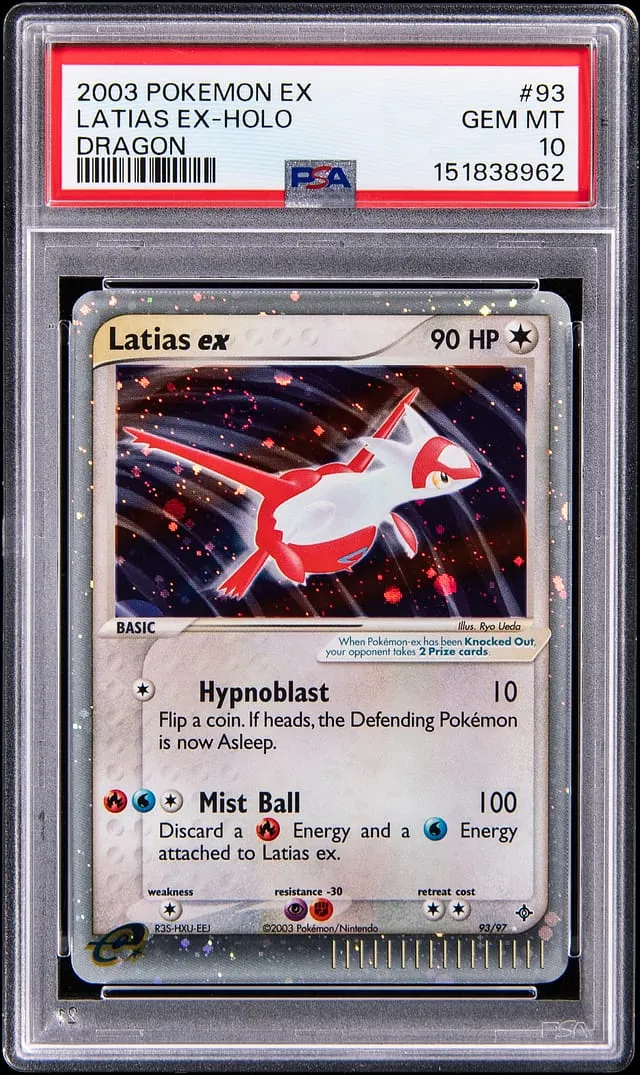
2003 EX Dragon Latias ex PSA 10 sells for $12.2K
2003 Pokémon EX Dragon Latias ex PSA 10 sold for $12,200 at Goldin. See what this sale means for EX-era holo collectors and recent price context.
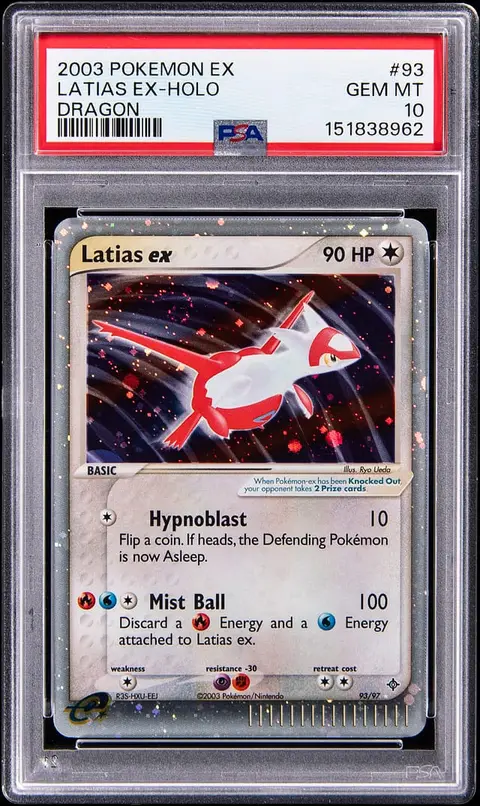
Sold Card
2003 Pokemon EX Dragon Holo #93 Latias ex - PSA GEM MT 10
Sale Price
Platform
Goldin2003 Pokemon EX Dragon Holo #93 Latias ex – PSA GEM MT 10 sold for $12,200 at Goldin on 2026-05-18. For collectors who focus on early 2000s EX era cards, this is a meaningful data point rather than just another headline sale.
Card overview
- Character: Latias ex
- Game/Brand: Pokémon TCG
- Year: 2003
- Set: EX Dragon (English)
- Card number: #93
- Rarity/finish: Holo ex card
- Grading company: PSA (Professional Sports Authenticator)
- Grade: GEM MT 10 (their highest standard grade)
- Type: Key ex-era chase card, not a rookie in the sports sense but an early TCG appearance for Latias in the EX era.
The EX Dragon set is part of the early “EX era” (roughly 2003–2007), known for featuring Pokémon-ex cards with higher HP and stronger attacks. These ex cards are printed with a distinctive border and holo treatment, and many were played heavily when released, which makes high-grade copies harder to find today.
Why this Latias ex matters
EX era nostalgia and scarcity
EX Dragon sits in a transitional period for Pokémon: post–Wizards of the Coast, pre–modern boom. Print runs were generally lower than today’s modern sets, and a lot of product was opened for play, not for preservation. That combination often leads to:
- Fewer sealed boxes remaining
- More surface and edge wear on surviving raw copies
- Relatively thin PSA 10 populations
Latias and Latios both have a strong fan base thanks to their role in the Ruby/Sapphire era of the video games and the anime film "Pokémon Heroes." Within EX Dragon, the Latias ex and Latios ex holos are among the most recognizable chase cards.
PSA GEM MT 10 significance
PSA GEM MT 10 indicates a card that is, in PSA’s eyes, virtually flawless: sharp corners, clean edges, strong centering, and minimal to no printing defects visible even under close inspection. For early 2000s ex cards, this can be challenging due to:
- Dark borders that show whitening easily
- Holofoil that picks up print lines and scratches
- Chipping along the edges from pack-out and handling
Population reports (often called “pop reports”) from PSA show how many copies exist at each grade level. While exact numbers change as more cards are submitted, Latias ex from EX Dragon typically has a modest PSA 10 population compared with mass-printed modern ultra rares. That keeps demand and pricing focused around the small pool of gem-mint copies.
Market context and recent sales
In market discussions, collectors refer to “comps” (short for comparables) to mean recent sales of the same card or very similar cards, used as a reference for current value.
For this 2003 Pokémon EX Dragon Holo #93 Latias ex in PSA 10, recent public-market comps over the past couple of years have generally been in the low five-figure range for strong auction results, with lower grades (PSA 9 and below) trailing meaningfully behind.
Key patterns from recent sales activity:
- PSA 10 copies tend to cluster in the low-to-mid five figures when sold through major auction houses, depending on timing, auction visibility, and overall Pokémon sentiment.
- PSA 9 copies typically sell at a significant discount to 10s, often landing in the mid to high four figures, reflecting both condition differences and stronger supply at the 9 level.
- Raw or ungraded copies vary widely based on condition, as small flaws have an outsized impact once graded.
This Goldin sale at $12,200 on 2026-05-18 lands comfortably in line with that low five-figure range for PSA 10 copies. It does not stand out as a dramatic outlier in either direction, but instead reinforces where the market currently seems willing to transact for a top-condition example.
If you zoom out further to other ex-era chase cards (like Charizard ex, Mew ex, or Latios ex from similar years and sets), you see a similar structure:
- Clear premium for PSA 10
- Healthy but smaller market in PSA 9
- Steady collector demand from fans of the era, even when broader Pokémon attention cools off
Sale significance
This sale does a few useful things for collectors and small sellers:
Resets expectations with a fresh comp
A recent, well-publicized auction result from a major platform like Goldin gives buyers and sellers a current reference point when negotiating private deals or listing on marketplaces.Confirms continued interest in ex-era holos
Even outside of the very top-tier characters, early 2000s ex cards in true gem condition continue to attract bids at meaningful levels. That matters for anyone holding or grading similar EX Dragon cards.Helps clarify the grade gap
By watching the spread between PSA 10 and PSA 9 sales, collectors can better judge whether it makes sense to pay the premium for top grade, or whether a well-centered PSA 9 offers a better fit for their budget and goals.
How this compares to closely related cards
Collectors often look at closely related cards to understand how a specific sale fits into the larger picture:
- Latios ex from EX Dragon: Typically tracks in a similar band, with some variance based on art preference and short-term demand.
- Other Latias cards from the 2003–2005 window: Non-ex versions and later-era Latias cards generally sell for less, highlighting how ex-era chase status and low-pop PSA 10s matter.
- Japanese equivalents and reprints: Japanese ex cards and any alternate artworks can create a broader Latias ex market, but conditions, print quality, and populations differ enough that direct price comparisons need care.
Across these, the 2003 EX Dragon Latias ex in PSA 10 tends to hold a place as one of the character’s key early English TCG appearances and a central target for character-focused collectors.
What collectors can take away
For newcomers, returning collectors, or small sellers, this Goldin sale underscores a few practical points:
- Condition is a major lever: The jump from a played copy to PSA 9 or PSA 10 is large, and the market is very sensitive to centering, edge wear, and holo surface.
- EX-era boxes and raw cards deserve close inspection: If you’re opening or buying EX Dragon-era cards, it can be worth carefully reviewing candidates for grading instead of assuming they are too old or worn.
- Data beats assumptions: Rather than relying on broad "Pokémon is hot" narratives, using recent sales like this one as grounded comps can help keep expectations realistic.
As always, these results are data points, not guarantees of future prices. But the $12,200 Latias ex PSA 10 sale at Goldin on 2026-05-18 is a clear sign that early ex-era staples in top grade continue to command serious attention in the Pokémon TCG market.
For figoca users tracking Pokémon, it’s another card to pin as a reference when you’re pricing, buying, or deciding which EX Dragon cards might be worth sending in for grading.