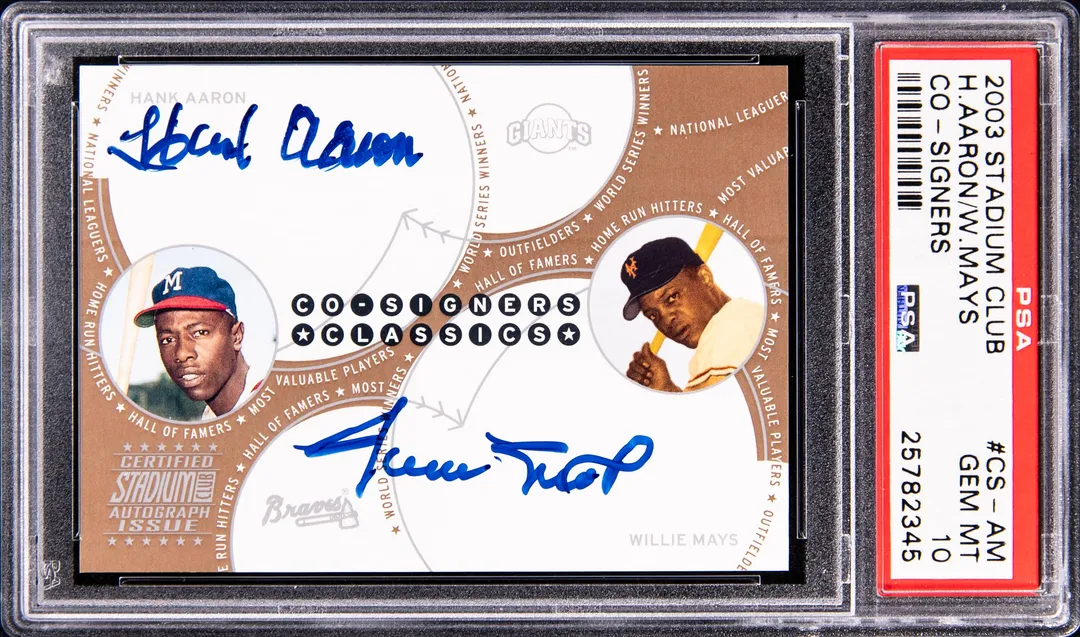
2003 Co-Signers Aaron/Mays PSA 10 Sells for $20K
Goldin sold a 2003 Stadium Club Co-Signers Hank Aaron/Willie Mays PSA 10 dual auto for $20,603. Pop 3 gem sets a strong benchmark for this key insert.
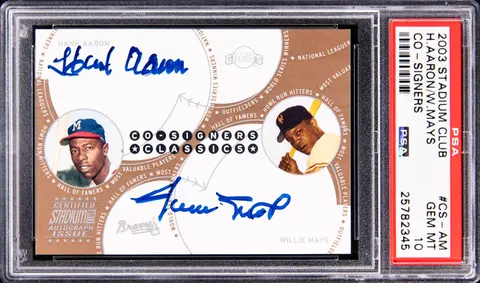
Sold Card
2003 Topps Stadium Club Co-Signers #CS-AM Hank Aaron/Willie Mays Dual-Signed Card - PSA GEM MT 10 - Pop 3
Sale Price
Platform
Goldin2003 Topps Stadium Club Co-Signers produced some of the most respected dual-autograph baseball cards of the 2000s. When two of the greatest players in MLB history share the same card – and both signatures grade out perfectly – collectors tend to pay attention.
On February 8, 2026, Goldin sold a 2003 Topps Stadium Club Co-Signers #CS‑AM Hank Aaron/Willie Mays dual-signed card, graded PSA GEM MT 10, for $20,603. This is one of just three examples at this grade level in PSA’s population report (often called the “pop report”), making it a true high-end outlier for this issue.
In this post, we’ll walk through why this specific copy matters, how it fits into the broader Hank Aaron and Willie Mays market, and what the price tells us about collector demand for early-2000s dual autos of all-time greats.
Card overview
Card: 2003 Topps Stadium Club Co-Signers
Card number: #CS‑AM
Players: Hank Aaron (Milwaukee/Atlanta Braves legend) and Willie Mays (New York/San Francisco Giants legend)
Set: 2003 Topps Stadium Club Co-Signers insert
Type: Dual on-card autograph
Rookie or key issue? Not a rookie, but a key dual-auto issue for both players in the modern-era autograph market
Grading company: PSA
Grade: GEM MT 10 (highest standard grade on PSA’s scale)
Population: Pop 3 in PSA 10 (per the sale description)
The Co-Signers inserts in 2003 Stadium Club paired stars and legends on the same card, with on-card signatures (the players signed directly on the card surface, not on a sticker). For Hank Aaron and Willie Mays, two of the most important names in baseball history, that combination gives the card natural long-term appeal to collectors who focus on inner-circle Hall of Famers.
While earlier playing-era cards of Aaron and Mays from the 1950s and 1960s are the traditional blue-chip pieces, modern dual autos like this have become a core way many collectors connect with vintage legends in a more contemporary format.
Why collectors care about this card
Several factors make this specific card important in the hobby:
Dual signatures of two inner-circle Hall of Famers
Hank Aaron and Willie Mays are both widely viewed as top-5 all-time players. Having both autographs on a single, licensed Topps release is a big draw for collectors who build Hall of Fame autograph runs.On-card autographs from a respected early-2000s insert
Early-2000s Topps insert autos are often seen as a bridge between vintage cardboard and the modern, hit-driven hobby. Co-Signers in particular is known for pairing stars and legends, and for clean, well-designed layouts that showcase the signatures.PSA GEM MT 10 with tiny population (Pop 3)
A PSA 10 grade on an autograph card from 2003 is not a given. Centering, edges, and surface can all present issues, especially on cards that were handled for signing. With only three PSA 10s reported, this copy sits in the very top tier of condition for the issue.Modern-era scarcity vs. vintage iconography
The early-2000s period isn’t vintage in the strict sense, but it predates the current ultra-modern era of serial-numbered, multi-color patch autos and case hits. Production was lower than today’s high-output environment, and this style of clean, on-card dual auto has become more appreciated as collectors look back at that era.Autograph appeal after Aaron’s passing
Hank Aaron passed away in 2021, meaning no new autographs are being added to the market. While there are still Aaron autos available, high-end, well-centered, well-preserved, on-card examples — especially paired with another icon like Mays — have taken on added significance for many collectors.
Market context and price range
The Goldin sale on February 8, 2026 closed at $20,603 for this PSA GEM MT 10 copy. To understand that number, it helps to look at three layers of context:
Exact-card, exact-grade comps
Population 3 in PSA 10 means there simply aren’t many public sales to build a long history. When a card is this thinly traded, single auction results can move around depending on who’s bidding.Recent public comp data for this specific card in PSA 10 is limited, and the few recorded results tend to be older or private. That makes this Goldin sale an important reference point for the top grade.
Same card in lower grades / ungraded
In lower grades or raw (ungraded) condition, dual autos of Aaron and Mays from this era have historically sold for a fraction of what a PSA 10 commands. Realized prices can vary based on autograph strength, eye appeal, and whether the card has any flaws like chipping or surface impressions.The spread between a strong PSA 9 and a PSA 10 can be significant for a low-pop, Hall-of-Fame dual auto. When the population is tiny at the top grade, collectors who specifically chase “pop 1–3” types of cards will often pay a large premium.
Comparable dual autos of Aaron and Mays
Across other licensed products, Aaron/Mays dual autographs and similar pairings of two all-time greats routinely land in the high four-figure to five-figure range, depending on:- Brand (Topps, Bowman, high-end premium releases)
- Serial numbering and print run
- Whether the autos are on-card vs. sticker
- Design and photo quality
Within that landscape, $20,603 for a top-pop PSA 10 copy of a notable early-2000s Topps dual-auto insert sits toward the higher end, but not out of character for a premium, low-pop Hall-of-Fame piece.
Because public data is thin for this exact card and grade, it’s more accurate to say this sale establishes a strong benchmark rather than a clear trend line.
How this sale fits into broader hobby trends
A few bigger-picture hobby themes show up in this result:
Growing focus on autograph quality and grading
Many collectors now care not only that a card is signed, but also how it presents and how it grades. A PSA GEM MT 10 label signals that the card’s surfaces, corners, and centering are all at the very top end, which matters more as prices rise.High-end demand for inner-circle legends
While prospecting and ultra-modern rookies get a lot of attention, steady demand continues for high-quality cards featuring all-time greats. Aaron and Mays fit squarely in that category, and this sale is consistent with the broader pattern of strong interest in top-tier Hall-of-Fame pieces.Respected early-2000s inserts gaining recognition
Sets like 2003 Stadium Club Co-Signers occupy an interesting middle ground: not vintage, not ultra-modern. As more collectors who grew up in the 1990s and 2000s return to the hobby, these inserts are getting more attention as “era-defining” cards.Limited supply at the true top end
With only three PSA 10s, this isn’t the kind of card that will surface every month. When one does appear at a major auction house like Goldin, the final price often reflects both current demand and the reality that it may be a long time before another comparable copy is available.
Takeaways for collectors and small sellers
If you collect Hank Aaron, Willie Mays, or Hall-of-Fame autographs more broadly, this sale highlights a few practical points:
- Card quality matters: For modern-era autos, condition and presentation can dramatically impact value. Clean surfaces, strong centering, and bold signatures are key.
- Grading can separate tiers: The jump from a nice raw copy or a mid-grade slab to a PSA 10 can be very large for low-population issues.
- Know the specific issue: Not all dual autos are equal. Brand, design, on-card vs. sticker, and era all play into how collectors view a card.
- Use this sale as context, not a guarantee: A $20,603 result on February 8, 2026 at Goldin is an important reference point, but it’s still one data point. Future results can move up or down based on timing, bidders, and broader market conditions.
For sellers, this sale reinforces that top-condition, well-graded, Hall-of-Fame autograph issues often perform best when consigned to platforms that can reach deep, competition-driven bidder pools.
For buyers, it underscores the value of understanding population reports, past sales, and set history before stepping into a five-figure purchase.
Summary
The 2003 Topps Stadium Club Co-Signers #CS‑AM Hank Aaron/Willie Mays dual-signed card that sold at Goldin on February 8, 2026 is a notable high-end hobby event:
- Dual on-card autographs of two inner-circle Hall of Famers
- PSA GEM MT 10 grade with a population of just three
- Realized price of $20,603, reflecting strong demand for top-tier Hall-of-Fame autograph cards from respected early-2000s inserts
As collectors continue to refine their focus around quality, scarcity, and historical significance, sales like this help define the upper end of the market for modern-era autograph issues of baseball’s greatest legends.