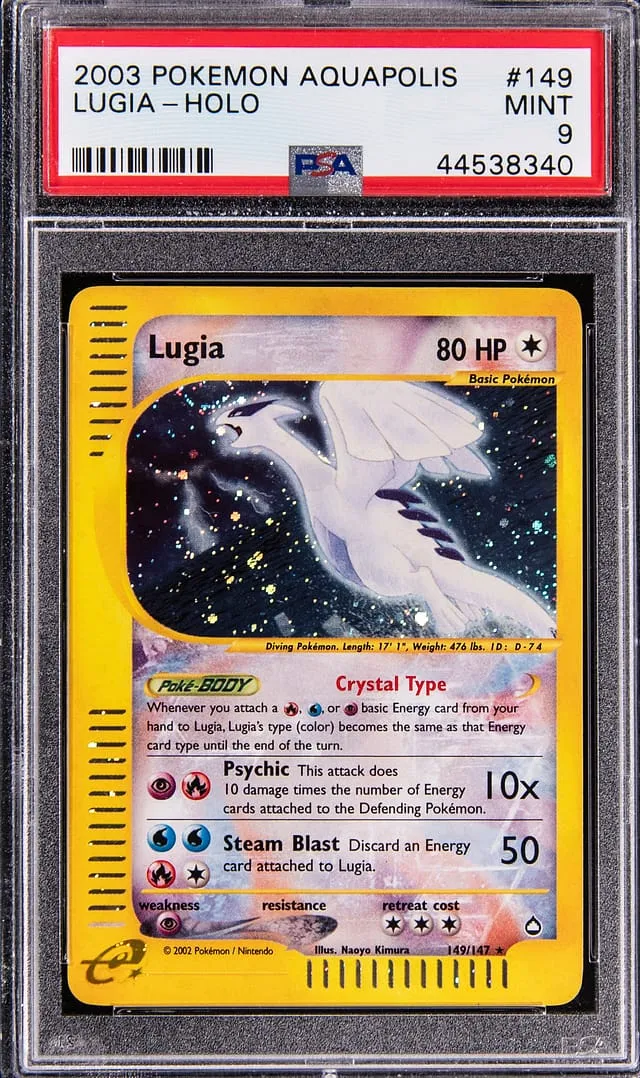
2003 Aquapolis Crystal Lugia PSA 9 Sells for $12,322
Market look at the 2003 Pokémon Aquapolis Crystal Lugia #149 PSA 9 that sold for $12,322 at Goldin on February 23, 2026.
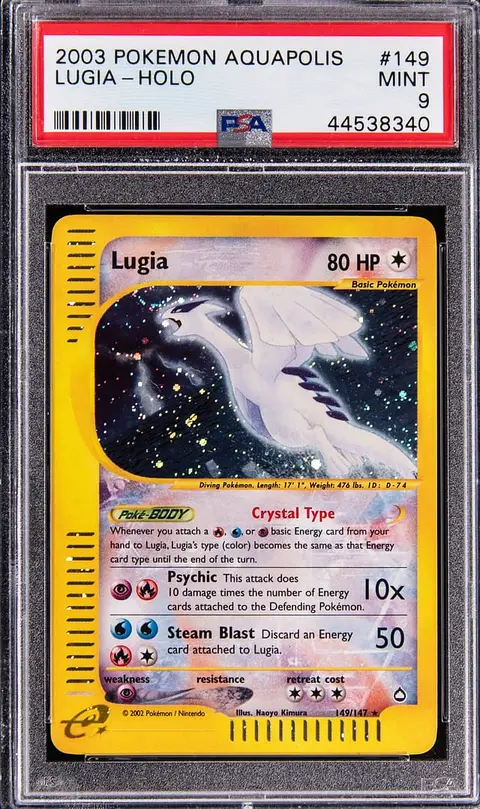
Sold Card
2003 Pokemon Aquapolis Secret Rare Holo #149 Crystal Lugia - PSA MINT 9
Sale Price
Platform
Goldin2003 Pokémon Aquapolis Crystal Lugia PSA 9 Sells for $12,322 at Goldin
On February 23, 2026, a major Lugia grail changed hands: a 2003 Pokémon Aquapolis Secret Rare Holo #149 Crystal Lugia graded PSA 9 MINT sold for $12,322 at Goldin. For many collectors, this card sits near the top of the early‑2000s Pokémon hierarchy, so every strong public sale helps reset expectations for what top‑end e‑Reader era cards can do.
In this breakdown, we’ll look at what makes Crystal Lugia so important, where this sale sits versus recent comps (comparable sales), and what it might signal for collectors tracking vintage and early‑WotC‑era Pokémon.
The Card: 2003 Aquapolis Crystal Lugia #149
Key details:
- Character: Lugia (Legendary Pokémon, Gen 2)
- Year: 2003
- Set: Pokémon Aquapolis (English, e‑Reader)
- Card number: #149
- Rarity/type: Secret Rare Crystal (Holo)
- Grading company: PSA
- Grade: PSA 9 MINT
- Notable attributes: Crystal type mechanic, secret rare, early e‑Reader era, key Lugia issue
Aquapolis is the second of the three e‑Reader sets (expanding on Expedition and preceding Skyridge). These sets were printed in relatively lower quantities than early Base/Jungle/Fossil, and they were more complex to produce, which has long made them a favorite among set builders and high‑end collectors.
Crystal Lugia is one of the headliners of Aquapolis. The Crystal mechanic effectively lets the Pokémon change its type depending on the Energy attached, and that special status is reflected in the card’s layout and foil treatment. As a Secret Rare, #149 sits beyond the regular set numbering, typically meaning lower pull rates than most of the set’s holos.
Within Lugia’s card history, this is not a rookie card in the strict sense, since Lugia debuted years earlier in the Neo era. But Aquapolis Crystal Lugia is widely viewed as one of the character’s premium early‑2000s appearances, often mentioned in the same breath as:
- Neo Genesis Lugia (especially in high grades)
- Other e‑Reader era chase cards
- Skyridge and Aquapolis Crystal counterparts
Grading and Scarcity: Why PSA 9 Matters
PSA’s MINT 9 grade indicates a clean, high‑end copy with only minor flaws under close inspection (tiny edge wear, soft corners, or very minor surface issues). For a 2003 holo with complex foil and borders, getting into PSA 9 or 10 territory is not trivial.
Two concepts matter here:
- Pop report (population report): This is the grading company’s count of how many copies exist in each grade. For many early‑2000s Pokémon holos, especially secret rares, PSA 10 populations are relatively slim, and PSA 9 often becomes the “accessible” top tier.
- Grade gap: The price step between PSA 9 and PSA 10 on key vintage and early‑WotC cards can be very large. That often makes PSA 9s a focal point for serious collectors who want something close to the top grade without paying the full premium.
Crystal Lugia’s PSA 10 population has historically stayed low, which pushes a lot of demand into the PSA 9 band, particularly for collectors who prioritize eye appeal over chasing the absolute highest technical grade.
The Sale: $12,322 at Goldin on February 23, 2026
- Auction house: Goldin
- Sale date (UTC): 2026‑02‑23
- Price realized: $12,322 (USD)
Within the context of Lugia and e‑Reader collecting, a five‑figure result for a PSA 9 Crystal Lugia aligns with its status as a flagship Aquapolis chase. While individual auction results can move around depending on timing, eye appeal, and bidder pool, this sale underscores that demand for high‑grade Crystal Lugia remains firm.
How This Price Compares to Recent Comps
When collectors talk about comps (short for comparables), they mean looking at recent, similar sales to understand a realistic range for a card.
For Crystal Lugia, useful comps often include:
- The same card in PSA 9 sold in the last 6–18 months
- PSA 10 copies of this card (to understand the grade premium)
- BGS or CGC high‑grade examples, adjusted for how each grading scale tends to be valued
- Related Crystal cards from Aquapolis and Skyridge, when direct comps are thin
Recent public sales for this exact card in PSA 9 have generally sat in the low‑ to mid‑five‑figure range, depending on:
- Sub‑grade equivalent (for non‑PSA slabs)
- Centering and holo quality (eye appeal)
- Timing of the broader Pokémon market cycle
A $12,322 hammer in early 2026 is consistent with that pattern: competitive, but not an outlier that redefines the category on its own. It’s better understood as another data point confirming that high‑grade Crystal Lugia still commands strong attention when it shows up in a major auction house.
Meanwhile, PSA 10 copies of Crystal Lugia have historically sold for a substantial premium over 9s, often significantly higher on a percentage basis than the jump from PSA 8 to 9. That gap reinforces the role of PSA 9 as the “sweet spot” grade for many collectors—high enough to feel truly premium, but not priced like a population‑capped trophy.
Why Collectors Care About Crystal Lugia
Several factors make this card a long‑running target:
Lugia’s status as a flagship Legendary
Lugia has been a marquee character since Generation 2, headlining Pokémon the Movie 2000 and serving as a cover mascot. Cards that pair a popular Legendary with a difficult pull rate and an unusual mechanic (like Crystals) tend to become long‑term hobby landmarks.E‑Reader era scarcity and aesthetics
Aquapolis is part of the short‑lived e‑Reader experiment, with distinctive card layouts and printing. These sets were not as heavily opened or printed as the earliest WotC sets, and the combination of age, holo foiling, and handling over the years means clean copies are not simple to find.Secret Rare Crystal status
Secret Rares sit beyond the standard set numbering, and the Crystal mechanic layered on top makes this more than “just another holo.” For many, this is the Lugia card they associate with the e‑Reader period, just as Neo Genesis Lugia defines the late‑Neo era.Condition difficulty
Complex foils and colored borders tend to show whitening and scratches more aggressively, which limits how many copies survive at PSA 9 and especially PSA 10. That difficulty in achieving top grades supports a stronger price ceiling for clean examples.
Market Context: Vintage and Early‑2000s Pokémon
Crystal Lugia sits in an interesting stretch of hobby time:
- Era: Early‑2000s WotC / e‑Reader
- Category: Often grouped with vintage or late‑WotC rather than fully “modern”
Over the past few years, the market has seen:
- Increased focus on early‑2000s sets beyond the original Base set
- Renewed appreciation for e‑Reader designs and their relative scarcity
- A more data‑driven approach from collectors, who now track pop reports, grade distributions, and auction histories closely
Lugia as a character continues to feature in modern Pokémon media and card products, but these newer appearances usually don’t affect the long‑term standing of a 2003 secret rare. Instead, demand for Crystal Lugia tends to track broader interest in:
- Completing e‑Reader master sets
- Building character‑focused Lugia collections
- Acquiring a small number of “statement pieces” from each era
What This Sale Signals for Collectors
This $12,322 PSA 9 sale at Goldin doesn’t rewrite the book on Crystal Lugia, but it does reinforce a few ongoing trends:
Consistency at the top end
High‑grade e‑Reader grails continue to attract serious bidding, even as the broader Pokémon market cycles through quieter and more active periods.Focus on condition and venue
Well‑presented PSA 9 copies sold through established auction houses like Goldin often command stronger outcomes than raw copies or lower‑visibility listings. The combination of eye appeal, trusted grading, and a competitive bidding environment tends to set the more reliable comps.PSA 9 as a key reference point
With PSA 10 populations small and pricing steep, collectors frequently use PSA 9 sales like this as a benchmark for what high‑quality Aquapolis Crystals are actually trading for.
For active hobbyists and small sellers, the main takeaway is less about chasing this exact card and more about understanding how the market values:
- Secret Rares and special mechanics from historically important sets
- Low‑population, high‑grade vintage/early‑WotC holos
- Proven characters like Lugia across different eras
How figoca Can Help You Track Sales Like This
If you’re trying to follow cards such as the 2003 Pokémon Aquapolis Secret Rare Holo #149 Crystal Lugia in PSA 9, it helps to:
- Watch multiple sales over time rather than anchoring on a single auction
- Compare grades directly and note any eye‑appeal differences
- Keep an eye on pop reports and whether new high‑grade copies are being added
Tools that consolidate auction records, grading data, and set checklists in one place make it easier to see where a result like $12,322 at Goldin fits into the bigger picture, rather than treating it as an isolated headline.
As more data accumulates on Crystal Lugia and its e‑Reader peers, collectors will have an even clearer sense of how these early‑2000s grails stack up against both the original WotC era and the high‑end modern chase cards that dominate today’s openings.
For now, this February 23, 2026 sale serves as another clear signal: top‑grade Aquapolis Crystals, and Crystal Lugia in particular, continue to be cornerstone pieces for serious Pokémon collections.