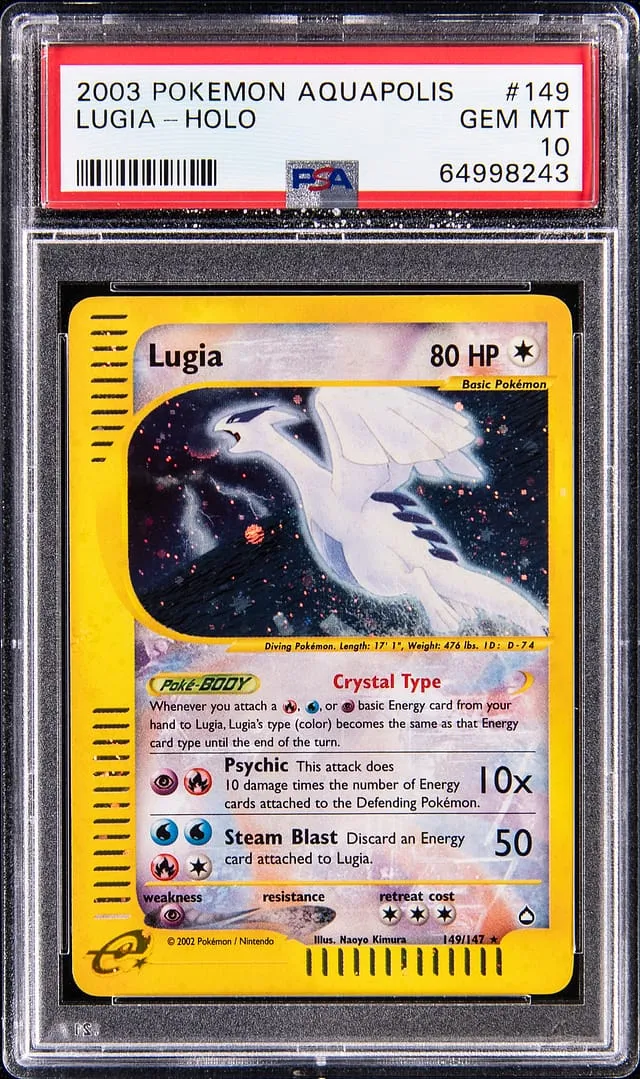
2003 Aquapolis Crystal Lugia PSA 10 sells for $95K
Inside the $95,770 Goldin sale of a 2003 Pokémon Aquapolis Crystal Lugia PSA 10 and what it means for WotC-era collectors.
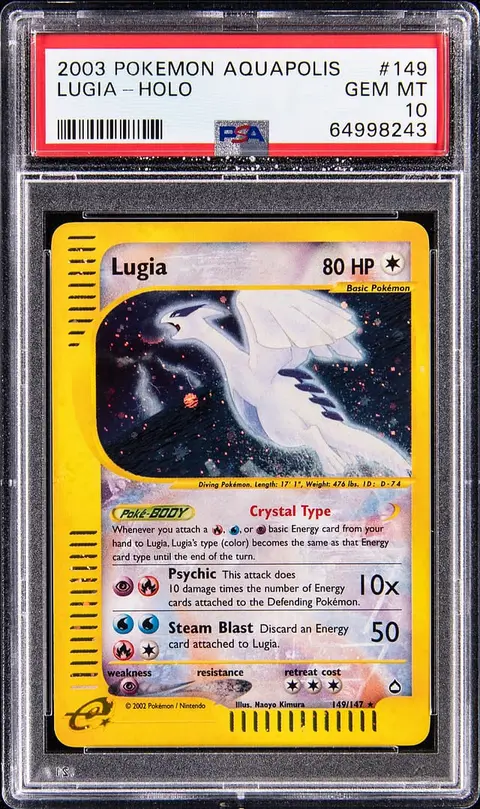
Sold Card
2003 Pokemon Aquapolis Holo #149 Crystal Lugia - PSA GEM MT 10
Sale Price
Platform
Goldin2003 Pokémon Aquapolis Crystal Lugia in PSA 10: What This $95,770 Sale Tells Us
On April 13, 2026, a 2003 Pokémon Aquapolis Holo #149 Crystal Lugia graded PSA GEM MT 10 sold at Goldin for $95,770. For one card, that’s a serious result, and it says a lot about where high-end Wizard of the Coast (WotC) Pokémon is today.
In this breakdown, we’ll look at what this card is, why collectors care so much about it, and how this sale fits into recent market data.
The card at a glance
- Character: Lugia
- Year: 2003
- Set: Pokémon Aquapolis (English, e-Card era)
- Card: Crystal Lugia
- Card number: #149
- Rarity/variant: Crystal (special type card, effectively the chase rarity of the set)
- Finish: Holofoil
- Era: Late WotC / e-Reader era
- Grading company: PSA (Professional Sports Authenticator)
- Grade: GEM MT 10
- Attributes: Non-numbered, no autograph, no patch; the appeal is rarity, condition, and set importance
This is not a rookie card in the sports sense, but within Pokémon it functions as a key issue: a top-tier, difficult-to-grade chase card from the final WotC-era sets.
Why Aquapolis Crystal Lugia matters to collectors
Part of the e-Reader “final chapter” of WotC
Aquapolis is the second of the three English e-Reader sets (Expedition, Aquapolis, Skyridge). These sets are known for:
- Low print runs compared to earlier WotC Pokémon sets
- Unusual, complex layouts and long names
- The e-Reader strip along the side, which had to stay clean for scanning
Within Aquapolis, the Crystal Pokémon cards are the clear headliners. Crystal Lugia sits at or near the top of that pyramid alongside Crystal Charizard from Skyridge.
Crystal Lugia specifically
Collectors value this card for several reasons:
- Iconic character: Lugia has been a fan favorite since Pokémon Gold & Silver and the second movie.
- Top chase card of the set: Among Aquapolis cards, Crystal Lugia is consistently one of the most expensive and sought after.
- Condition difficulty: The e-Reader border, holo surface, and age make true gem copies rare. Surface and edge wear are common, so PSA 10s are highly contested.
- Historic WotC endpoint: As one of the final-era WotC chase cards, it represents the end of a foundational period for Pokémon TCG.
For collectors who focus on WotC grails, Aquapolis Crystal Lugia in PSA 10 is typically on the short list with cards like 1st Edition Base Charizard and Skyridge Crystal Charizard, even if it trades less frequently.
Population and scarcity in top grade
When people talk about pop reports (short for population reports), they mean the official counts from grading companies that show how many copies exist in each grade.
For Crystal Lugia #149:
- PSA’s population in PSA 10 is low relative to demand. Exact numbers change over time, but this card has historically had a very small PSA 10 population compared with modern chase cards and even some earlier WotC holos.
- Lower grades like PSA 8 and PSA 9 appear more often and have a noticeably wider owner base.
The combination of:
- Scarcity in PSA 10
- Strong international demand for Lugia
- Limited high-end supply hitting auction
is what allows a single PSA 10 sale to command a mid five-figure to low six-figure result.
Market context: where does $95,770 sit?
To understand a sale like this, collectors usually look at comps, short for comparables: recent sales of the same card (or the closest equivalent) to see a realistic range.
Because this is a high-end WotC grail in PSA 10, it does not trade every week. Instead, it tends to surface occasionally at major auction houses like Goldin, Heritage, PWCC, or high-end eBay/PWCC Weekly listings. Each sale can move the reference point for future auctions.
Based on recent patterns for Aquapolis Crystal Lugia:
- PSA 10 copies have generally been trading in the upper five-figure to low six-figure range when they appear, depending on timing, auction venue, and overall market sentiment.
- PSA 9 copies typically sell for a fraction of the PSA 10 price, often in the mid-to-high four figures or low five figures, again depending on condition specifics and timing.
Within that context, the $95,770 result at Goldin on April 13, 2026 (UTC) fits within the current understanding of the card as a premier WotC grail:
- It reflects ongoing strength for top-end vintage and WotC-era Pokémon even as more volatile modern/ultra-modern segments can move up and down more sharply.
- It is consistent with the idea that truly scarce, historically important cards in top grade maintain a distinct market from more common chase cards.
Because this card trades infrequently, each new PSA 10 auction adds an important new data point rather than simply confirming a tightly established average.
Comparing this sale to related versions
While exact day-by-day sales will fluctuate, a few patterns generally hold:
- Ungraded / raw Crystal Lugia: Often show notable wear; high risk when buying raw, especially for those hoping to grade.
- PSA 7–9: Provide more accessible entry points for collectors focusing on owning the card itself rather than chasing top population grades.
- BGS / CGC equivalents: High-grade copies from other grading companies exist, but PSA 10s usually form the benchmark for record prices.
The spread between a PSA 10 and PSA 9 here is a practical illustration of how condition scarcity works: a one-grade difference on a card like Crystal Lugia can translate into a very large price gap.
Era and macro hobby context
This sale is part of a broader pattern:
- Vintage and WotC era (late 1990s to early 2000s) remain the foundation of many serious Pokémon collections.
- Within that era, rare chase cards in low-pop, top grades have tended to hold collector attention even during cooling periods in other parts of the market.
By contrast, modern and ultra-modern Pokémon often see more rapid swings in prices due to larger print runs, more frequent new releases, and quicker hype cycles.
Lugia itself continues to see steady interest:
- It appears in ongoing video game, anime, and TCG products, keeping the character relevant.
- Nostalgia for the Game Boy Color and Game Boy Advance era is strong among collectors now entering or already in their peak earning years.
These factors help explain why a 2003 Crystal Lugia in PSA 10 can still draw competitive bidding in 2026.
What this means for collectors and small sellers
This Goldin sale doesn’t mean every Lugia card is suddenly worth more, but it does provide a useful reference point:
- For high-end collectors, it reinforces that Aquapolis Crystal Lugia PSA 10 remains a top-tier WotC target with real depth of demand.
- For holders of PSA 8–9 copies, it underlines the importance of condition, centering, and eye appeal when comparing to PSA 10 results.
- For small sellers or people returning to the hobby, it’s a reminder that:
- Not all old cards are this scarce or this valuable.
- Provenance (who graded it, which auction house sold it, when) matters for big results.
If you’re evaluating your own Crystal Lugia—or any WotC-era holo—consider:
- Surface: Scratches, print lines, and clouding under strong light.
- Edges and corners: Whitening and small nicks along the e-Reader border.
- Centering: How evenly the borders frame the artwork.
Those details are what separate a strong mid-grade copy from a potential high-end submission.
Takeaways from the Goldin sale
The April 13, 2026 Goldin auction result of $95,770 for a 2003 Pokémon Aquapolis Holo #149 Crystal Lugia – PSA GEM MT 10 confirms a few key points:
- WotC-era grails with low PSA 10 populations continue to be treated as premier collectibles.
- Even in a more data-aware hobby environment, rare top-grade examples can command strong bidding when they surface at major auction houses.
- Crystal Lugia maintains its place among the most respected non-Charizard chase cards from the e-Reader era.
For collectors, this sale is less a shock headline and more another data point: a reminder that certain corners of the Pokémon market are driven by long-term scarcity, set history, and character nostalgia just as much as short-term hype.
As always, individual collecting decisions should be based on your own budget, interests, and time horizon. Sales like this are best used as context—not as instructions.
Sale referenced: 2003 Pokémon Aquapolis Holo #149 Crystal Lugia – PSA GEM MT 10, sold for $95,770 at Goldin on April 13, 2026 (UTC).