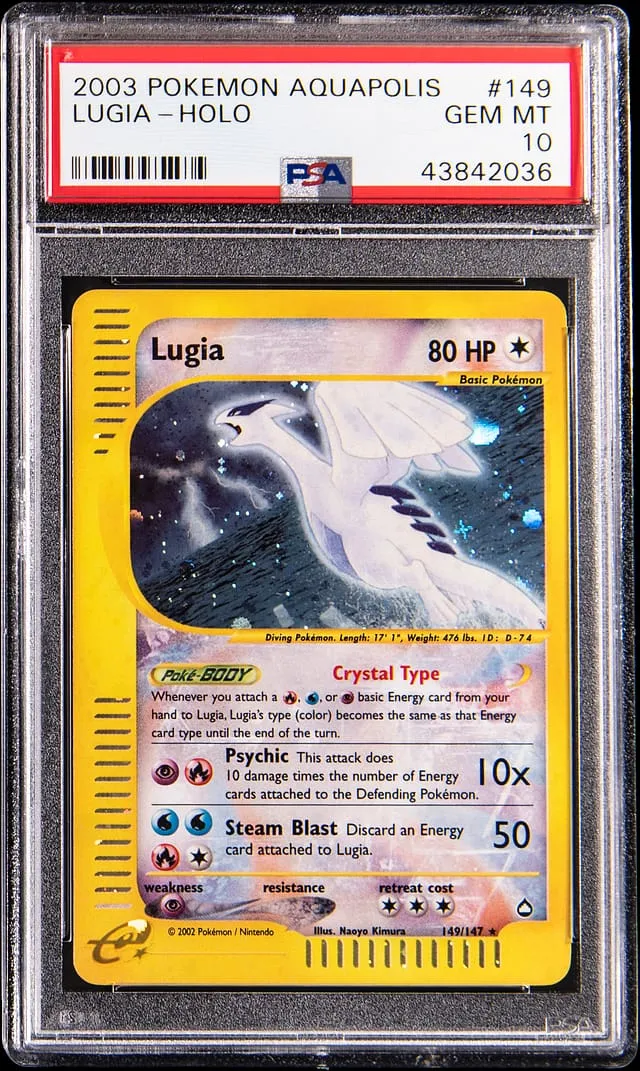
2003 Aquapolis Crystal Lugia PSA 10 sells for $768K
Goldin sold a 2003 Pokémon Aquapolis Crystal Lugia PSA 10 for $768,610. See how this key Lugia card fits into the wider Pokémon market.
Sold Card
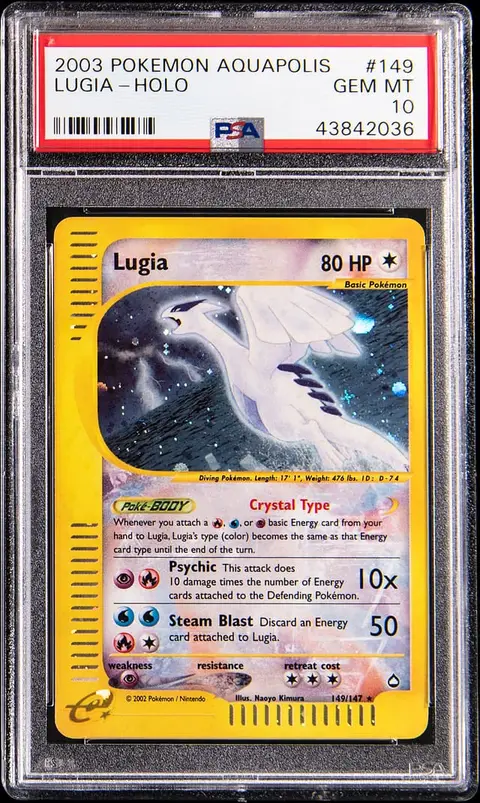
2003 Pokemon Aquapolis Holo #149 Crystal Lugia - PSA GEM MT 10
Sale Price
Platform
Goldin2003 Pokémon Aquapolis Holo #149 Crystal Lugia in PSA GEM MT 10 quietly cleared another important bar for the high‑end Pokémon market.
On May 18, 2026, Goldin sold a copy for $768,610. For a card that many collectors already see as one of the pillars of the early‑2000s era, this result adds another clear data point to an already thin but very closely watched market.
The card at a glance
- Character: Lugia (Crystal Type)
- Year: 2003
- Set: Pokémon-e Aquapolis
- Card: Holo #149, Crystal Lugia
- Parallel/variant: Crystal (special type mechanic unique to this era)
- Card status: Key issue, not a rookie but a cornerstone Lugia card
- Era: Early WotC/EX transition (often grouped with late “vintage”/early “mirror era” cards)
- Grading company: PSA (Professional Sports Authenticator)
- Grade: GEM MT 10 (PSA’s highest standard grade)
Crystal Lugia is one of the three Crystal cards in Aquapolis alongside Crystal Nidoking and Crystal Kingdra, and it is widely regarded as the chase card of the set. It combines a popular Legendary Pokémon with a low‑print, complex e‑Reader era release and a notoriously tough foil surface.
Why Aquapolis and Crystal Lugia matter
Aquapolis sits in a unique pocket of Pokémon history:
- Low print run: As one of the later English sets produced by Wizards of the Coast (WotC), Aquapolis is generally accepted to have been printed in smaller quantities than many classic Base–Neo sets.
- e‑Reader layout: The long, segmented card borders that allowed Game Boy Advance e‑Reader functionality added printing complexity and made the set visually distinct.
- Crystal mechanics: The “Crystal Type” mechanic gave certain Pokémon three energy types and a unique design treatment. In practice, these became the set’s ultra‑premium chase cards.
Lugia already had hobby respect thanks to Neo Genesis and its role in Pokémon’s second generation. Crystal Lugia takes that popularity and places it into what many collectors consider one of the hardest English sets of the era to complete in high grade.
Grading, condition, and perceived scarcity
PSA GEM MT 10 is the top standard grade on PSA’s scale, indicating a card that is effectively pack‑fresh: sharp corners, strong centering, no visible print lines or edge wear under normal viewing.
For a card like Crystal Lugia, several factors make that grade hard to achieve:
- Full‑foil surfaces that are prone to scratching and print lines
- Colored borders that show even tiny bits of whitening
- Early‑2000s factory handling and storage, long before large‑scale grading was common
While pop reports (population reports – public counts of how many copies have received each grade from a grading company) can change over time as more cards are submitted, PSA 10 Crystal Lugia has consistently stayed in very low double digits relative to demand. That scarcity is a key part of why high‑grade copies attract outsized attention compared with many modern chase cards that have much higher populations.
Market context and recent sales
Because PSA 10 Crystal Lugia surfaces so rarely at auction, each sale tends to be treated as its own event rather than just another data point. The comp history (recent comparable sales used as a reference) is thin but instructive:
- Earlier public sales of PSA 10 copies over the past several years established six‑figure expectations whenever a true auction appeared, with private sales sometimes reported higher, sometimes lower, depending on timing and market sentiment.
- Lower grades such as PSA 9 and PSA 8 have generally sold for a fraction of PSA 10 prices, but still at levels that reflect how important the card is within the Aquapolis set.
Against that backdrop, the $768,610 Goldin result in May 2026 sits in the very top tier of Lugia sales overall and in line with the broader pattern we have seen for scarce, early‑era Pokémon grails:
- High‑grade copies of true set‑defining cards tend to hold attention even when the wider market cools.
- Price swings are often more about when a copy happens to surface than about day‑to‑day sentiment.
Because PSA 10 examples are so uncommon at auction, it’s safer to think of this sale as a fresh reference point rather than a rigid “market price.” Each future auction will have its own conditions, including timing, macro hobby trends, and the pool of active high‑end bidders.
How this sale compares within Lugia’s card lineup
In Lugia’s card catalog, a few issues tend to draw the most focus:
- 2000 Neo Genesis Lugia (especially 1st Edition holo)
- 2001 Neo Revelation Shining Lugia (Japanese)
- 2003 Aquapolis Crystal Lugia
- Later‑era full‑art and alternate‑art Lugia cards
Within that set, Crystal Lugia often sits at or near the top in terms of:
- Difficulty of obtaining a clean raw copy
- Population in PSA 10 versus total graded
- Visual distinctiveness compared to other Lugia artworks
This $768,610 sale reinforces the idea that Crystal Lugia belongs in the conversation with other blue‑chip Lugia cards, not just as an alternative but as a pillar in its own right.
What collectors can take from this sale
For new or returning collectors, results like this can feel distant, but they still carry useful lessons:
- Set context matters. Aquapolis is not just another mid‑2000s set; its shorter print run and e‑Reader complexity give it a different supply profile than many modern releases.
- Top grades are a separate market. A PSA 10 Crystal Lugia lives in a different world from raw copies or mid‑grade slabs. The price gap reflects that.
- Comps are guidelines, not guarantees. With so few sales, each auction can land above or below expectations. Treat recent sales as context rather than promises.
- Character plus era plus scarcity. Lugia’s popularity, the early‑2000s WotC transition era, and the Crystal mechanic together create a layered demand story that goes beyond one data point.
Final thoughts
The May 18, 2026 Goldin auction of the 2003 Pokémon Aquapolis Holo #149 Crystal Lugia in PSA GEM MT 10 at $768,610 does not rewrite what collectors believe about this card so much as it confirms it. Crystal Lugia remains one of the keystones of the e‑Reader era, and when a top‑grade copy surfaces, the market is prepared to treat it accordingly.
For most collectors, the lesson is not to chase this exact price point, but to understand why certain cards – set anchors with low populations in top grade – behave differently from the rest of the market. As more data emerges in future auctions, figoca will continue to track how this and other high‑end Pokémon cards evolve over time.