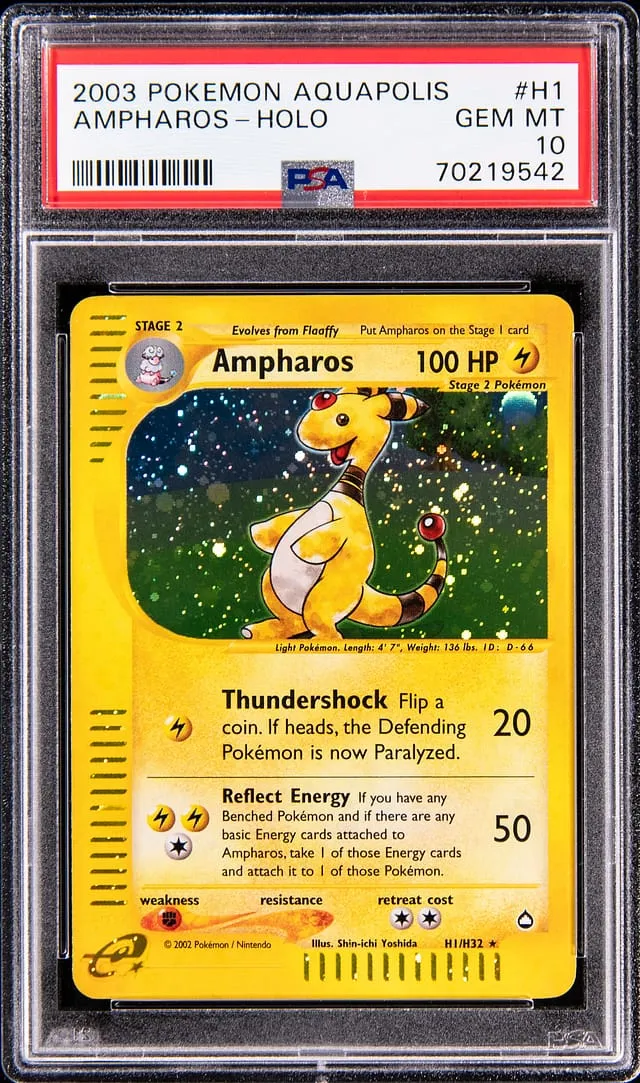
2003 Aquapolis Ampharos PSA 10 sells for $12,201
Market breakdown of the 2003 Pokémon Aquapolis Holo Ampharos #H1 PSA 10 that sold for $12,201 at Goldin on March 2, 2026.
Sold Card
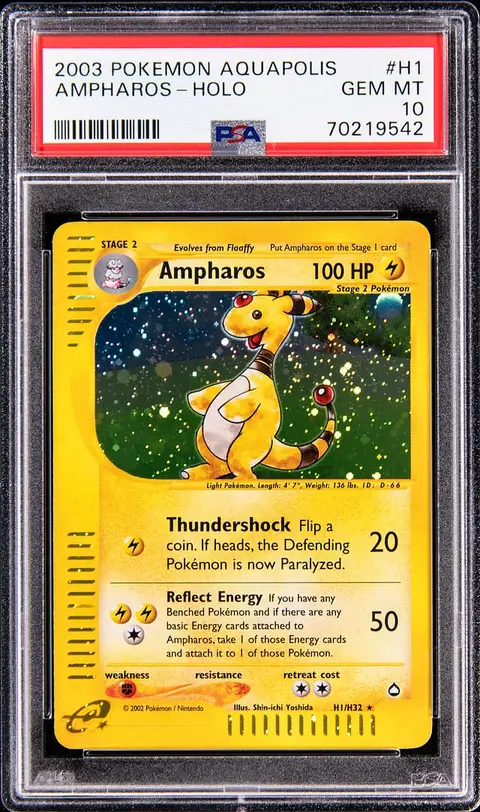
2003 Pokemon Aquapolis Holo #H1 Ampharos - PSA GEM MT 10
Sale Price
Platform
Goldin2003 Pokémon Aquapolis Holo #H1 Ampharos in a PSA GEM MT 10 holder quietly changed hands at Goldin on March 2, 2026 for $12,201. For a niche-but-beloved second-generation Pokémon and a late‑Wizards of the Coast era set, that’s an important data point for collectors who track the high end of early 2000s holo cards.
Card overview
Let’s start with the basics:
- Card: 2003 Pokémon Aquapolis Holo Ampharos
- Card number: #H1 (H-numbered holo from the set’s holo lineup)
- Set: Aquapolis (e-Card era, Wizards of the Coast)
- Year: 2003
- Character: Ampharos (Gen 2 Electric-type, Mareep line final evolution)
- Parallel/variant: Standard English holofoil from Aquapolis (not a reverse holo or Crystal type)
- Grading company: PSA
- Grade: GEM MT 10 (PSA’s highest standard grade)
- Attributes: No autograph, no serial number – the appeal here is condition rarity within a historically important, low‑print, late‑WotC set.
This is not a “rookie card” in the sports sense, but within Pokémon it functions as a key early‑era appearance for Ampharos in one of the most respected non‑Base sets.
Why Aquapolis matters
Aquapolis sits in a unique place in Pokémon history:
- Late WotC era: Released in 2003, Aquapolis is one of the final English sets printed by Wizards of the Coast before the transition to The Pokémon Company. That short window and transition period contribute to relatively lower print runs compared with more widely printed modern sets.
- e‑Card format: Aquapolis is part of the “e‑Reader” era. These cards have the vertical dot‑code strip designed to be scanned by the Game Boy Advance e‑Reader. The technical novelty, distinctive layout, and complexity of printing add to collector interest.
- Set reputation: Alongside Skyridge, Aquapolis is viewed as a premium, low‑supply, early‑2000s set. While the Crystal Pokémon draw the headlines, many of the holo rares – like Ampharos – have developed strong followings because they are much tougher to find in pristine condition than their art might suggest.
For many collectors returning to the hobby, Aquapolis and Skyridge were sets they never saw on shelves, which adds a sense of “missed era” nostalgia.
PSA 10 scarcity and population context
PSA’s population report ("pop report" – a census of how many copies exist in each grade) is one of the core tools collectors use to understand relative scarcity. For Aquapolis holos, pops in PSA 10 tend to be modest:
- Low submission numbers: Compared with modern sets, far fewer Aquapolis cards were opened, preserved, and later submitted for grading.
- Tough grading: Centering, print quality, and edge wear from the era make true GEM MT copies harder to achieve.
Exact PSA 10 population numbers for Ampharos H1 can move over time as more copies are submitted, but in general it sits in the “small, but not one‑of‑one” range: scarce enough that high‑grade copies are meaningful, but not so scarce that they never appear.
For veteran collectors, PSA 10 on an Aquapolis holo signals:
- Top‑tier eye appeal
- A card that’s relatively hard to upgrade beyond
- A candidate for long‑term set builds and high‑end master collections
Market context and recent sales
Any time we talk about prices, it’s important to frame them as recent sales, not guarantees. The $12,201 result at Goldin on March 2, 2026 is one sale in a moving market, but it does help anchor expectations.
Looking at available public data for the same card and closely related versions:
- PSA 10 copies of Ampharos H1 have historically traded far below the flagship Crystal Pokémon from Aquapolis but comfortably above non‑holo rares and most reverse holos.
- Earlier public auctions (often on platforms like eBay, PWCC, or prior Goldin runs) generally showed PSA 10 Ampharos H1 in the low‑to‑mid four‑figure range when they appeared, with variability tied to timing and overall sentiment toward WotC holos.
- Lower grades (PSA 9 and below) tend to sit at a significant discount to PSA 10, which is typical for early‑2000s holos where the 10s are genuinely tough.
In that context, $12,201 at Goldin stands toward the strong side for an Ampharos Aquapolis holo in PSA 10:
- It reflects the continuing premium that collectors are willing to pay for late‑WotC sets in top condition.
- It shows that even non‑headliner Pokémon from Aquapolis can command notable prices when the example is a true high‑end copy.
Because sales for this specific card are relatively infrequent, it’s better viewed as a fresh benchmark rather than an outlier or a new “standard” price.
How this sale fits into the broader Aquapolis market
Within Aquapolis, the hierarchy usually looks something like this:
- Crystal Pokémon (e.g., Crystal Lugia, Crystal Charizard equivalents in other sets) – headline cards and common record‑setters.
- Top‑tier holos and fan favorites – popular species, strong artwork, and low pop in PSA 10.
- Other holos and reverse holos – still desirable but typically below the Crystal tier and the most iconic holos.
Ampharos H1 sits in the second tier:
- It’s not a Crystal
- It does have a loyal fan base and sits in a respected set
- It benefits from Aquapolis’s overall reputation and scarcity
When a second‑tier holo in PSA 10 pushes past $10,000, it says a few things about the market:
- Set‑driven collecting is strong. Many buyers are chasing complete Aquapolis or full e‑Reader era runs in PSA 10, which supports demand across the holo checklist.
- Condition premiums are healthy. The gulf between PSA 9 and PSA 10 is real for tough early‑2000s sets.
- Non‑mascot Pokémon can matter. While Charizard and Lugia drive headlines, strong results for Ampharos signal interest in the broader ecosystem of WotC holos.
Collector significance
Why would someone target this specific card in this grade?
- Set building: Aquapolis master‑set collectors often aim for all holos in PSA 10. As the #H1 holo, Ampharos is a checklist staple.
- Art and nostalgia: The Aquapolis art direction and layout are distinct from earlier WotC sets. For fans who grew up with Gen 2 or discovered Ampharos through the games, this card hits both nostalgia and visual appeal.
- Era scarcity: Early‑2000s sealed product is not as plentiful as modern booster boxes. Every PSA 10 copy represents a card that survived 20+ years without damage, then passed a strict grading screen.
Viewed that way, the Goldin result is less about a single Ampharos and more about what it represents: high‑end, late‑WotC collecting getting deeper than just the marquee names.
What this sale might signal going forward
Without making predictions, we can highlight a few practical takeaways for different types of hobby participants:
New or returning collectors:
- Aquapolis is a complex, relatively low‑print set with many cards that are more affordable than this Ampharos, especially in raw or mid grades.
- If you like the era, you don’t have to chase PSA 10s to enjoy it. PSA 7–9 or ungraded copies provide access to the same artwork at very different price points.
Set and grade chasers:
- Expect competition on key Aquapolis holos in PSA 10. Sales like this confirm that there are committed buyers at the top end.
- Pop reports are your friend; understanding how many 10s exist helps you judge how hard it might be to find another copy.
Small sellers:
- This sale is a reminder to look carefully at older e‑Reader era holos you might have set aside years ago.
- Condition checks, careful handling, and, where appropriate, grading can materially change the outcome for cards from this era.
Final thoughts
The $12,201 sale of the 2003 Pokémon Aquapolis Holo #H1 Ampharos in PSA GEM MT 10 at Goldin on March 2, 2026 is a focused case study in how late‑WotC scarcity, condition sensitivity, and set‑driven collecting intersect.
It doesn’t rewrite the broader Pokémon market on its own, but it adds another clear data point: serious collectors are still willing to pay high‑end prices for non‑mascot, early‑2000s holos when they appear in top grade from historically important sets.
For collectors building an Aquapolis run or simply appreciating the e‑Reader era, Ampharos H1 in PSA 10 is now anchored by a well‑documented, five‑figure public sale, and that’s useful context for anyone making decisions around this part of the hobby.