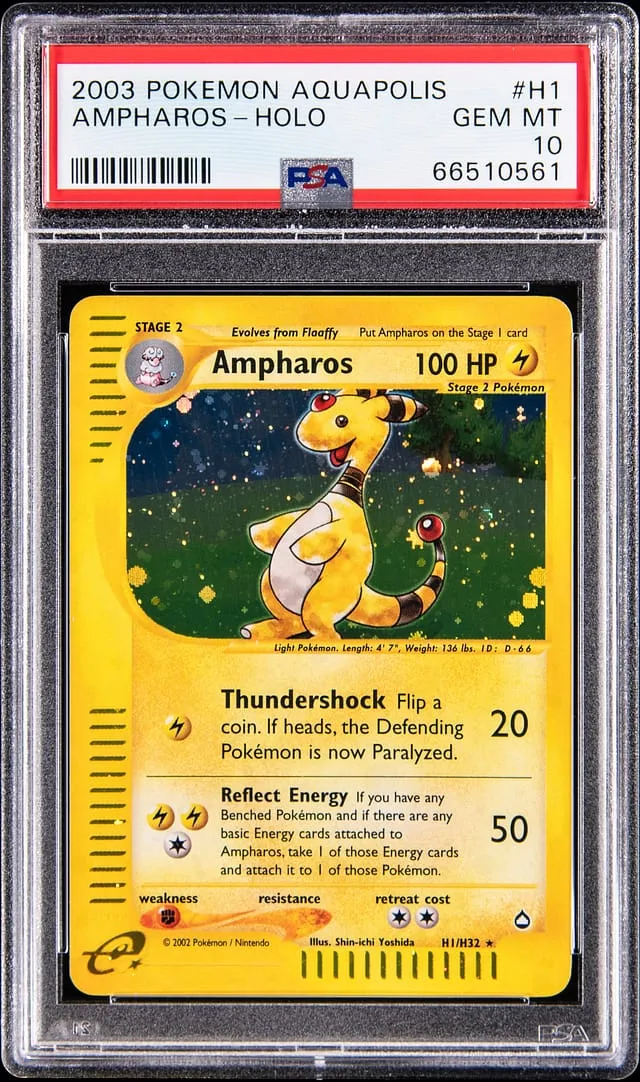
2003 Aquapolis Ampharos PSA 10 sells for $12,200
Breakdown of the 2003 Pokémon Aquapolis H1 Ampharos PSA 10 sale at $12,200 on Goldin and what it means for e‑Reader era collectors.
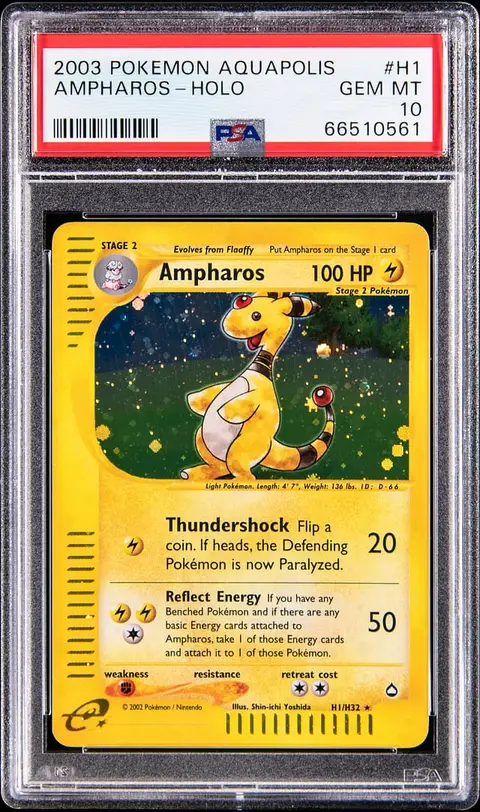
Sold Card
2003 Pokemon Aquapolis Holo #H1 Ampharos - PSA GEM MT 10
Sale Price
Platform
GoldinA 2003 Pokémon Aquapolis Holo #H1 Ampharos, graded PSA GEM MT 10, just closed at $12,200 on Goldin on 2026-05-11. For a mid‑generation holo of a non–cover star, that is a meaningful result and a clear signal about how the market is treating early‑2000s e‑Reader era cards.
The card at a glance
- Card: 2003 Pokémon Aquapolis Holo Ampharos
- Set: Aquapolis (e‑Reader, second e‑Series set in English)
- Card number: #H1 (H holo slot, not a common/rare slot)
- Character: Ampharos (Gen 2 Electric‑type Pokémon)
- Finish: Holofoil
- Language: English
- Grading company: PSA (Professional Sports Authenticator)
- Grade: GEM MT 10
- Attributes: Non‑auto, non‑serial‑numbered; condition rarity is the key driver
- Era: Early EX / e‑Reader era, often grouped with late WotC / early Nintendo
It is not a rookie card in the sports sense, but within Pokémon it functions as a key holo from a historically important, low‑print run set.
Why Aquapolis matters to collectors
Aquapolis is the second of the English e‑Reader sets (after Expedition and before Skyridge). These sets are known for:
- Lower print runs than late Wizards of the Coast (WotC) era staples like Base Set Unlimited.
- Complex, expensive box breaks today, which limit fresh supply of pack‑fresh cards.
- Distinctive e‑Reader border design, which some collectors initially disliked but is now widely appreciated as a unique visual era.
Within Aquapolis, the H‑numbered holos like Ampharos sit in a sweet spot: not the headliner Crystal Pokémon tier, but still scarce, visually strong holos anchored in a set that is tough to open and tougher to grade.
PSA GEM MT 10: condition scarcity
Pokémon from 2002–2003 is notorious for quality issues:
- Edge chipping and corner whitening out of the pack
- Print lines and holo scratches from manufacturing and handling
- Off‑center cuts, which can cap a card at PSA 9 even when otherwise clean
A PSA GEM MT 10 (PSA’s top standard grade) means:
- Sharp corners and edges
- Clean holo with minimal to no visible scratching under normal light
- Centering within PSA’s strict Gem Mint tolerance
Population reports (often called a "pop report")—PSA’s count of how many copies exist in each grade—tend to show a steep drop‑off from PSA 9 to PSA 10 for Aquapolis holos. Even if we do not quote exact current numbers here, the market behavior across many Aquapolis holos confirms that 10s are significantly harder to find than 9s.
Market context: where does $12,200 sit?
Based on recent public sales data for Aquapolis Ampharos H1:
- PSA 9 copies have typically traded in a materially lower range than this result, consistent with the usual 9‑to‑10 premium seen in e‑Reader holos.
- Raw (ungraded) or lower‑grade copies sell at a significant discount, reflecting surface and centering issues that keep them from Gem Mint territory.
When we zoom out to comparable cards—that is, cards of a similar era, set, and role—PSA 10 holos of popular non‑cover Pokémon from Aquapolis and Skyridge often:
- Outperform many modern ultra‑rare cards on a percentage basis, because supply is structurally limited.
- Show relatively stable pricing compared to the more speculative swings seen in new releases.
This $12,200 sale on Goldin fits that pattern: a strong but not irrational price for a condition‑scarce, mid‑tier holo from a low‑print, historically important set.
How this sale compares to broader e‑Reader trends
To understand the significance of this Ampharos result, it helps to look at the broader e‑Reader market:
- Top‑end crystals and marquee holos from Aquapolis and Skyridge in PSA 10 have seen firm to gradually rising levels over the last few years, even as some modern chase cards cooled.
- Non‑headliner holos like Ampharos tend to move more quietly, but when high‑grade examples do surface, they often clear at healthy premiums over their last known sales, reflecting both low supply and more collectors quietly building e‑Series master sets.
Within that lens, a $12,200 closing price:
- Underscores that collector attention has moved beyond only the biggest names (Charizard, Lugia, etc.) to robust second‑tier favorites.
- Reinforces the view that Gem Mint e‑Reader holos are condition pieces: supply does not refresh quickly because sealed product is scarce and tough to justify ripping at current box prices.
Collector significance: why Ampharos H1 matters
Ampharos sits at an interesting crossroads in the hobby:
- It is a Gen 2 fan favorite with recognizability across games and the anime.
- It appears in a visually distinctive Aquapolis artwork, with the e‑Reader layout framing the holo nicely.
- It is part of a difficult set to complete in high grade, which appeals to set builders and long‑term collectors.
For many collectors who grew up with Gold/Silver/Crystal, Ampharos has nostalgic value even if it is not a marquee mascot. That combination—nostalgia, visual appeal, and set rarity—often supports steady demand without wild speculation.
What this sale may signal (without forecasting)
Instead of speculating on future prices, it is more useful to frame what this Goldin sale tells us today:
Healthy appetite for e‑Reader GEM MT
When a non‑Crystal, non‑Charizard Aquapolis holo in PSA 10 commands five figures, it suggests a deep buyer pool that values this era specifically.Set builders are likely active
Aquapolis master sets in high grade are challenging. Each time a pop‑scarce holo like Ampharos surfaces in PSA 10, serious set collectors often compete, which can push realized prices above casual expectations.Condition and provenance matter
Major auction houses like Goldin tend to bring out higher‑end examples and give them visibility. That matters for liquidity and for price discovery on less frequently traded cards.
None of this guarantees what the "next" Ampharos H1 PSA 10 will sell for. But it does give current and returning collectors a clear reference point for recent market behavior.
Takeaways for collectors and small sellers
For collectors who own or are chasing this card:
- PSA 10 is a genuine condition tier for Aquapolis holos. A clean raw copy will not automatically grade Gem Mint; careful pre‑grading inspection is crucial.
- PSA 9s remain important, particularly for budget‑conscious set builders. The gap between 9 and 10 is wide in price because it is wide in rarity.
For small sellers considering grading or listing Ampharos H1:
- Review surface, centering, and corners under strong light before committing to grading fees.
- When listing, include clear front and back scans; many e‑Reader buyers are highly condition‑sensitive.
- Use recent public sales like this Goldin result as context, not as a guaranteed target number. Auction outcomes can vary with timing, exposure, and bidder mix.
Final thoughts
The 2003 Pokémon Aquapolis Holo #H1 Ampharos PSA GEM MT 10 sale at $12,200 on Goldin on 2026-05-11 is another datapoint in a growing pattern: collectors are steadily assigning real value to high‑grade e‑Reader holos, even beyond the headline names. For anyone who loves the look and history of Aquapolis, Ampharos H1 in Gem Mint is now firmly established as a noteworthy piece of the set’s high‑end landscape.
At figoca, we track these kinds of sales to help collectors understand not just what a card sold for, but why it matters in the broader hobby story. Ampharos H1 is a reminder that in Pokémon, era, set, and condition can be every bit as important as character tier when the market decides what to reward.