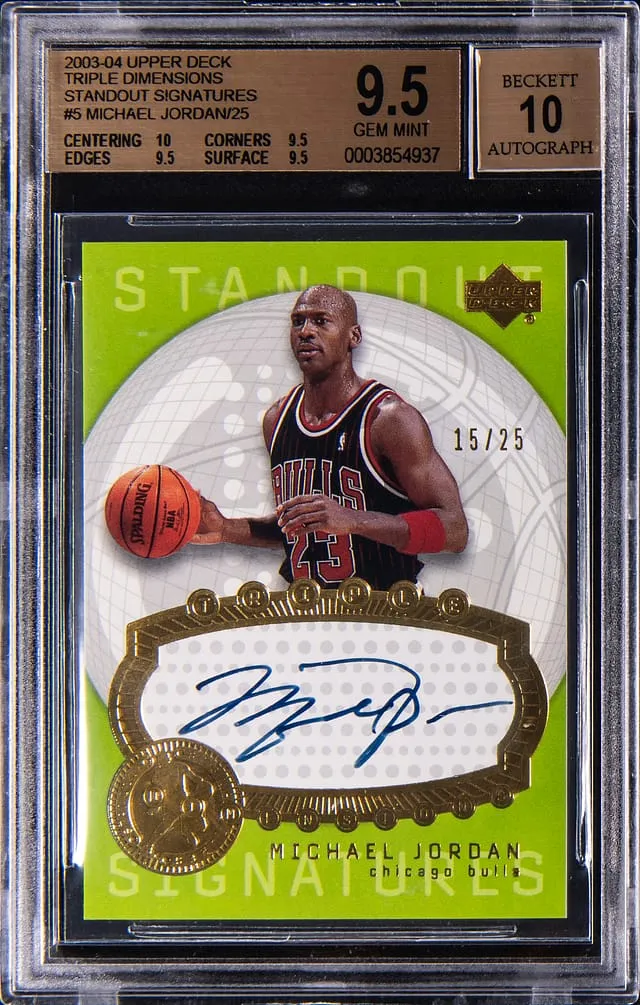
2003-04 UD Triple Dimensions MJ Auto BGS 9.5 Sale
Breaking down Goldin’s $21,970 sale of a 2003-04 Upper Deck Triple Dimensions Michael Jordan Standout Signatures BGS 9.5 / 10 auto.
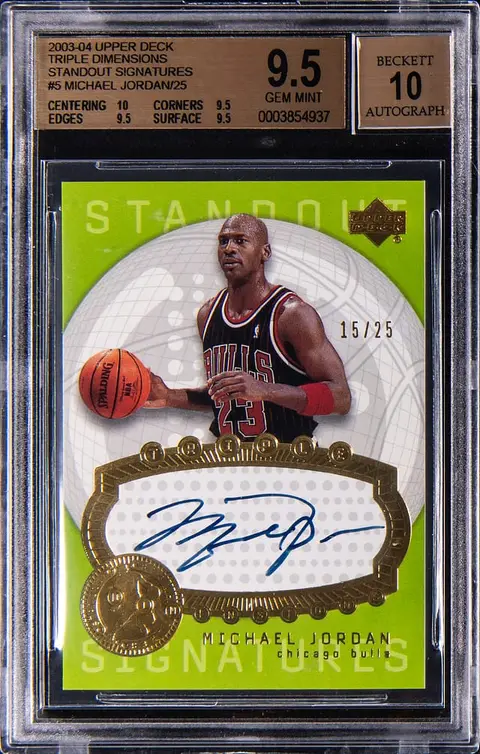
Sold Card
2003-04 Upper Deck Triple Dimensions Standout Signatures #STA5 Michael Jordan Signed Card (#15/25) - BGS GEM MINT 9.5, Beckett 10 - True Gem+
Sale Price
Platform
GoldinA BGS 9.5 / 10 Michael Jordan autograph from the early 2000s just quietly cleared the six-figure mark.
On March 15, 2026, Goldin sold a 2003-04 Upper Deck Triple Dimensions Standout Signatures #STA5 Michael Jordan signed card, serial-numbered 15/25, for $21,970. The card is graded BGS GEM MINT 9.5 with a Beckett 10 autograph and labeled True Gem+.
In this breakdown, we’ll walk through what this card is, why the grade matters, and how this sale fits into the broader Jordan auto market.
The card at a glance
- Player: Michael Jordan (Chicago Bulls)
- Year / Product: 2003-04 Upper Deck Triple Dimensions
- Subset / Insert: Standout Signatures
- Card number: #STA5
- Serial number: 15/25
- Autograph: On-card (signed directly on the card surface)
- Grading company: Beckett Grading Services (BGS)
- Grade: BGS 9.5 GEM MINT, Autograph 10
- Subgrades: Labeled as True Gem+ (all four subgrades at 9.5 or better, with at least one 10)
- Era: Early 2000s, post-playing-days Jordan in modern insert/auto era
This is not a rookie card. Instead, it’s a low-serial, on-card autograph from a well-regarded early-2000s Upper Deck insert lineup. For Jordan collectors, it sits in that space between 1990s grail inserts and later mass-produced autographs.
Why 2003-04 Upper Deck Triple Dimensions matters
Upper Deck in the late 1990s and early 2000s built its reputation on creative inserts, serial-numbered parallels, and hard-signed autographs. Triple Dimensions continued that trend with:
- Multi-layer and foil-based designs
- Short-printed inserts
- Premium autograph subsets like Standout Signatures
For Jordan, key non-rookie cards from this era have become important because they bridge:
- The 1990s insert boom (Precious Metal Gems, Jambalaya, etc.)
- The modern premium auto era (Exquisite Collection and beyond)
While Exquisite tends to grab the headlines, limited-run Upper Deck Jordan autos like Standout Signatures offer a more focused chase: smaller print runs, simple checklist structure, and a clear emphasis on clean, on-card signatures.
True Gem+: why this particular grade matters
BGS 9.5 GEM MINT is already a high grade. Within that grade, collectors pay attention to subgrades — centering, corners, edges, and surface.
- True Gem: all four subgrades are 9.5
- True Gem+: all four subgrades 9.5 or better with at least one 10
True Gem+ is often treated as a premium within the 9.5 range because:
- It’s visually and structurally closer to a BGS 10 Pristine
- Some collectors view it as a better candidate if a card is ever crossed over to another grading company
Layer on top of that the Beckett 10 autograph grade, and this copy checks the boxes condition-focused Jordan collectors are usually after.
Market context and recent sales
When collectors talk about “comps,” they mean comparable recent sales used as a reference for price. For a low-serial Jordan autograph like this, comps are often:
- The same card in different BGS/PSA grades
- Other Jordan autos from the same era with similar print runs
- Closely related inserts from 2000–2005 Upper Deck products
Recent public sales for this exact card and similar Jordan autos show a few consistent themes:
- Serial-numbered Jordan autos /25–/50 from early 2000s Upper Deck typically sit in the low- to mid-five-figure range in strong grades.
- BGS 9.5 / 10 autos usually command a premium over BGS 9 or raw (ungraded) copies, especially when the subgrades are well-balanced.
- Insert autos that are not Exquisite or 1990s “grail” inserts tend to be more accessible, but still see steady demand because of Jordan’s limited signing volume with Upper Deck.
At $21,970, this Goldin result lands in the expected band for a high-end, early-2000s Jordan on-card autograph /25 in a top grade. It doesn’t read as an outlier spike, nor as a distressed sale — more like a reaffirmation of what the market has been willing to pay for clean Jordan ink from this period.
Population and scarcity
“Pop report” is short for population report, a grading company’s count of how many copies of a given card have received each grade.
For a numbered card like this:
- The hard cap is 25 copies by serial numbering.
- The number of high-grade BGS 9.5 / 10 auto examples will be a subset of that.
The overall pop for this specific card is relatively small compared to base cards or mass-printed inserts, and True Gem+ copies are a smaller slice inside the 9.5 population. Even if more raw copies are graded in the future, there’s a natural ceiling on supply.
How this sale fits into the broader Jordan auto market
Jordan’s autograph market has a few important segments:
- Exquisite and ultra-premium patch autos (six-figure and above for top examples)
- Iconic 1990s inserts and first-wave autos
- Early- to mid-2000s on-card autos with low print runs, like this Triple Dimensions Standout Signatures
- Later-era, higher-print-run autos and memorabilia cards
This Standout Signatures sale reinforces the strength of segment 3:
- Collectors still prioritize on-card autos over stickers when all else is equal.
- Low serial numbering (like /25) signals defined scarcity, even within a long career like Jordan’s.
- Clean, high-grade examples continue to bring a consistent premium.
The market has already priced in Jordan’s status — there’s no new player-performance catalyst coming. Instead, price movements tend to be driven by:
- Broader hobby cycles (liquidity, interest in high-end basketball)
- Shifts in grading preferences (PSA vs BGS vs others)
- How often truly top-condition copies come to auction
Against that backdrop, this $21,970 result looks like a steady, data point rather than a one-off spike.
Takeaways for collectors and small sellers
For collectors considering similar Jordan autos:
- Focus on card quality first. On-card signatures with strong eye appeal and secure ink placement generally fare better over time than busy designs or fading autos.
- Understand the grading nuance. A standard BGS 9.5 is strong; a True Gem+ with a 10 autograph grade adds an extra layer of appeal for condition-sensitive buyers.
- Use comps as a range, not a promise. Recent sales of similar Jordan autos can frame expectations, but individual results still depend on timing, auction venue, and bidder interest.
For small sellers:
- Premium Jordan pieces tend to perform best at established auction houses like Goldin, especially when the card is already slabbed by a major grading company.
- Clear photos highlighting the autograph quality, serial number, and subgrades help bridge the gap between mid-tier and top-tier outcomes.
The March 15, 2026 Goldin sale of this 2003-04 Upper Deck Triple Dimensions Standout Signatures #STA5 Michael Jordan — BGS 9.5 True Gem+ with a Beckett 10 auto — is another data point underscoring how the market continues to value clean, scarce Jordan ink from the early 2000s.
For many collectors, it’s not just about chasing the biggest headline Exquisite card. Cards like this offer a focused, well-defined lane: low print runs, on-card signatures, and grading that leaves very little to question.