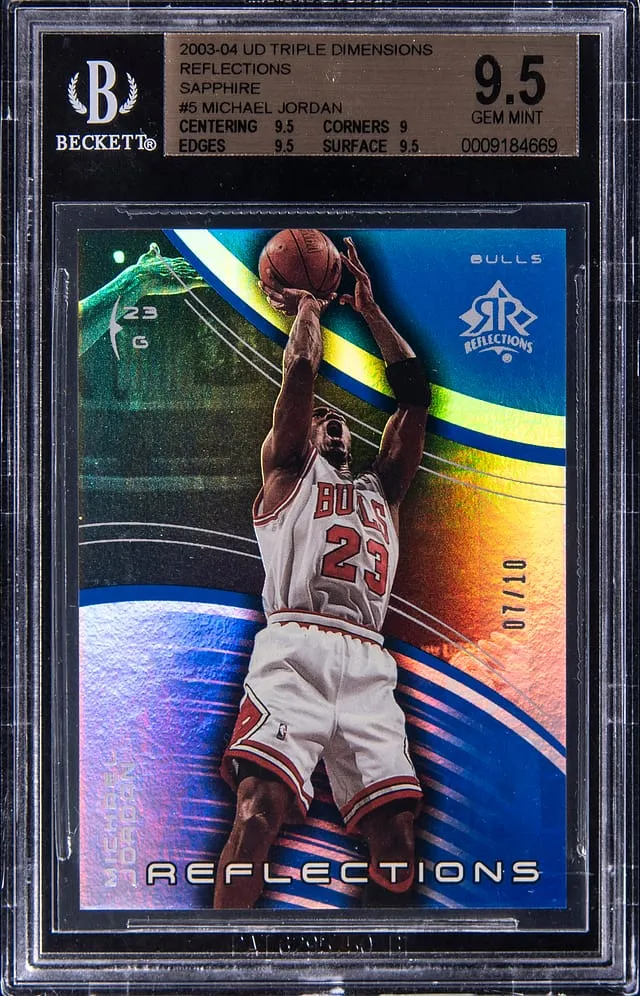
2003-04 UD Reflections Sapphire Jordan BGS 9.5 Sale
A BGS 9.5 pop 1 2003-04 UD Triple Dimensions Reflections Sapphire /10 Michael Jordan sold for $12,689 at Goldin. Here’s what it means for collectors.
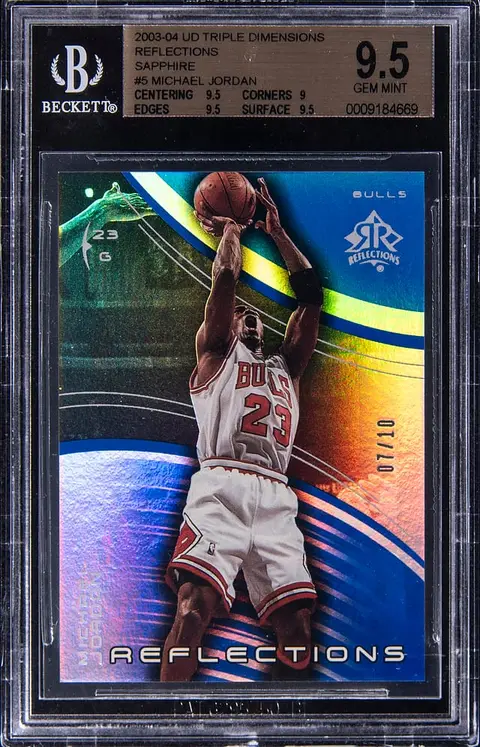
Sold Card
2003-04 Upper Deck Triple Dimensions Reflections Sapphire #5 Michael Jordan (#07/10) - BGS GEM MINT 9.5 - Pop 1
Sale Price
Platform
GoldinThe 2003–04 Upper Deck Triple Dimensions Reflections Sapphire #5 Michael Jordan is the kind of card that quietly slips past many casual checklists, yet it checks almost every box serious Jordan collectors care about: low serial numbering, tough parallel, and a top-tier grade with true population scarcity.
For this specific copy, the headline details are straightforward:
- Player: Michael Jordan
- Team shown: Washington Wizards
- Year: 2003–04
- Set: Upper Deck Triple Dimensions Reflections
- Parallel: Sapphire
- Card number: #5
- Serial number: 07/10
- Rookie?: No – this is a late-career Jordan issue
- Grading company: Beckett Grading Services (BGS)
- Grade: GEM MINT 9.5
- Population: BGS pop 1 at this grade (no others equal or higher at the time of sale)
- Special attributes: low-serial /10 parallel, non-auto, non-memorabilia insert/parallel
On March 15, 2026, Goldin sold this card for $12,689.
For a non-rookie Jordan without an autograph or patch, that is a serious result. To understand why, it helps to zoom out.
Where this card sits in the Jordan landscape
Most collectors first think of Michael Jordan’s 1986 Fleer rookie or his 1990s refractors and PMGs when they think “high-end Jordan.” This Triple Dimensions Reflections Sapphire doesn’t fit those usual buckets, but it taps into a different lane that has been gaining traction for years: extremely low-serial, early-2000s MJ parallels.
Key context points:
- Era: 2003–04 is firmly “early modern.” It’s post-playing-career for Jordan’s Bulls run, but still within the period where print runs were smaller and parallel structures were more constrained than many ultra-modern sets.
- Set reputation: Upper Deck Triple Dimensions Reflections doesn’t carry the brand weight of Exquisite or SP Authentic, but it sits comfortably in that early-2000s Upper Deck ecosystem that produced many low-pop, foil-heavy, condition-sensitive parallels.
- Parallel tier: Sapphire is one of the low-numbered parallels in the Reflections run. With a print run of just 10 copies, it functions as a true chase card, closer to a modern “color match / short print” concept than a basic insert.
- Non-rookie, but key issue: This is not a rookie card, but within the narrow niche of 2003–04 Jordan parallels, it’s a key issue because of its /10 serial and the fact that BGS reports only a single GEM MINT 9.5 at the time of this sale.
In other words, this is a niche, premium Jordan parallel from a respected early-2000s Upper Deck product. That’s exactly the kind of lane where advanced MJ collectors quietly compete.
Grading, condition, and population
Grading matters more when the total supply is tiny. With only ten copies printed, every point on the grading scale meaningfully changes how many collectors can target the “best available” version.
- Grade: BGS GEM MINT 9.5
- Subgrades: Not all subgrades are publicly documented on sales archives, but BGS 9.5 typically implies 9.5 or better on centering, corners, edges, and surface, with the occasional 9 subgrade.
- Population report: Pop 1 in BGS 9.5 means there is currently only one copy graded at GEM MINT, with none higher. PSA and SGC populations for this specific parallel appear very thin overall.
For collectors who prioritize the best-graded example of a scarce parallel, “BGS 9.5 pop 1” effectively means: if you want this card at this quality level, this may be your only shot for quite some time.
Market context and recent sales
Because this is a /10 Jordan parallel from a lower-print early-2000s product, true apples-to-apples comps (comparable sales) are limited. Comps are simply past sale prices for the same or very similar cards, used as rough context for current prices.
What we do know from public data and broader patterns:
- Exact copies of this Sapphire #5 /10 in BGS 9.5 rarely surface. There are no frequent, recent auction cycles like you’d see with Jordan rookies.
- Other low-serial, early-2000s Jordan parallels (/10 to /25) in high grade from brands like SPx, SP Authentic, and Exquisite Inserts have increasingly sold in the mid four-figure to low five-figure range, depending on set prestige, design appeal, and whether they feature Bulls or Wizards imagery.
- Within that context, $12,689 at Goldin sits toward the upper end for non-auto, non-memorabilia, non-rookie Jordan parallels from this era, but it is not an outlier for truly scarce, /10-level pieces.
In other words, the result is strong but defensible: it reflects both the ultra-low print run and the fact that this is the only known BGS 9.5 at the time of sale.
Why collectors care about this card
Collectors don’t chase this card because it is the most famous Jordan ever printed. They chase it because it fits several things the modern high-end MJ market increasingly values:
True scarcity, not just grading scarcity
This is not a common card made “rare” only by grade. With just ten serial-numbered copies, the base supply is hard-capped. Grading only sharpens that edge by further limiting how many examples qualify as top-tier.Early-2000s Upper Deck appeal
The early-2000s were a sweet spot for Upper Deck: advanced foil technology, complex parallel structures, and lower print runs than the 1990s boom, but without the extreme proliferation of parallels seen in some ultra-modern sets.Jordan’s long-term collector base
Jordan’s collector demand is unusually stable across hobby cycles. Even when modern prospecting cools down, MJ’s key issues and premium parallels tend to hold collector interest because they function as both nostalgia pieces and historical artifacts.Cross-collecting from modern parallels
Many collectors who started with modern color-chase cards (think /10 golds, color matches, etc.) have migrated backwards into the early-2000s, looking for similar scarcity and visual appeal with legendary players. Cards like this Sapphire parallel are natural targets for that shift.
How this Goldin sale fits into the bigger picture
The March 15, 2026 sale at Goldin does a few things for the market:
Reaffirms demand for early-2000s MJ parallels
Seeing a non-rookie, non-auto Jordan cross five figures helps underscore that there is a real collector base focused on rarity and era, not just rookie status.Highlights pop 1 premiums
When supply is already limited to ten copies, a pop 1 GEM MINT introduces a meaningful premium. This sale is a concrete example: bidders clearly valued the combination of /10 serial and lone top grade.Provides a reference point for similar cards
While exact comps for this specific Sapphire are rare, the $12,689 hammer gives collectors and small sellers a reference anchor when evaluating other low-serial 2000s Jordan parallels.
Takeaways for collectors and small sellers
If you’re new to this segment of the Jordan market, here are a few practical notes:
Look at both print run and grade
A /10 parallel with a strong BGS or PSA grade will often track differently than a more common card with a top grade. Supply at the serial level matters.Check pop reports, but in context
Pop reports (population reports) show how many copies have been graded at each grade level. With ultra-low serial cards, low pop numbers can reflect both true scarcity and the fact that many raw copies haven’t been submitted. Still, a pop 1 GEM MINT on a /10 Jordan is a meaningful datapoint.Respect set reputation, but don’t ignore under-the-radar brands
Exquisite and SP Authentic draw the most attention, but results like this show that collectors will pay up for the right mix of scarcity, design, and player—even in less headline-grabbing products like Triple Dimensions.Use comps as context, not prediction
Past sales (like this Goldin result on March 15, 2026) are useful context, but they are not guarantees of future prices. Each auction has its own mix of bidders, timing, and liquidity.
For Jordan specialists, this sale is a quiet confirmation of something they already knew: truly scarce, early-2000s parallels of Michael Jordan, especially in lone top grades, remain deeply contested pieces whenever they surface.
For everyone else, it’s a reminder that the Jordan market isn’t just about the 1986 Fleer rookie or the most famous 1990s inserts. There is an entire layer of early-2000s, low-serial Upper Deck Jordan issues that are only now getting the consistent attention their scarcity deserves.
And this 2003–04 Upper Deck Triple Dimensions Reflections Sapphire #5 Michael Jordan, BGS GEM MINT 9.5 pop 1, sold at Goldin for $12,689 on March 15, 2026, is now one of the clearer reference points in that evolving story.