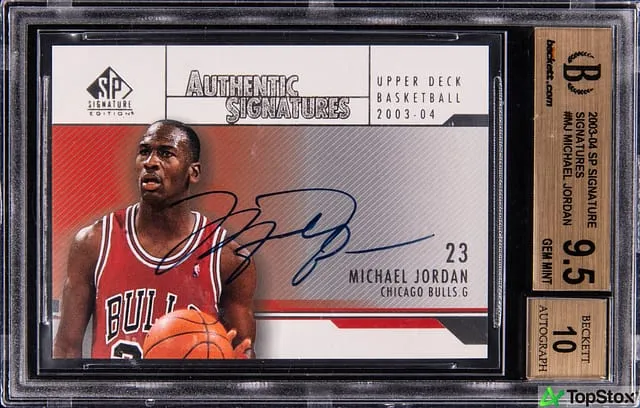
2003-04 SP Signature Michael Jordan Auto BGS 9.5 Sale
Goldin sold a 2003-04 SP Signature Edition Michael Jordan BGS 9.5/10 auto for $25,626. See how this key MJ autograph fits recent market trends.
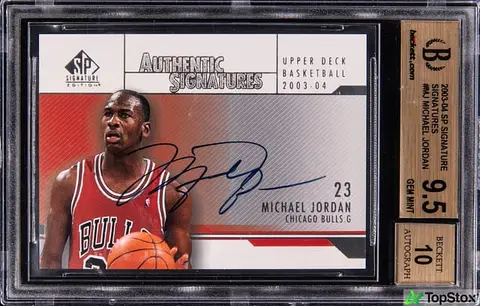
Sold Card
2003-04 Upper Deck SP Signature Edition Signatures #AS-MJ Michael Jordan Signed Card - BGS GEM MINT 9.5, Beckett 10
Sale Price
Platform
GoldinA BGS 9.5 / 10 Michael Jordan autograph from the early-2000s SP era just cleared a strong number at auction, giving Jordan collectors another data point in a maturing on-card auto market.
On March 15, 2026, Goldin sold a 2003-04 Upper Deck SP Signature Edition Signatures #AS-MJ Michael Jordan signed card, graded BGS GEM MINT 9.5 with a Beckett 10 autograph, for $25,626.
In this breakdown, we’ll look at what this card is, why collectors care, and how this sale fits into recent price action for Jordan autos.
The card at a glance
- Player: Michael Jordan
- Team (pictured): Chicago Bulls (post-playing-era auto issued during his Wizards years / early 2000s hobby era)
- Year: 2003-04
- Set: Upper Deck SP Signature Edition
- Subset: Signatures
- Card number: #AS-MJ
- Type: Certified autograph card (not a rookie card; key Jordan auto issue from the early 2000s)
- Autograph type: On-card (signed directly on the card, not on a sticker)
- Grading company: Beckett Grading Services (BGS)
- Grade: BGS GEM MINT 9.5, with a Beckett 10 auto grade
SP Signature Edition was one of Upper Deck’s focused autograph products in the early 2000s, built around clean designs and direct-signed cards. For Michael Jordan collectors who prefer his playing-era or immediately post-playing-era autographs over modern insert overload, this era has become increasingly important.
This specific #AS-MJ card is a non-rookie, certified MJ autograph from a respected, low-production, autograph-driven set. While it doesn’t carry the same name recognition as his 1986-87 Fleer rookie or early 1990s inserts, it sits in that sweet spot of:
- On-card signature
- Licensed Bulls image
- Established brand (SP from Upper Deck)
Combined with the BGS GEM MINT 9.5 / 10 auto, you’re looking at a premium copy of a key early-2000s Jordan autograph.
Grading: why BGS 9.5 / 10 matters
In the early 2000s, BGS was a go-to grading option for higher-end basketball cards. A BGS 9.5 GEM MINT label typically means:
- Centering, corners, edges, and surface mostly in the 9.5 range
- Very minor flaws visible under magnification only
The Beckett 10 autograph grade is also important. Beckett assigns a separate grade to the signature itself, evaluating:
- Ink strength
- Streaks or smudges
- Completeness of the autograph
For autograph-focused collectors, a 9.5/10 split (GEM MINT card, GEM MINT auto) is often the preferred configuration: the card presents at the top of the scale, and the signature—really the star of the show here—is confirmed as clean and bold.
Market context: where does $25,626 fit?
The Goldin sale closed at $25,626 on March 15, 2026.
Because this is a relatively niche early-2000s SP Signature Edition Jordan, it does not change the overall Jordan market by itself, but it does contribute to a clearer price band for high-end on-card MJ autos from that era.
In recent years, sales for comparable Michael Jordan autograph cards have generally stacked up something like this:
- Early-2000s on-card autos in PSA 9 / BGS 9: often in the mid–four figures to low–five figures, depending on the set, image, and scarcity.
- Premium grades (PSA 10, BGS 9.5 with 10 auto) of desirable designs: frequently stretching into the teens and low–twenties, with especially preferred designs, patches, or low-serial parallels sometimes surpassing that.
Within that context, $25,626 sits on the strong side for a non-rookie, non-logoman, non-exquisite-style Jordan auto, but it’s not out of step with what we’ve seen for:
- High-grade, on-card MJ autos from respected early-2000s sets
- Cards where the autograph is graded 10 and the card itself achieves a true GEM MINT-level grade
In other words, this result fits a broader pattern: collectors are willing to stretch for clean, early-2000s Jordan autographs that check the boxes of brand, era, and presentation.
Comps and nearby cards
When collectors talk about “comps” (short for comparables), they mean recent sales of the same card—or as close as possible—to estimate current value.
For this 2003-04 SP Signature Edition Signatures #AS-MJ specifically, public sales are not as frequent as for headline Jordan cards like his 1986 Fleer rookie or iconic 1990s inserts. That thinner data makes each high-grade sale more informative.
Recent trends around comparable Jordan autos show:
- On-card MJ autos from early-2000s Upper Deck lines (SP Authentic, SPx, Ultimate, Exquisite-era products) have remained relatively resilient even as some modern, speculative cards have softened.
- Cards with strong eye appeal—centered, minimal chipping, bold signature—continue to outperform technically similar but less visually appealing copies.
- A BGS 9.5 / 10 or PSA 10 / 10 label can create a meaningful premium over lower-grade versions, especially when the pop report (population report, which counts how many copies have earned a given grade) is modest.
Because exact, grade-matched comps for this #AS-MJ are limited, collectors typically triangulate value using:
- Other early-2000s MJ SP/Upper Deck autos in GEM MINT with 10 autos.
- Slightly lower grades of the same card (BGS 9, raw) and then adjusting upward for condition and eye appeal.
- Adjacent sets from the same era with similar design, print approach, and collector following.
Against that backdrop, the Goldin result is consistent with a healthy, but not overheated, segment of the Jordan market.
Why this card matters to collectors
Several factors contribute to this card’s appeal:
1. Era: early-2000s Upper Deck and the MJ auto lane
2003-04 sits in an important time window:
- Jordan had recently finished his Wizards run.
- LeBron James was entering the league, and 2003-04 products were heavily focused on the new rookie class.
- Upper Deck was still the exclusive home for licensed Michael Jordan autographs and game-used cards.
This combination means that Jordan autos from this time are not mass-produced modern inserts; they’re part of a more controlled, premium-oriented strategy around his signature.
2. On-card autograph vs. sticker
Collectors consistently show a preference for on-card autographs—where the player signs directly on the card—over sticker autos, where the signature is applied to a small sticker and later placed on the card.
The SP Signature Edition line was built around on-card signatures, and that matters here:
- The signature flows naturally with the design.
- There’s no visual distraction from a clear sticker border.
- It more closely reflects the classic autograph-card experience many collectors prefer.
3. Brand and design
SP and SP Signature Edition occupy a respected niche:
- Clean, professional layouts and photography.
- A focus on the autograph as the centerpiece, rather than layered inserts and parallels.
- A reputation as an autograph-first product, not a base-set-with-a-few-autos-added.
For Jordan-focused collectors who want something more refined than loud modern designs, this aesthetic lane has aged well.
4. Grade scarcity and population
Population reports ("pop reports") from grading companies show how many copies of a particular card have received each grade. While we aren’t quoting specific pop counts here, it’s safe to say:
- BGS 9.5 copies of early-2000s on-card Jordan autos are not extremely common, especially with a 10 auto.
- Many earlier autographs suffer from minor edge or surface issues, or from slightly imperfect signatures.
That combination makes each GEM MINT / 10 auto example meaningful. Collectors targeting the very top of this niche will naturally gravitate toward copies like the one that just sold at Goldin.
How this sale fits the broader Jordan market
The Michael Jordan market has gradually matured:
- His key rookie and 1990s inserts remain the headline drivers.
- High-end autographs, especially on-card and from respected brands, form a strong “second pillar” of demand.
Within that structure, this 2003-04 SP Signature Edition Signatures #AS-MJ sale supports a few observations:
- Autograph quality continues to be rewarded. A BGS 10 auto grade adds real weight.
- Early-2000s, non-rookie Jordan autos still command serious attention. This is not a speculative modern insert; it’s a steady, collector-driven lane.
- Auction visibility matters. A major auction house like Goldin, with a concentrated base of high-end basketball buyers, helps surface strong bidding for niche but important cards.
What collectors and small sellers can take from this
For collectors, especially those new or returning to the hobby:
- If you’re building a focused Jordan collection, it can help to think in lanes: rookies, 1990s inserts, on-card autographs, and specific brand eras like early-2000s Upper Deck. This card firmly belongs in the on-card auto, early-2000s SP lane.
- When evaluating Jordan autos, pay attention to:
- On-card vs. sticker
- Brand and year
- Autograph grade (not just the card grade)
- Eye appeal in hand
For small sellers:
- High-end, early-2000s MJ autos with clean signatures are still drawing healthy bids at major houses.
- If you’re holding similar cards raw (ungraded), it may be worth carefully evaluating them for grading, especially if centering and surface are strong and the autograph is bold and complete.
- When you do list or consign, clear, detailed descriptions—year, set, on-card auto, grading info—help buyers connect it to comps.
Final thoughts
The March 15, 2026 Goldin sale of a 2003-04 Upper Deck SP Signature Edition Signatures #AS-MJ Michael Jordan autograph in BGS GEM MINT 9.5 with a Beckett 10 auto, at $25,626, underscores the steady demand for:
- On-card Jordan autographs from the early-2000s Upper Deck era
- High-grade examples where both the card and the signature present at a top level
It’s not a record-setting headline, but for serious Jordan collectors tracking this lane of the market, it’s a meaningful confirmation: clean, early-2000s MJ autos in elite grade continue to occupy a strong, collector-driven tier of the basketball card landscape.
If you’re mapping out your own Jordan PC (personal collection), cards like this SP Signature Edition serve as a reminder that the story of Jordan in cardboard isn’t just about his rookie—it’s also about how his autograph was curated and presented during the early-2000s boom in premium products.