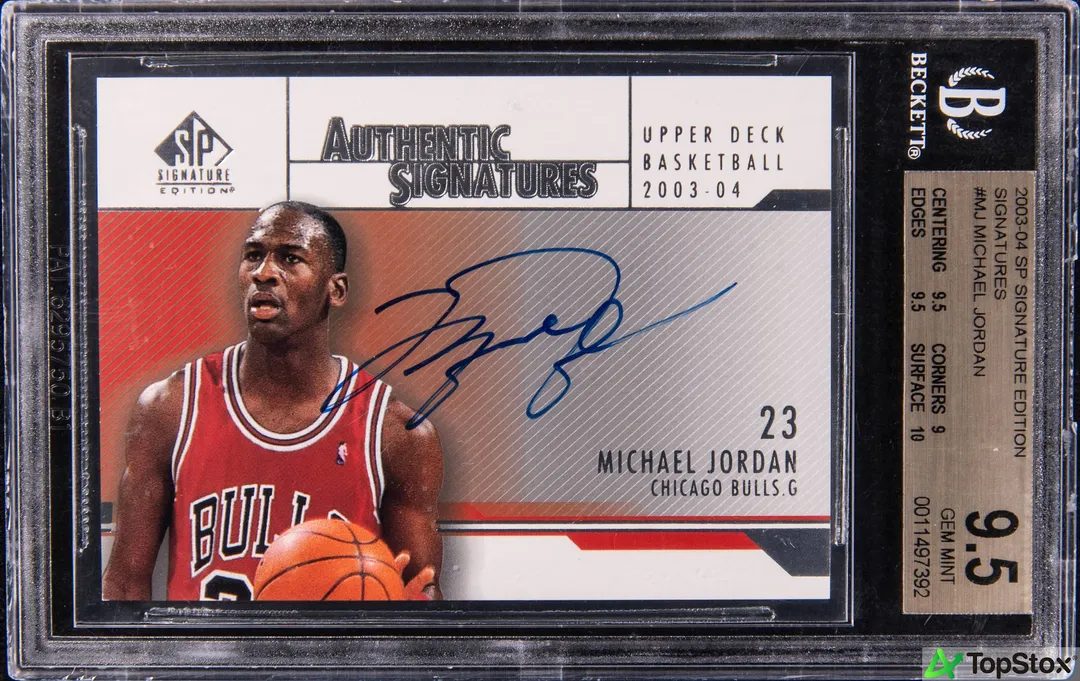
2003-04 SP Signature Michael Jordan Auto BGS 9.5
Goldin sold a 2003-04 SP Signature Edition Michael Jordan BGS 9.5 auto for $19,520. See what this Gem Mint sale means for Jordan collectors.
Sold Card
2003-04 Upper Deck SP Signature Edition Signatures #AS-MJ Michael Jordan Signed Card - BGS GEM MINT 9.5
Sale Price
Platform
GoldinMichael Jordan’s autograph issues from the early 2000s sit in a sweet spot for many collectors: modern enough for clean design and on‑card ink, but early enough that print runs and signings were still relatively controlled compared with today.
The recent sale at Goldin of a 2003‑04 Upper Deck SP Signature Edition Signatures #AS‑MJ Michael Jordan Signed Card – BGS GEM MINT 9.5 for $19,520 on February 8, 2026 (UTC) is a useful case study in how this segment of the Jordan market is behaving.
The card at a glance
- Player: Michael Jordan
- Team on card: Washington Wizards (final playing years)
- Year: 2003‑04
- Set: Upper Deck SP Signature Edition – Signatures subset
- Card number: #AS‑MJ
- Autograph: On‑card (signed directly on the card, not on a sticker)
- Rookie card? No – this is a key autograph issue from Jordan’s late‑career era, not a rookie.
- Grading company: Beckett Grading Services (BGS)
- Grade: BGS Gem Mint 9.5 overall (a high‑end condition grade just below a perfect BGS 10)
SP Signature Edition is an autograph‑driven product line from Upper Deck. The focus of the product is signatures, not base rookies, and the Michael Jordan Signatures card is one of the central hits collectors chase from 2003‑04.
While this particular card is not serial‑numbered on the front like some modern autos, it is widely treated as a controlled‑print, premium Jordan auto rather than a mass print‑run insert. In practical terms, that means there are far fewer copies than a standard base card from the same era, and even fewer in Gem Mint condition.
Why this card matters to collectors
1. Early‑2000s Jordan autographs
Jordan’s autograph portfolio is broad, but collectors often break it into rough eras:
- Playing‑days autos (1990s through Wizards years) – viewed as more nostalgic and historically important.
- Post‑retirement and modern Upper Deck autos – still coveted, but produced during years of higher overall autograph output.
This card sits near the end of his active playing timeline. For many, that makes it more appealing than later‑era autos issued long after his retirement, while still offering modern card aesthetics and relatively stable print quality.
2. SP Signature Edition as a brand
SP Signature Edition has a reputation as a “hit‑focused” product: collectors buy it primarily for guaranteed autographs rather than base cards. That gives Jordan autos from this line a certain built‑in status:
- The Signatures subset is essentially the headliner for the product.
- Jordan’s inclusion anchors the checklist and is treated as a core chase card.
It’s not quite on the same level of mystique as an Exquisite Collection patch auto, but it occupies a strong tier just below the true “grails,” with significantly more accessible price points.
3. Condition and BGS Gem Mint 9.5
Condition is a major value driver for any premium Jordan card. BGS Gem Mint 9.5 typically implies:
- Centering, corners, edges, and surface are all in near‑perfect shape.
- Only very minor flaws keep the card from a BGS 10.
For a thicker, autograph‑focused card stock, achieving a 9.5 can be challenging due to chipping, surface issues, and handling during the signing process.
A Gem Mint grade significantly narrows the available supply. Even if hundreds (or more) of these cards exist raw, the population of BGS 9.5 copies is usually a fraction of that.
Market context and recent sales
When collectors talk about “comps”, they’re referring to comparable recent sales—actual transaction data that helps frame where a card’s market value has been.
For this Jordan SP Signature Edition auto, recent public sales data across major auction houses and marketplaces has generally shown:
- Raw (ungraded) copies: Typically trade at a noticeable discount to high‑grade slabs, with meaningful price spread depending on autograph quality and surface condition.
- Mid‑grade slabs (BGS 8–9, PSA 8–9): Often cluster in the low‑ to mid‑four‑figure range, reflecting strong demand for authentic, on‑card Jordan signatures even without gem‑level condition.
- Top‑end grades (BGS 9.5 / PSA 10): Move into a higher band, where collectors pay a premium for population scarcity and long‑term desirability.
Within that structure, Goldin’s $19,520 result for a BGS 9.5 lands toward the upper area of expectations for this specific configuration. That figure is consistent with how the broader Jordan autograph market has been behaving:
- Iconic, high‑end grails (Exquisite patch autos, limited‑numbered signatures, and early 1990s autos) still command a separate tier of pricing.
- Strong but more attainable autos like the SP Signature Edition have stabilized at levels that reflect both sustained demand and the post‑boom cooling of the broader market.
Compared with earlier peaks during the 2020–2021 surge, many Jordan autograph prices have reset to more data‑driven levels. At the same time, they have not collapsed; instead, they seem to have found a collector‑supported range where clean, authenticated, on‑card signatures remain highly sought after.
How this sale fits wider Jordan trends
Several long‑running factors support continued interest in Jordan autos like this one:
- All‑time status – Jordan’s position in basketball history is secure, and his hobby relevance does not depend on current‑season performance.
- On‑card autograph preference – Many collectors prefer on‑card signatures over sticker autos because the player handled the card itself. This tends to support values for sets like SP Signature Edition.
- Early‑2000s scarcity profile – The early‑2000s are modern enough for grading and collecting culture to be well established, but still far from the ultra‑high production levels of some more recent products.
Against that backdrop, a Gem Mint example achieving nearly $20,000 at a major auction house like Goldin is consistent with the idea that the market now differentiates clearly between:
- True top‑end condition examples that rarely surface, and
- More common, mid‑grade or ungraded copies.
Takeaways for collectors and small sellers
For collectors who are newer to this segment of the hobby, here are a few practical observations drawn from this Goldin sale:
Grade separation matters
The gap between ungraded or mid‑grade Jordan autos and a BGS 9.5 can be steep. When you look at comps, make sure you’re comparing similar:- Grading companies (BGS vs PSA vs SGC).
- Numerical grades and subgrades (especially centering and surface).
- Autograph presentation (bold vs faded ink, smudges, streaks).
Set identity drives long‑term interest
SP Signature Edition is recognized as an autograph‑centered product, which helps support demand. When researching any Jordan auto, ask:- Is this a core auto from a respected set?
- Or a lower‑tier insert from a product with less hobby attention?
Auction houses vs fixed‑price marketplaces
A sale through a major house like Goldin on February 8, 2026 gives the card high visibility. That can help set short‑term expectations for future listings, but realized prices can still vary based on:- Timing and broader market sentiment.
- How many similar copies are on the market.
- Presentation: photos, descriptions, and whether subgrades are highlighted.
Think in ranges, not single numbers
A single sale at $19,520 is one data point. For buying or selling decisions, it’s usually more useful to look at a range of recent results and understand where a particular copy might sit within that band based on its specific attributes.
Final thoughts
The 2003‑04 Upper Deck SP Signature Edition Signatures #AS‑MJ Michael Jordan Signed Card – BGS GEM MINT 9.5 sale at $19,520 via Goldin on February 8, 2026 reinforces a few themes:
- Early‑2000s, on‑card Jordan autos from well‑regarded products continue to be treated as foundational pieces in advanced collections.
- Condition, grading, and set reputation work together to create meaningful price separation.
- Even in a more measured market, key Jordan autograph issues maintain strong, data‑supported demand.
For collectors and small sellers tracking Jordan’s autograph landscape, this result is a clear marker of where one important piece of that puzzle currently stands—neither a speculative outlier nor a bargain basement comp, but a solid, high‑end reference point for a Gem Mint example from a respected autograph line.