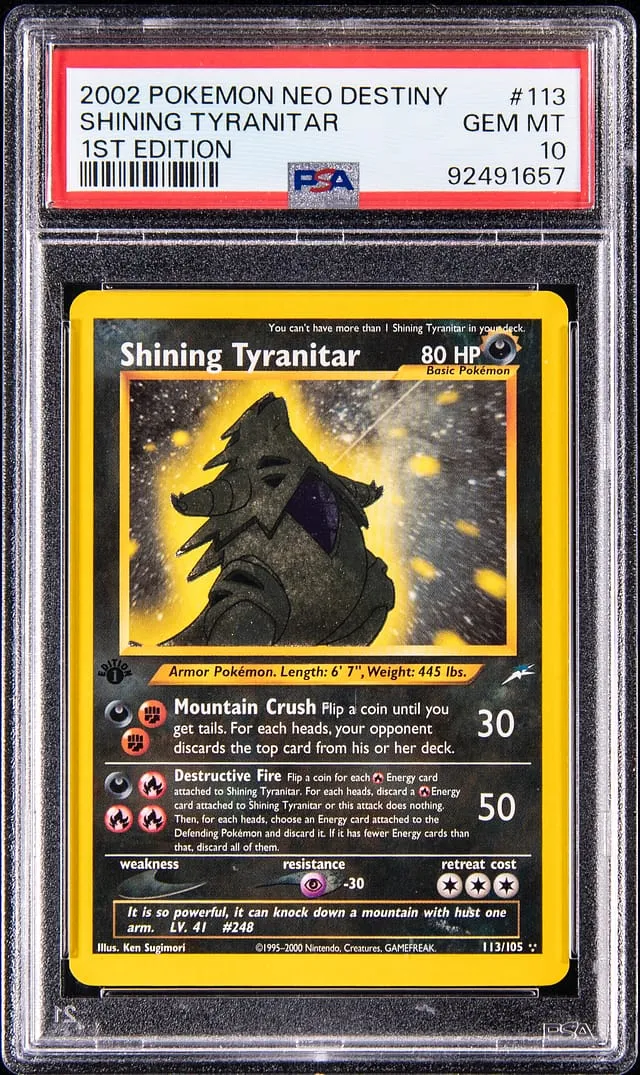
2002 Neo Destiny Shining Tyranitar PSA 10 Sells for $18K
Figoca reviews the $18,936 Goldin sale of a 2002 Neo Destiny 1st Edition Shining Tyranitar PSA 10 and what it means for WOTC Pokémon collectors.
Sold Card
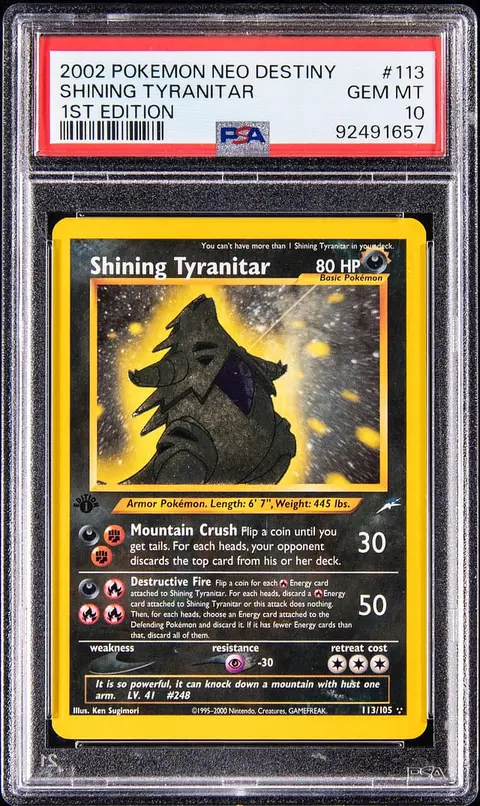
2002 Pokemon Neo Destiny 1st Edition #113 Shining Tyranitar - PSA GEM MT 10
Sale Price
Platform
Goldin2002 Pokémon Neo Destiny 1st Edition #113 Shining Tyranitar in PSA 10 just changed hands at Goldin for $18,936 on April 13, 2026. For a card that many collectors still remember pulling (or failing to pull) as kids, this is a meaningful data point for one of the hobby’s most important shiny-era chase cards.
In this breakdown, we’ll walk through what the card is, why it matters, and how this sale fits into the broader market picture for Shining Tyranitar and Neo Destiny.
The card at a glance
- Card: 2002 Pokémon Neo Destiny 1st Edition Shining Tyranitar
- Card number: #113 (Secret Rare)
- Set: Neo Destiny (Wizards of the Coast era)
- Edition: 1st Edition
- Character: Tyranitar (shiny variant – alternate color palette)
- Attributes: Non-holo layout with sparkling “Shining” foil on the character art
- Grading company: PSA (Professional Sports Authenticator)
- Grade: GEM MT 10 (top standard grade on PSA’s scale)
- Era: Late WOTC (vintage Pokémon, 1999–2003 period)
Shining Tyranitar is a secret rare from Neo Destiny, the final English Pokémon set released by Wizards of the Coast. The Shining cards are widely viewed as the spiritual ancestors of today’s shiny and alternate-art chase cards. Tyranitar, as a pseudo-legendary with strong fandom from the Game Boy and competitive eras, sits near the top of the Shining hierarchy.
This specific copy is graded PSA GEM MT 10, meaning PSA judged it essentially flawless under normal viewing: sharp corners, strong centering, clean surfaces, and no noticeable print defects.
Why Shining Tyranitar matters to collectors
Several factors make this card more than just another rare Tyranitar:
1. Key card from the last WOTC set
Neo Destiny closed out the Wizards of the Coast run of Pokémon TCG in English. That “final WOTC set” status gives it a built-in historical premium, similar to how some sports collectors treat the last year of a classic design.
Within Neo Destiny, the Shining subset (including Shining Charizard, Mewtwo, Celebi, etc.) defines the identity of the set. Shining Tyranitar is one of the most desirable non-Charizard cards in the run.
2. Early shiny representation
Before full-art shinies and modern chase mechanics, the Neo-era Shining cards were the way Pokémon TCG represented alternate-color Pokémon. For collectors who care about the history of shiny Pokémon, this is an early, important piece of that story.
3. 1st Edition scarcity and condition difficulty
1st Edition Neo Destiny was not printed in the same volume as later modern sets. Pull rates for Shining cards were low, the set was expensive at the time, and many copies that were pulled were played or mishandled.
High-grade examples can be challenging due to:
- Dark borders and back edges that easily show whitening.
- Print quality variability in late WOTC-era production.
The result: while raw copies surface with some regularity, true PSA 10s are comparatively scarce, and collectors looking for top-end Neo Destiny builds have to compete over a small population.
4. Character demand
Tyranitar sits in a strong tier of fan favorites: not quite Charizard-level, but consistently popular in both the games and the TCG. It has:
- A long competitive history in the video games.
- Distinctive design and strong presence on the tabletop.
- A reputation as one of the standout non-legendary powerhouses from the Johto era.
Put together, this makes Shining Tyranitar a focal piece for Tyranitar collectors and Neo Destiny set builders alike.
The Goldin sale: $18,936 on April 13, 2026
On April 13, 2026 (UTC), Goldin closed an auction for a 2002 Pokémon Neo Destiny 1st Edition #113 Shining Tyranitar – PSA GEM MT 10 at a final price of $18,936 USD.
Goldin is one of the major auction houses for high-end collectibles, so their results tend to be watched closely by serious Pokémon collectors and market watchers.
Market context and recent sales
When collectors talk about “comps” (comparable sales), they mean looking at recent, verifiable sale prices for the same card (and grade) or very closely related versions, to understand a realistic range of what buyers have recently been willing to pay.
For Shining Tyranitar specifically, the key comparisons are:
- Same card, same grade: 2002 Neo Destiny 1st Edition Shining Tyranitar, PSA 10.
- Same card, lower grades: PSA 9 and PSA 8.
- Same character, different versions: Unlimited print, other grading companies, or raw copies.
Across major public marketplaces and auction houses, there is a clear pattern:
- PSA 10 copies do not appear constantly. They tend to surface in waves—often when broader Pokémon interest ticks up or when a high-profile auction encourages other consignments.
- PSA 9 and below see more frequent movement and noticeably lower prices, creating a visible gap between “true gem” examples and everything else.
Based on accessible public information, this $18,936 result sits in the upper tier of what has been observed for PSA 10 Shining Tyranitar 1st Edition. It aligns more with strong auction outcomes than with occasional lower private or fixed-price transactions. That is typical for scarce WOTC-era PSA 10s: the right venue and timing can pull in multiple determined bidders.
Lower-grade examples, by contrast, tend to transact for a fraction of this figure, reinforcing the premium that collectors assign to top-population (“top pop”) material.
Because auction cycles, bidder pools, and timing vary, it’s useful to treat this sale as one strong data point in a range, not as a guaranteed new normal.
Population and scarcity in PSA 10
A “pop report” (population report) is a grading company’s public count of how many copies of a given card have received each grade.
For 1st Edition Shining Tyranitar:
- The total number of PSA-graded copies is meaningfully higher than the number of PSA 10s.
- PSA 10s make up only a small slice of that total.
That concentrated population at the top end helps explain why PSA 10 auctions often produce sharp bidding: collectors vying for a limited number of “set-finishers” or long-term personal grails may compete more aggressively when a clean copy surfaces at a major house like Goldin.
How this sale fits into the broader Neo Destiny market
This Goldin result lines up with several broader themes in the WOTC-era Pokémon market:
Sustained respect for Neo Destiny: Neo Destiny’s Shining cards have generally resisted the deepest pullbacks that more speculative, ultra-modern cards have seen. Prices move, but the floor is supported by real collector demand rather than only short-term speculation.
Top grades hold a premium: As with other vintage and early-2000s Pokémon issues, the gap between PSA 10 and PSA 9 remains significant. This sale reinforces that there is still a healthy premium for the cleanest possible 1st Edition copies.
Auction-house effect: High-profile venues like Goldin tend to attract a more concentrated bidder pool for rare pieces, especially when they are marketed clearly and presented alongside other notable cards. That can result in outcomes near the stronger end of recent comp ranges.
What collectors can take away
For collectors, returning hobbyists, and small sellers, this sale offers a few practical takeaways:
If you own a Shining Tyranitar:
- Raw or lower-grade copies will be worth significantly less than a PSA 10, but this sale is still a useful reference point when thinking about sending strong candidates in for grading.
- Careful handling and storage matter. Condition is the main driver of the gap between a mid-grade card and something that can compete with this kind of result.
If you’re looking to buy:
- Use this Goldin sale as one of several comps. Check recent public auctions and reputable marketplaces for PSA 9s and other PSA 10 results to form a realistic range.
- Remember that single auction outcomes can sit slightly high or low depending on timing, cross-collectible competition, and bidder interest.
If you’re a Neo Destiny or WOTC-era set builder:
- This confirms Shining Tyranitar’s place as one of the key “anchor” cards for any high-end Neo Destiny run.
- When budgeting, it’s helpful to treat Tyranitar, Charizard, and Mewtwo as the main cost centers if you’re targeting high grades.
None of this should be taken as financial advice or as a promise of future price behavior. Market conditions, collector tastes, and available supply all change over time.
Final thoughts
The 2002 Pokémon Neo Destiny 1st Edition #113 Shining Tyranitar – PSA GEM MT 10 sale at Goldin for $18,936 on April 13, 2026 is another clear signal of how collectors value top-tier WOTC-era chase cards.
It highlights:
- The lasting appeal of Neo Destiny as the final WOTC Pokémon set.
- The strength of early shiny-era cards.
- The scarcity premium attached to PSA 10 copies.
For collectors who care about the history of the Pokémon TCG, this card remains one of the cornerstone non-Charizard pieces from the early years of the hobby—and this sale provides a fresh, concrete marker for where the market currently stands.