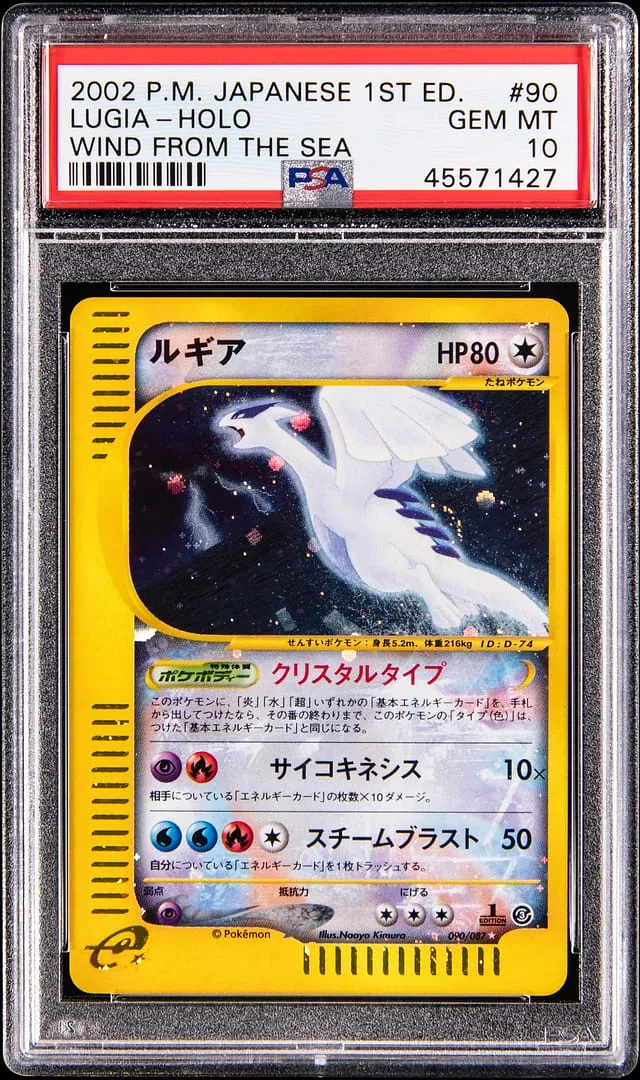
2002 Japanese Crystal Lugia PSA 10 Sells for $35.9K
Goldin sold a 2002 Pokémon Japanese Wind From The Sea Crystal Lugia PSA 10 for $35,991. See the market context and why this Lugia matters.
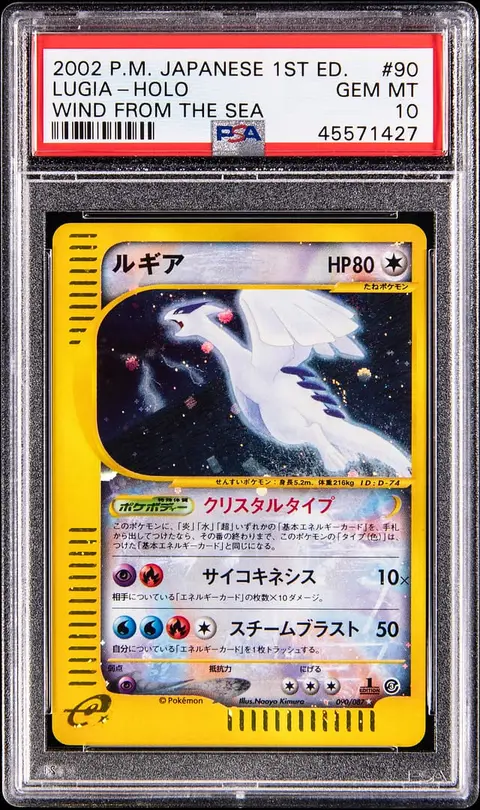
Sold Card
2002 Pokemon Japanese Wind From The Sea 1st Edition Holo #90 Crystal Lugia - PSA GEM MT 10
Sale Price
Platform
Goldin2002 Pokémon Japanese Wind From The Sea 1st Edition Holo #90 Crystal Lugia in PSA 10 just recorded a notable sale with Goldin, closing at $35,991 on May 18, 2026 (UTC). For collectors who track older Japanese-era grails, this is an important data point in a market that has been slowly maturing rather than spiking.
The Card: 2002 Japanese Crystal Lugia, PSA GEM MT 10
- Character: Lugia (Crystal type)
- Year: 2002
- Set: Japanese Pokémon e-Card Series – Wind From The Sea (the Japanese counterpart to Aquapolis)
- Card number: #90
- Edition: 1st Edition
- Finish: Holo, Crystal Pokémon
- Grading company: PSA
- Grade: GEM MT 10
- Attributes: Non-auto, non-serial-numbered, but a key “Crystal” chase card from the e-Series era.
This is not a rookie card in the traditional sports sense, but it is widely considered a key issue for Lugia collectors, alongside the 2000 Neo Genesis Lugia and the English Aquapolis Crystal Lugia.
Why Crystal Lugia Matters
The Japanese Wind From The Sea Crystal Lugia sits at the intersection of several collecting lanes:
Crystal Pokémon subset
Crystal cards in the e-Card era functioned like ultra-chase inserts: low pull rates and very tough to grade due to holo surfaces, borders, and print technology. Lugia is one of the headliners of this subset.Early 2000s Japanese e-Series
The e-Series sets (Expedition, Aquapolis, Skyridge in English; their Japanese counterparts including Wind From The Sea) were printed in lower quantities than modern sets and have a reputation for condition sensitivity. Many raw copies show edge wear, print lines, or centering issues, which limits the population in high grades.Lugia’s hobby status
Lugia is a franchise-level legendary for Pokémon, often placed only a step behind Charizard in terms of long-term collector interest. Major Lugia cards across Neo Genesis, e-Series, and later high-end releases are often treated as “pillar” pieces in serious Pokémon collections.
Population and Grade Scarcity
PSA’s population report (a count of how many copies have been graded at each grade level) historically shows very few PSA 10s for the Japanese Crystal Lugia, with a much larger share clustered in PSA 7–9. Even without quoting exact figures, the pattern is clear:
- Most graded copies do not reach GEM MT 10.
- PSA 10s appear infrequently at public auction, so each sale tends to get attention and can reset expectations.
That scarcity at the top of the grading scale is a key driver behind this $35,991 result.
Market Context and Recent Sales
A few points of context help frame this Goldin result:
Comparable grades (PSA 9, BGS 9.5, etc.)
Lower grades for this card typically transact at a significant discount to PSA 10. Recent public sales in strong PSA 9 have commonly landed in the mid–four-figure to low–five-figure range, depending on eye appeal and auction venue.Other premium Lugia cards
High-grade Neo Genesis Lugia and English Aquapolis Crystal Lugia have also posted strong results over the last few years. Those benchmarks remind collectors that Lugia’s top-tier appearances remain in demand even amid broader market cooling.Relative direction, not a spike
At $35,991, this PSA 10 sale is toward the upper end of the historical range for this card in top grade, but it fits within the pattern that rare, early-2000s Japanese chase cards can still command substantial interest when they surface in best-in-class condition.
Because PSA 10 copies do not appear at auction often, each sale functions more like a fresh price discovery event than a simple repeat comp.
What This Sale Signals to Collectors
Instead of viewing this result as a one-off spike, it can be more useful to think of it as a confirmation of a few ongoing themes:
Quality continues to matter most
In a market that has cooled from the 2020–2021 peak, the highest grades for truly scarce, early-2000s cards have generally held up better than mid-grade or heavily supplied modern cards. A PSA GEM MT 10 on a condition-sensitive Japanese e-Series crystal is exactly the kind of profile that has continued to draw stable interest.Japanese originals are standing on their own
For years, English versions often dominated the conversation. More recently, collectors have increasingly recognized the importance of Japanese-first releases, unique artwork, and different print runs. This card is a good example of that shift: it’s not an English Crystal Lugia, but it still garners a serious price.Selective strength, not universal strength
Not every Lugia or every early-2000s holo is seeing results like this. The market is very selective. Cards with:- clear historical significance,
- real scarcity in top grade, and
- recognizable artwork/characters tend to hold the most attention.
Important Context for Newer Collectors
If you are newer to Pokémon or to Japanese cards, a few definitions and ideas can help:
Comps (comparables): Past sales of the same card (or a very similar version) that collectors look at to understand current price ranges. This Goldin sale at $35,991 becomes a new comp for PSA 10 copies.
Pop report (population report): The grading company’s public count of how many copies exist in each grade. Low pop in a top grade usually means fewer available copies, which can support stronger prices when demand exists.
Key issue: A card that is especially important within a character’s or set’s run. Crystal Lugia from Wind From The Sea is widely treated as a Lugia key issue, especially for collectors who favor the e-Series era.
Era context: 2002 Pokémon falls into what many consider the early "vintage-to-modern bridge" period. Print runs are far below today’s sets, but the hobby infrastructure was mature enough that a meaningful portion of these cards ended up in collector hands and, eventually, grading.
Why This Goldin Sale Matters
The Goldin auction house is one of the key venues for high-end trading card and memorabilia sales. A result like this, logged on May 18, 2026 (UTC), does a few things:
- Anchors expectations for anyone holding a PSA 10 Crystal Lugia or considering submitting a high-grade raw copy.
- Provides a new reference point for negotiation on private deals involving PSA 9s and other premium Lugia cards, as collectors mentally adjust the hierarchy between grades.
- Reinforces the role of Japanese e-Series as a serious part of high-end Pokémon collecting, not just a niche side category.
Takeaways for Different Types of Collectors
New or returning collectors:
Use this sale as an example of how rarity, condition, and set context work together. Not all Lugia cards are this valuable; the combination of Crystal subset, early-2000s Japanese print, and PSA 10 grade is what makes this one stand out.Active hobbyists:
When reviewing comps, be careful to separate PSA 10 from PSA 9/8 on this card. Pop and eye appeal differences can translate into large price gaps. Also pay attention to the auction venue and timing: a strong result at Goldin can differ from a fixed-price marketplace sale.Small sellers:
This kind of sale can help when explaining to buyers why certain older Japanese holos or Crystal cards carry a premium over modern releases, even when both are graded. Point to scarcity in top grades, not just character popularity.
Final Thoughts
The $35,991 sale of the 2002 Pokémon Japanese Wind From The Sea 1st Edition Holo #90 Crystal Lugia in PSA GEM MT 10 at Goldin on May 18, 2026, is less a shock headline and more a quiet confirmation. It reinforces that collectors continue to recognize and pay for:
- historically important characters (Lugia),
- difficult, low-pop subsets (Crystal Pokémon), and
- the best available condition (PSA 10), especially from early-2000s Japanese sets.
For those tracking the upper tier of Pokémon cards, this is another data point showing that key e-Series grails still command attention when they surface, even in a more measured and data-aware market.